



TL;DR:
- Effective legacy planning in Singapore involves coordinating wills, CPF nominations, LPAs, and property ownership to ensure assets transfer smoothly according to your wishes. Many families overlook conflicts between instruments, such as joint tenancy overriding wills or outdated CPF nominations causing unintended distribution. Regular reviews and proper alignment of all legal instruments, especially after major life events, are essential to prevent delays, disputes, and unintended outcomes.
Legacy financial planning in Singapore is the process of organising your assets, legal instruments, and beneficiary designations so that your wealth transfers to the right people, in the right way, with minimal delay or dispute. The industry term for this is estate planning, and it covers far more than writing a will. A comprehensive legacy plan in Singapore involves five coordinated tools: a Lasting Power of Attorney (LPA), a will, a CPF nomination, a trust, and an Advance Care Plan (ACP). Each instrument covers a different scenario, and a gap in any one of them can produce outcomes you never intended. This guide walks you through every component, with specific attention to CPF rules, HDB ownership structures, and the 2026 update making LPA applications free of charge.
What are the key legal instruments to plan legacy finances in Singapore?

Estate planning in Singapore is not a single document. It is a coordinated system of five instruments, each controlling a distinct category of assets or decisions. Understanding what each one does, and what it does not cover, is the starting point for any serious legacy plan.
The will governs the distribution of assets you own outright, such as bank accounts, investments, private property held as tenancy-in-common, and personal belongings. It also lets you appoint an executor to administer your estate and name guardians for minor children. What a will cannot do is distribute your CPF savings. CPF savings cannot be passed through a will under any circumstances. They are governed exclusively by a CPF nomination, which operates under a separate statutory framework. If you die without a valid CPF nomination, your savings go to the Public Trustee’s Office, which distributes them under intestacy rules, often causing months of delay.
The LPA authorises a trusted person to manage your financial and personal affairs if you lose mental capacity. As of 2026, the application fee for a basic LPA (Form 1) has been removed, making this one of the most cost-effective protections you can put in place. Without an LPA, your family must apply to the court for a deputyship order, which is significantly more expensive and time-consuming.
Trusts add a layer of control over how and when assets are distributed, particularly useful for protecting beneficiaries who are minors or who may not manage a lump sum responsibly. Trusts and insurance structures can also provide liquidity for multi-generational wealth transfer, supplementing what a will and CPF nomination alone can achieve.
The Advance Care Plan (ACP) records your healthcare preferences for situations where you cannot communicate them. It is not legally binding in the same way as the other instruments, but it provides clear guidance to medical teams and family members.
The table below summarises how these instruments interact:
| Instrument | What it covers | Key consideration |
|---|---|---|
| Will | Non-CPF assets, guardianship | Cannot cover CPF savings |
| CPF nomination | CPF Ordinary, Special, Medisave, Retirement accounts | Overrides will for CPF funds |
| LPA | Financial and personal decisions during incapacity | Now free to apply in 2026 |
| Trust | Controlled asset distribution over time | Useful for minors or complex estates |
| ACP | Healthcare and end-of-life preferences | Not legally binding but strongly persuasive |
Pro Tip: Map every asset you own to the instrument that controls it before drafting any document. This single step reveals gaps and conflicts that most people only discover after a family member has passed.
How does property ownership affect legacy planning in Singapore?
Property is often the largest asset in a Singaporean household, and the way you hold it determines exactly how it transfers on death. This is where many families discover that their intuitive assumptions about inheritance are wrong.
Ownership structure materially affects how an HDB flat or private property passes to beneficiaries. The two structures are joint tenancy and tenancy-in-common, and they behave very differently:
- Joint tenancy: Ownership passes automatically to the surviving owner by the right of survivorship. Your will has no effect on this asset. If you and your spouse hold your HDB flat as joint tenants, your spouse inherits your share regardless of what your will says.
- Tenancy-in-common: Each owner holds a defined share. On death, that share is distributed according to the will or, if there is no will, under the Intestate Succession Act. Probate or Letters of Administration is required to transfer the share.
- HDB eligibility rules: The inheriting party must meet HDB eligibility criteria. If the beneficiary already owns a private property, they may be required to dispose of one within a set period.
- CPF refund on death: CPF funds used to purchase a property must be refunded to the deceased’s CPF account on sale or transfer. This refund reduces the net proceeds available to beneficiaries and is a detail many families overlook.
- MOP implications: An inherited HDB flat that has not met its Minimum Occupation Period (MOP) carries restrictions on sale, which can affect a beneficiary’s liquidity.
To leave your HDB flat to a specific beneficiary who is not your co-owner, you need a tenancy-in-common structure with a will that explicitly names that beneficiary and their share. Joint tenancy makes this impossible without first severing the tenancy.
Pro Tip: Check your property’s ownership structure in the HDB portal or land title documents before you draft your will. Misalignment between the two is one of the most common and costly mistakes in inheritance planning Singapore.
What common pitfalls arise in legacy financial planning?
The most damaging mistakes in estate planning in Singapore are not about forgetting to write a will. They are about the conflicts and gaps between instruments that seem fine individually but contradict each other in practice.
CPF nomination overriding the will is the single most misunderstood issue. Many people assume their will covers everything. It does not. If your CPF nomination names your sibling but your will leaves everything to your spouse, your spouse receives nothing from your CPF savings. These two documents must be reviewed together, not in isolation.
Delays from missing probate or Letters of Administration are another major source of family stress. Letters of Administration are required when someone dies without a valid will, and they typically take two to four months to process. Filing should happen within six months of death. Incomplete documents extend this timeline further, freezing assets that beneficiaries may urgently need.
Inheritance disputes often arise not from greed but from ambiguity. When a will is vague about specific assets or fails to account for changed circumstances, family members fill the gaps with their own interpretations. Exclusion clauses and no-dispute clauses in a will can significantly reduce the risk of contestation. An exclusion clause removes a named person from the estate; a no-dispute clause penalises beneficiaries who challenge the will by forfeiting their share.
Here is a practical checklist to avoid the most common mistakes:
- Confirm your CPF nomination is current and aligns with your will
- Verify the ownership structure of every property you hold
- Review all beneficiary designations after marriage, divorce, or the birth of a child
- File probate or Letters of Administration promptly if you are administering an estate
- Include dispute-prevention clauses when drafting or updating your will
- Store your will and LPA in a location your executor can access
How to execute your legacy finance plan step by step
Knowing the instruments is one thing. Putting them in place is another. The following steps give you a clear sequence for how to manage legacy finances from start to finish.
Step 1: Inventory your assets. List every asset you own and identify which instrument controls it. CPF accounts go to your CPF nomination. Property held as joint tenancy passes by survivorship. Everything else goes through your will or intestacy rules.
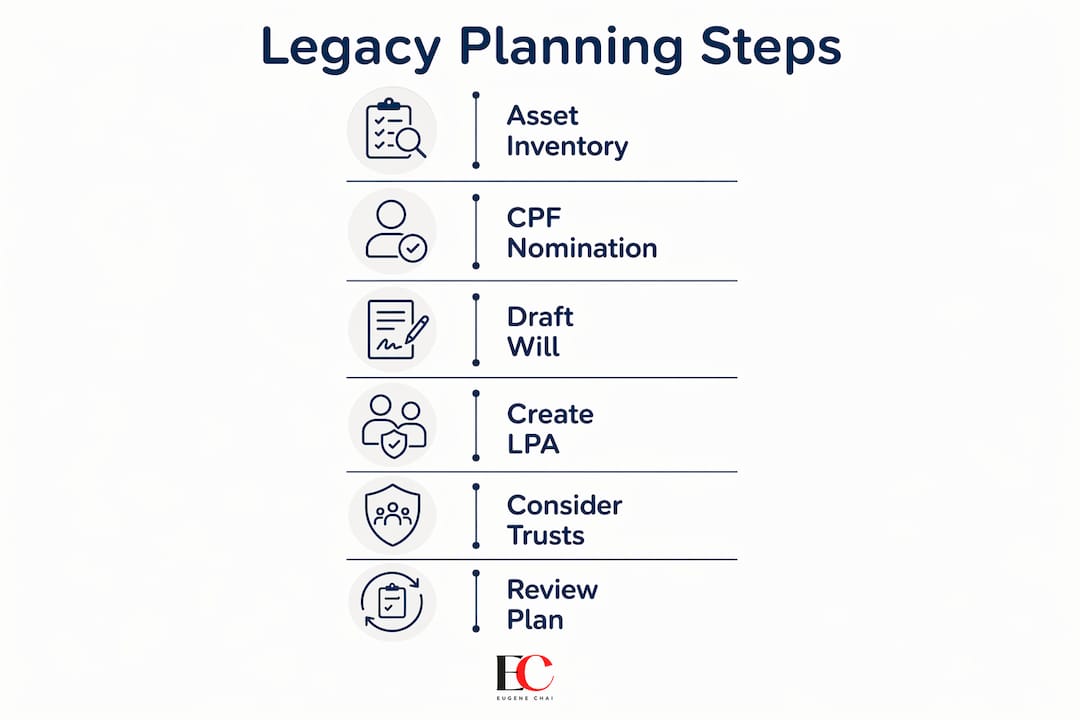
Step 2: Update your CPF nomination. Log in to the CPF website and check your current nomination. Life stage triggers like marriage, having children, or retirement are the right moments to update this. Many people set a nomination once and never revisit it, which means an ex-spouse or deceased parent may still be listed.
Step 3: Draft or update your will. Work with a lawyer to draft a will that covers all non-CPF assets, names an executor, and includes dispute-prevention clauses where relevant. A basic will in Singapore typically costs between $200 and $500 through a law firm.
Step 4: Make or renew your LPA. Apply online through the Office of the Public Guardian. The basic Form 1 LPA application is now free in 2026. This step protects your family from the cost and delay of a court deputyship application if you lose capacity.
Step 5: Consider trusts or insurance products. For families with minor children or complex estates, a trust provides structured distribution. Endowment plans and life insurance policies with nominated beneficiaries can also supplement your legacy plan by providing immediate liquidity on death.
Step 6: Review on a schedule. Set a calendar reminder to review your entire plan every three years or after any major life event.
| Step | Who to contact | Approximate timeframe |
|---|---|---|
| Asset inventory | Self or financial advisor | 1 to 2 weeks |
| CPF nomination update | CPF Board (cpf.gov.sg) | Same day online |
| Will drafting | Qualified lawyer | 2 to 4 weeks |
| LPA application | Office of the Public Guardian | 2 to 3 months for certification |
| Trust or insurance setup | Licensed financial advisor | 4 to 8 weeks |
| Probate or Letters of Administration | Law firm or court | 2 to 4 months |
Pro Tip: Treat every major life milestone, a new child, a property purchase, a divorce, as a mandatory trigger to review all five instruments together. A plan that was correct three years ago may be dangerously out of date today.
Key takeaways
Effective legacy financial planning in Singapore requires coordinating your will, CPF nomination, LPA, and property ownership structure so that no instrument contradicts another.
| Point | Details |
|---|---|
| CPF nomination is separate from your will | Update it independently after every major life change to avoid unintended distribution. |
| Property ownership structure controls transfer | Joint tenancy bypasses your will entirely; tenancy-in-common requires probate. |
| LPA is now free in 2026 | Apply through the Office of the Public Guardian at no cost using Form 1. |
| Dispute clauses reduce family conflict | Include exclusion and no-dispute clauses in your will to deter costly litigation. |
| Timely filing prevents asset freezes | File for probate or Letters of Administration within six months of death. |
My honest view on legacy planning in Singapore
I have spoken with enough Singaporeans about money to know that legacy planning is the topic most people keep deferring. The common reason is that it feels morbid or premature. The real reason, I think, is that it forces you to confront complexity you would rather not deal with today.
The single biggest mistake I see is treating the CPF nomination as an afterthought. People spend weeks agonising over their will and then realise their CPF nomination, which controls a significant portion of their liquid savings, still names a parent who passed away years ago. That is not a minor administrative error. It means those funds go to the Public Trustee and get distributed under intestacy rules, not your wishes.
The second issue I see constantly is misaligned property ownership. Couples hold their HDB flat as joint tenants, which is fine for survivorship purposes, but then write a will that tries to leave a share to their children. The will cannot override joint tenancy. The children get nothing from that flat unless the tenancy is severed first. This is the kind of conflict that only surfaces after someone has died, at which point it is too late to fix.
My advice is straightforward. Start with your CPF nomination today. It takes ten minutes on the CPF website and costs nothing. Then book a session with a lawyer to align your will with your ownership structures. If you have young children or a complex estate, explore life insurance as a liquidity tool alongside your trust arrangements. Do not wait for a health scare to make this feel urgent. The families who handle inheritance smoothly are the ones who planned before there was any crisis to respond to.
— Eugene
Start your legacy plan with Eugenechaitf
If this guide has prompted you to take action, Eugenechaitf has the resources to help you move forward with confidence. Eugene Chai’s personal finance blog covers the full spectrum of wealth transfer strategies Singapore residents need, from CPF management to insurance structuring and investment planning for long-term goals.
Whether you are just starting to think about inheritance planning Singapore or you need to update a plan that has not been reviewed in years, the Eugenechaitf personal finance hub offers practical, locally grounded guidance built for Singaporeans. You can also explore the tax-efficient investing checklist to align your investment strategy with your broader legacy goals. Take the first step today, because the best time to plan was yesterday, and the second best time is now.
FAQ
What is legacy finance planning in Singapore?
Legacy finance planning, formally known as estate planning, is the process of organising your assets and legal instruments so they transfer to your chosen beneficiaries with minimal delay or dispute. It covers wills, CPF nominations, LPAs, trusts, and property ownership structures.
Can a will distribute CPF savings in Singapore?
No. CPF savings cannot be distributed through a will. They are controlled exclusively by a CPF nomination, and without one, the funds go to the Public Trustee under intestacy rules.
How long does Letters of Administration take in Singapore?
Letters of Administration typically take two to four months to process. Filing within six months of death and submitting complete documents helps avoid further delays.
Is there inheritance tax in Singapore?
Singapore abolished estate duty in 2008, so there is no inheritance tax on assets passed to beneficiaries. However, CPF funds, property transfers, and trust distributions may carry administrative costs and CPF refund obligations that reduce net proceeds.
How often should I update my legacy plan?
Review your entire plan every three years or after any major life event such as marriage, divorce, the birth of a child, or a significant property purchase. Life stage triggers are the most reliable prompts for keeping your plan current.
Disclaimer: Informational only. Consult an MAS-licensed advisor before investing.






Leave a Reply