


TL;DR:
- UK individuals and families can invest in most Singapore assets, but restrictions apply to landed residential properties and HDB flats for foreigners. Sector licensing, national security screening under SIRA, and registration checks impose strict limits, requiring careful pre-investment review and local legal advice. Violating these rules can lead to void transactions, fines, and criminal penalties.
UK individuals and families can invest in most Singapore assets, but three hard limits apply: landed residential property and HDB flats are largely off-limits to foreigners, sectors such as banking and broadcasting require regulatory licences or prior approvals, and the Significant Investments Review Act (SIRA) 2024 adds a national security screening layer for designated entities. Private condominiums, commercial property, and most company stakes remain accessible. Before transferring any funds, every UK investor should run through four immediate checks:
- Property type: Is it landed, HDB, or private? Only private non-landed units are generally open to foreigners.
- Designated entity check: Does the target company appear on the SIRA or TSA designated list?
- Sector licences: Does the target hold a MAS, IMDA, or Broadcasting Act licence that imposes its own ownership thresholds?
- Local counsel: Instruct a Singapore-qualified lawyer and tax adviser before signing anything or paying a deposit.
Table of Contents
- What do Singapore’s investment laws actually say?
- Which licensed sectors create the biggest hurdles for foreign investors?
- How does buying property in Singapore work for a UK individual?
- What are the rules for buying shares in Singapore companies?
- Your pre-investment checklist before committing funds
- What timelines and costs should you realistically budget for?
- Red flags that should pause any transaction
- Eugene’s perspective: what I actually do when helping a UK investor
- Key takeaways
- Useful official sources and further reading
- FAQ
What do Singapore’s investment laws actually say?
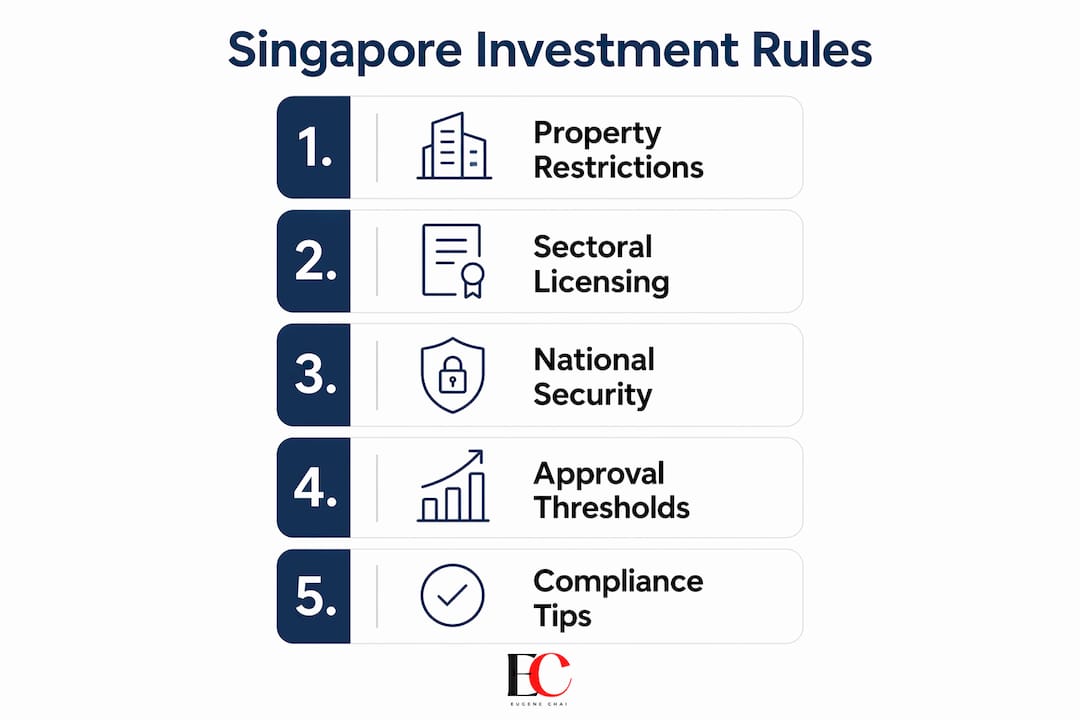
Singapore’s foreign investment framework rests on three pillars: property law, sectoral licensing, and national security screening.

The Residential Property Act restricts foreigners from acquiring vacant land, landed residential properties, and HDB public flats. Attempting to use complex entity structures to hide beneficial ownership typically fails: transfers can be declared void and parties may face criminal charges. The consequences are not merely administrative — they can include fines and imprisonment.
SIRA, which came into force on 28 March 2024, targets entities critical to Singapore’s national security. The Minister for Trade and Industry designates specific entities; to date, designations have covered defence, logistics, petrochemicals, public security, and technology. Crucially, SIRA also grants “calling-in” powers: the Minister can review any transaction within two years, even where no designated entity is involved, and order an unwind with no minimum shareholding threshold required.
Sectoral licensing statutes sit alongside SIRA. The Banking Act (administered by MAS), the Telecommunications Act (IMDA), the Broadcasting Act, and the Newspaper and Printing Presses Act (NPPA) each impose their own controller thresholds and fit-and-proper tests. Non-compliance across any of these frameworks can result in void transactions, licence revocation, and criminal liability.
Pro Tip: SIRA applies to both foreign and local acquirers, and it covers internal restructurings — so even reorganising an existing Singapore holding structure can trigger notification obligations.
Which licensed sectors create the biggest hurdles for foreign investors?
Practitioners consistently find that licensing regimes present more immediate timing and qualitative hurdles than ownership limits alone. Here is where the main gates sit:
- Banking and finance (MAS): Controller thresholds at 5%, 12%, and 20% require prior MAS approval; the Minister for Finance assesses fit-and-proper status and national interest before approving substantial shareholdings.
- Telecommunications and broadcasting (IMDA): Specific controller thresholds apply; broadcasting licences can be refused where foreign sources hold more than 49% of shares.
- Media and newspapers (NPPA): Newspaper companies require management shares and citizen directors; foreign control is tightly constrained.
- Transport (TSA): The Transport Sector (Critical Firms) Act 2024, in force since 1 April 2025, mirrors SIRA’s notice and approval structure for essential air, land, and sea transport operators.
- Utilities and critical infrastructure: Subject to SIRA designation and sector-specific oversight.
| Sector | Regulator | Key threshold | Approval type |
|---|---|---|---|
| Banking | MAS | 5% / 12% / 20% | Prior approval |
| Telecommunications | IMDA | Licence-specific | Prior approval |
| Broadcasting | IMDA | 49% foreign cap | Licence condition |
| Newspapers | NPPA | Management shares | Structural requirement |
| Transport (critical) | MTI / TSA | SIRA-equivalent | Prior approval |
How does buying property in Singapore work for a UK individual?
The rules divide sharply by property type. Private non-landed apartments and condominiums are generally open to foreign buyers. Landed houses, vacant land, and HDB flats are not, with very limited exceptions requiring ministerial approval under the Residential Property Act.
Sentosa Cove landed properties occupy a middle ground: foreigners may apply to purchase them, but approval from the Minister of Law is still required, and approval is not guaranteed.
Costs to budget for a foreign buyer:
- Additional Buyer’s Stamp Duty (ABSD): Foreign buyers currently pay ABSD on top of standard Buyer’s Stamp Duty. For detailed current ABSD rates, check the IRAS stamp duty guidance.
- Legal and conveyancing fees: Typically range from a few thousand Singapore dollars upward depending on property value and complexity.
- Advisory fees: Specialist property lawyers and tax advisers add to the upfront cost but are worth every dollar given the void-transfer risk.
For a full breakdown of stamp duties and conveyancing steps, the Singapore property investment guide on Eugenechaitf covers the process in detail.
Pro Tip: Choose your asset class before you choose your property. Committing to a private condominium rather than a landed house removes the need for ministerial approval entirely and saves weeks of processing time.
| Property type | Open to foreigners? | Approval needed? |
|---|---|---|
| Private non-landed apartment / condo | Yes | No (standard conveyancing) |
| Landed residential (mainland) | Generally no | Ministerial approval required |
| HDB flat | No | Not available to foreigners |
| Sentosa Cove landed | Limited | Ministerial approval required |
| Commercial / industrial property | Yes | No ownership restriction |
What are the rules for buying shares in Singapore companies?
Singapore generally allows 100% foreign ownership of companies, which makes it one of the more open investment destinations in Asia. The exceptions come from sector licences and SIRA designations, not from a blanket foreign ownership cap.
SIRA thresholds in practice: Under SIRA, a person (together with their associates) who becomes a 5% controller of a designated entity must notify the relevant Minister in writing within seven days. Prior approval is mandatory before reaching 12%, 25%, or 50% control. These obligations apply to indirect control and to internal restructurings, not just direct share purchases. Completing a transaction without the required approval renders it void.
For MAS-regulated banks, the thresholds are 5%, 12%, and 20%, each requiring prior approval and a fit-and-proper assessment. For listed targets, the Singapore Exchange (SGX) Takeover Code also applies once certain shareholding levels are crossed.
Structuring choices matter. A direct share purchase in a designated entity triggers SIRA. Acquiring assets rather than shares may avoid some thresholds, but the calling-in power means the Minister can still review asset acquisitions where national security is engaged.
Pro Tip: Map your aggregate holdings with associates before submitting any notification. SIRA counts associates’ stakes alongside yours — missing this can push you over a threshold without realising it.
For more on MAS licensing thresholds, Eugenechaitf’s dedicated guide explains the financial sector requirements clearly.
Your pre-investment checklist before committing funds
- Confirm asset type and governing statute. Property? Identify whether it is landed, HDB, or private. Company stake? Check if the target is incorporated or active in Singapore.
- Check SIRA and TSA designation. Search the Government Gazette and OSIR guidance to confirm whether the target is a designated entity.
- Identify sector licences. Does the target hold a MAS, IMDA, Broadcasting Act, or NPPA licence? Each imposes its own thresholds.
- Instruct local counsel and a tax adviser. Do this before paying any deposit or signing a letter of intent.
- Prepare KYC documentation. Expect to provide certified identification, source-of-funds evidence, and corporate structure charts for AML purposes.
- Submit notifications or seek approvals. File SIRA notices within seven days of crossing 5%; obtain prior approval before reaching 12%, 25%, or 50%.
- Plan FX transfers and repatriation. Singapore has no exchange controls, but banks apply AML scrutiny to large inbound transfers. Prepare documentation early.
Key contacts:
- OSIR / MTI: SIRA notifications and approvals
- HDB: Public housing eligibility queries
- MAS: Banking and financial services licensing
- IMDA: Telecommunications and broadcasting enquiries
Pro Tip: Perform “threshold mapping” at the outset: list all entities in which you and your associates already hold stakes in Singapore. Aggregate holdings can trigger SIRA obligations you did not anticipate.
To avoid common pitfalls, the guide on investment scams in Singapore is also worth reading before you commit.
What timelines and costs should you realistically budget for?
Timelines:
- SIRA 5% controller notice: within a short period after the triggering event
- SIRA prior approval (for designated control levels) must be obtained before completion; no statutory deadline for submission, but allow several weeks minimum
- Property conveyancing (private condo): typically takes a couple of months from option to completion
- Ministerial approval (landed property): variable; can take several months
Cost considerations:
- ABSD for foreign buyers: check current rates with IRAS directly, as rates have changed in recent years
- Legal fees for property purchase: typically a few thousand SGD upward
- SIRA / licensing application advisory fees: vary by complexity; specialist legal advice is not optional
- Bank transfer and FX: no exchange controls apply, but large transfers attract AML documentation requirements and may take several business days to clear
For tax treatment on gains, the Singapore capital gains tax guide on Eugenechaitf explains what applies to foreign investors.
Red flags that should pause any transaction
Watch for these warning signs before proceeding:
- Acquiring landed residential property without ministerial approval — the transfer will be void and criminal liability may follow.
- Buying into a designated entity without SIRA prior approval — the transaction is automatically void.
- Target operates in a licensed sector with no regulator pre-clearance — licence revocation risk transfers to the buyer.
- Complex ownership structures obscuring beneficial ownership — regulators treat this as an aggravating factor, not a workaround.
- Seller insisting on offshore completion without local counsel present — a reliable sign that something needs closer scrutiny.
- Inability to obtain certified statutory searches — title searches and company searches are standard; refusal to provide them is a serious concern.
Pro Tip: Run a quick red-flag screen before instructing lawyers: confirm property type, check the SIRA/TSA gazette, identify all sector licences, and verify the seller’s beneficial ownership chain. Ten minutes of checking can prevent months of legal problems.
Eugene’s perspective: what I actually do when helping a UK investor
When someone comes to me planning a Singapore investment from the UK, the first thing I do is build a risk map before any money moves. That means identifying the asset class, checking the SIRA gazette, and listing every sector licence the target holds. Only then do I recommend instructing a Singapore-qualified lawyer.
I always advise using conditional offers and, where possible, escrow arrangements. This protects the buyer if an approval is refused or takes longer than expected. One reader I worked with was initially drawn to a landed property in a prime district. After checking the Residential Property Act, we redirected to a private condominium in the same area, avoiding a ministerial approval process entirely and saving both time and uncertainty.
The behavioural lesson is straightforward: treat regulatory guidance as mandatory, not optional. Regulators in Singapore are efficient and consistent, but they do not forgive procedural shortcuts.
Key takeaways
Singapore is genuinely open to foreign investment in most asset classes, but the Residential Property Act, SIRA, and sector licensing regimes create firm limits that void non-compliant transactions and carry criminal penalties.
| Point | Details |
|---|---|
| Property class first | Foreigners can buy private condos freely; landed property and HDB flats are largely restricted. |
| SIRA thresholds are strict | Notify at 5% within seven days; obtain prior approval before reaching 12%, 25%, or 50% control. |
| Sector licences add extra gates | Banking (MAS), broadcasting (IMDA), and transport (TSA) each impose separate approval criteria. |
| Non-compliance is severe | Void transfers, fines, licence revocation, and criminal liability are all live consequences. |
| Engage local counsel early | Instruct a Singapore-qualified lawyer before paying any deposit or signing any agreement. |
Useful official sources and further reading
Use these official portals to verify rules and begin applications:
- SIRA — MTI / OSIR: Check designated entities, download application forms, and read OSIR guidance. Start here for any company stake in a potentially critical entity.
- SIRA full text — Singapore Statutes Online: The primary legislation; use this to verify thresholds and controller definitions.
- UNCTAD Investment Laws Navigator — SIRA 2024: Useful for cross-referencing SIRA provisions in a searchable format.
- HDB (hdb.gov.sg): Confirms eligibility rules for public housing; foreigners should check here before any HDB-related enquiry.
- MAS (mas.gov.sg): Licensing pages for banking, capital markets, and financial services; essential for any investment in a MAS-regulated entity.
- IMDA (imda.gov.sg): Telecommunications and broadcasting licence conditions and controller thresholds.
- IRAS (iras.gov.sg): Current ABSD rates, stamp duty calculators, and tax guidance for foreign property buyers.
For broader investing guidance tailored to Singapore, the investment tips and strategies section on Eugenechaitf is a practical starting point.
Disclaimer: Informational only. Consult an MAS-licensed adviser before investing.
FAQ
Can a UK citizen buy property in Singapore?
Yes, but only certain types. Private non-landed apartments and condominiums are generally available to foreign buyers; landed residential properties and HDB flats are largely restricted under the Residential Property Act, with limited exceptions requiring ministerial approval.
What is SIRA and does it affect UK investors?
SIRA (Significant Investments Review Act 2024) applies to all investors, foreign and local alike. It requires a 5% controller to notify the Minister within seven days and mandates prior approval before reaching 12%, 25%, or 50% control of a designated entity.
What happens if you breach Singapore’s foreign investment rules?
Non-compliant transfers can be declared void, licences may be revoked, and parties face potential fines and criminal liability under the relevant statute, whether the Residential Property Act or SIRA.
Does Singapore have exchange controls on repatriating funds?
No. Singapore imposes no exchange controls, so funds can be repatriated freely. However, banks apply standard AML and KYC scrutiny to large transfers, so prepare source-of-funds documentation in advance.
Which regulator oversees SIRA applications?
OSIR (Office for Significant Investments Review), an agency under the Ministry of Trade and Industry (MTI), administers SIRA. Applications and notifications are submitted to OSIR.






Leave a Reply