



TL;DR:
- Insurance agent earnings are primarily influenced by product type, agency model, and renewal book size rather than upfront rates alone. Building a large, persistent book in high-renewal verticals like P&C or Medicare is key to maximizing long-term income, while understanding chargebacks and lead efficiency is vital for profitability. Choosing between captive and independent roles depends on financial stability preferences and investment capacity, shaping earning potential over time.
An insurance agent commission is the percentage of premium or fixed fee an agent earns each time a client purchases or renews a policy, and it forms the primary income source for most agents in Singapore and comparable markets. The industry term for this payment structure is “producer compensation,” though “commission” is the term used universally in practice. Median annual earnings for full-time agents in 2026 sit between $59,080 and $60,370, with top performers exceeding $130,350 and entry-level agents earning $30,000 to $45,000. That wide range is not random. It reflects the direct impact of product vertical, agency model, and career tenure on every agent’s take-home pay. This guide unpacks each of those variables so you can plan your career with clear expectations.

How do insurance agent commissions vary by product type?
Commission rates in insurance differ dramatically depending on the product you sell, and understanding these differences is the single most important decision you will make as a new agent.
| Product vertical | First-year commission | Renewal commission |
|---|---|---|
| Life insurance (term/whole/IUL) | 40% to 115% of premium | 2% to 5% of premium |
| Medicare Advantage (US CMS-regulated) | $626 fixed cap (2026) | $313 per member per year |
| Property and casualty (P&C) | 8% to 15% of premium | 10% to 15% of premium |
| ACA/health plans | Flat per-member-per-month fee | Flat per-member-per-month fee |
| Annuities | 1% to 8% of premium | Minimal or none |
First-year life insurance commissions range from 40% to 115% of the first-year premium, while property and casualty products pay only 8% to 15%. This gap explains why many new agents gravitate toward life insurance despite its steeper learning curve and higher chargeback risk.
Medicare Advantage deserves special attention. The US Centers for Medicare and Medicaid Services (CMS) caps the 2026 Medicare Advantage commission at $626 per new enrollment, with a residual of $313 per member per year for renewals. This regulatory ceiling limits upside but creates predictable, recurring income that compounds well over time.
P&C products like home and motor insurance pay lower first-year rates, but their renewal commissions of 10% to 15% are notably higher than life insurance renewals. This makes P&C a strong choice for agents who prioritize building a stable, recurring book of business over chasing large upfront payouts.
Pro Tip: Never evaluate a product vertical based on first-year commission alone. Calculate the expected lifetime value of a policy by factoring in renewal rates, average policy duration, and chargeback probability before committing to a specialisation.
Captive vs. independent agents: how does the commission structure differ?
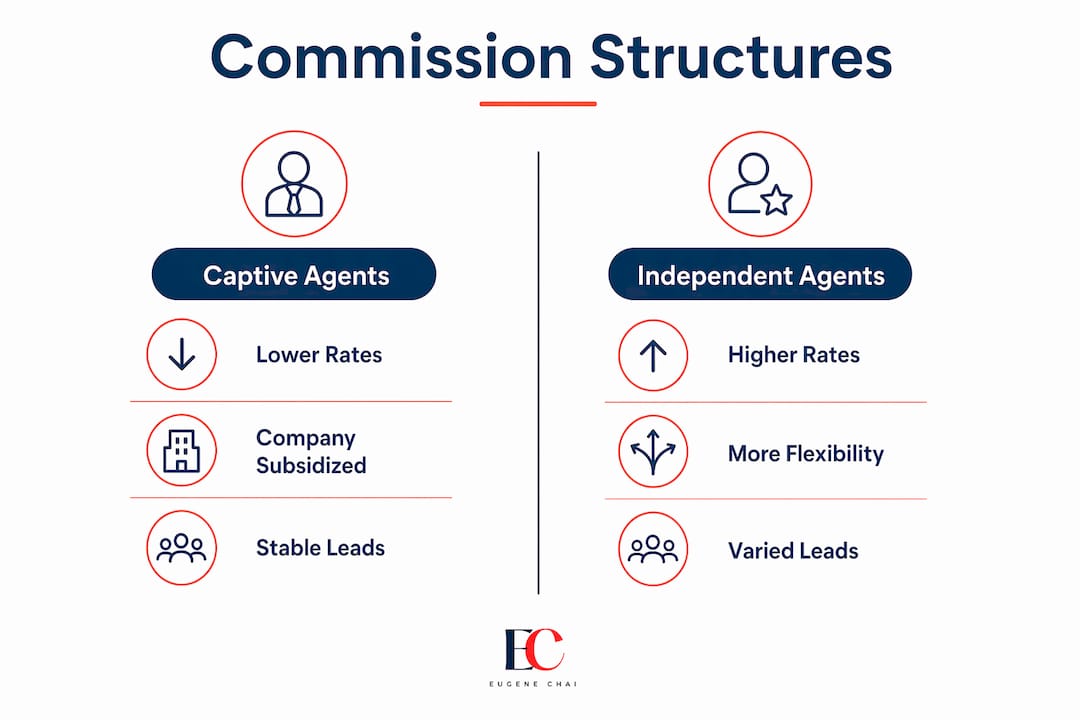
The agency model you choose shapes your commission structure for agents as much as the products you sell. The two primary models are captive and independent, and each carries distinct trade-offs.
Captive agents work exclusively for one insurer, such as Prudential, AIA, or Great Eastern in Singapore. They typically receive:
- Lower commission percentages (often 20% to 30% below market rate)
- A salary, draw, or allowance that provides income stability in the first 12 to 18 months
- Company-provided leads and marketing support
- Structured training programmes and compliance oversight
Independent agents represent multiple carriers and retain full control over their product recommendations. Their compensation profile looks quite different:
- Higher commission shares, typically 20% to 35% more than captive equivalents
- Commission splits with their agency ranging from 40/60 to 60/40 in the agent’s favour
- Agency overrides available once they build a producing team
- Full responsibility for lead generation, marketing costs, and business expenses
| Factor | Captive agent | Independent agent |
|---|---|---|
| Commission rate | Lower (company subsidised) | Higher (market rate) |
| Income stability | Higher (salary/draw available) | Lower (fully commission-based) |
| Lead support | Provided by company | Self-funded |
| Carrier access | Single carrier | Multiple carriers |
| Long-term earning ceiling | Lower | Higher |
The right choice depends on your financial runway. If you have limited savings to fund your first year, a captive role with a draw or salary reduces the pressure of building a client base from scratch. If you have capital to invest in leads and marketing, the independent route offers meaningfully higher long-term earnings. Understanding Singapore’s insurance ecosystem before choosing your model will help you align your decision with local market realities.
How do experience, specialisation, and lead investment affect earnings?
Insurance agent earnings do not follow a linear path. The first 12 to 18 months are typically the lowest-income period, as agents build their pipeline and learn their product. Experienced agents transition from this initial grind to a stable book manager role between years three and five, where renewal commissions begin compounding meaningfully.
Vertical specialisation is the largest single factor in income trajectory. According to InsureLeads research, Medicare provides high volume with predictable per-member fees, while indexed universal life (IUL) insurance offers the highest revenue per sale but carries the greatest chargeback and lapse risk. Choosing your niche early prevents the burnout that comes from spreading yourself across too many product lines.
Lead investment efficiency is where many agents quietly lose money. The ratio of cost per lead (CPL) to cost per acquisition (CPA) determines your actual net profit per sale. Optimising CPL-to-CPA metrics separates top-performing agents from those who generate strong gross commissions but thin net income. Live transfer leads convert at higher rates than web leads but cost significantly more per unit. Understanding this trade-off before scaling your lead spend is critical.
Key income growth levers for agents at different career stages:
- Years 0 to 2: Focus on close rate improvement and lead cost management over volume
- Years 2 to 5: Begin building renewal book; cross-sell complementary products to existing clients
- Years 5 and beyond: Leverage renewal income as a passive base; consider recruiting and earning agency overrides
Cross-selling is consistently underused by newer agents. A client who holds a life insurance policy is a natural candidate for critical illness coverage or a Medisave-linked plan. Deepening your knowledge of critical illness products directly increases your revenue per client without additional lead costs.
Pro Tip: Track your CPA by lead source every month. If a lead channel costs $80 per lead but converts at 5%, your CPA is $1,600. If another channel costs $150 per lead but converts at 20%, your CPA drops to $750. The more expensive lead is often the better investment.
What are chargebacks, renewal commissions, and contingency bonuses?
Chargebacks are the financial risk most new agents underestimate. When a policyholder cancels or lapses a policy within the first year, the carrier claws back the commission already paid. Chargeback schedules typically apply a full clawback for lapses within the first six months, then a 50% clawback for lapses between months six and twelve. In life insurance, where first-year commissions can exceed 100% of premium, a single lapse can wipe out thousands of dollars in earned income.
Renewal commissions are the antidote to chargeback volatility. Life insurance renewals pay 2% to 5% of premium annually, while P&C renewals pay 10% to 15%. These figures sound modest, but a mature book of 500 active policies generates meaningful passive income that grows each year without additional sales effort.
Contingency bonuses add a third income layer for agencies that perform well at scale. Contingency payments of 1% to 3% of total premium are awarded by carriers to agencies that meet loss ratio targets and growth benchmarks. These bonuses incentivise quality underwriting and client retention, not just volume. They are typically paid at the agency level and shared with top-producing agents.
Successful agents treat their book of business as an asset, not just a sales pipeline. Persistency, the rate at which clients keep their policies active, is the metric that determines whether your renewal income grows or erodes each year.
Before signing with any agency, review the contract vesting schedule carefully. Some agencies retain ownership of your book of business if you leave within a set period. Owning your book outright is a significant long-term financial advantage, particularly if you plan to sell or transfer your client base later in your career. Reading about whole life policy surrender risks from the client’s perspective also helps you understand what drives lapses and how to prevent them.
How can you practically maximise your commission income?
Building strong insurance sales compensation requires a deliberate strategy, not just hard work. Here is a practical framework for agents at the start of their career:
- Choose a vertical with favourable CPL-to-CPA economics. Final expense and Medicare are widely recommended for beginners because the sales cycle is shorter and close rates on quality leads are higher than in complex life insurance products.
- Understand your lead types before scaling spend. Live transfer leads close faster but cost more. Web leads require stronger follow-up systems. Match your lead type to your current conversion skills, not your aspirational close rate.
- Mitigate chargeback risk through client education. Clients who understand what they bought and why are far less likely to lapse. Set clear expectations at the point of sale about premium commitments and policy benefits.
- Build your renewal book from day one. Every policy you sell is a future renewal commission. Treat client retention as a revenue strategy, not just a service obligation.
- Cross-sell systematically. A client with a term life policy is a candidate for a Medisave-linked plan, a hospitalisation plan under MediShield Life, or an Integrated Shield Plan (IP). Each additional policy deepens the relationship and adds to your renewal base.
- Invest in continuous learning. Agents who deepen their product knowledge, particularly in life insurance planning, consistently outperform generalists over a five-year horizon.
Focusing on total contract value and residual income streams, rather than headline commission percentages, is the approach that distinguishes agents who build lasting careers from those who burn out chasing large upfront payouts.
Key takeaways
Insurance agent commission income is determined primarily by product vertical, agency model, and the quality of your renewal book, not by upfront commission rates alone.
| Point | Details |
|---|---|
| Product vertical drives income range | Life insurance pays 40% to 115% first-year; P&C pays 8% to 15% but offers stronger renewals. |
| Agency model shapes your commission split | Independent agents earn 20% to 35% more but fund their own leads and operations. |
| Chargebacks are a real financial risk | Full clawback applies within six months; manage persistency to protect earned income. |
| Renewal commissions compound over time | A mature book of business generates passive income that grows without additional sales. |
| CPL-to-CPA efficiency determines net profit | Optimising lead cost to conversion rate separates top earners from average performers. |
My honest view on building a commission-based insurance career
I have spent considerable time studying how commission-based careers play out in Singapore’s financial services sector, and the pattern I see repeatedly is this: agents who focus obsessively on the headline commission rate almost always underperform agents who focus on contract terms, persistency, and vertical fit.
The first year in insurance is genuinely difficult. You are building a client base from scratch, learning complex products, and managing cash flow on variable income. The agents who survive this period are not necessarily the best salespeople. They are the ones who picked a niche early, understood their chargeback exposure, and treated lead costs as a business investment rather than an expense to minimise.
What I find most interesting about the 2026 commission data is the gap between median and top-decile earnings. The median sits around $59,080 to $60,370, but the top 10% earn over $130,350. That gap is not explained by luck or even by raw sales talent. It is explained almost entirely by renewal book size and vertical specialisation. Agents who built a large, persistent book in a high-renewal vertical like P&C or Medicare are the ones sitting in the top decile five to ten years later.
Technology is also reshaping how commissions are earned. Data-driven lead sourcing and CRM tools are giving agents who invest in systems a measurable edge over those relying purely on referrals. If you are entering the industry in 2026, treating your practice like a business from day one, with proper budgeting, lead tracking, and client retention systems, is no longer optional. It is the baseline for sustainable earnings.
— Eugene
Start your insurance and personal finance journey with Eugenechaitf
If you are serious about building a career in insurance or simply want to make smarter financial decisions, Eugenechaitf is the resource I built specifically for Singaporeans navigating these exact questions.
On the Eugenechaitf personal finance platform, you will find practical guides on insurance planning, budgeting, saving, and investing, all written from the perspective of someone who has lived through the financial decisions you are facing. Whether you are evaluating your first insurance product, managing a fluctuating commission income, or planning long-term wealth building, the content is designed to give you clarity without the jargon. Explore the full blog at eugenechaitf.com and take the next step in your financial education today.
FAQ
What is the average insurance agent commission rate?
Commission rates vary by product: life insurance pays 40% to 115% of first-year premium, property and casualty pays 8% to 15%, and Medicare Advantage is capped at $626 per enrollment in 2026. Renewal commissions are lower but provide ongoing passive income.
How do captive and independent agents differ in commission earnings?
Independent agents earn 20% to 35% more in commission than captive agents due to higher commission splits and access to multiple carriers. Captive agents trade higher rates for salary support, company leads, and structured training.
What is a chargeback in insurance commissions?
A chargeback is a clawback of commission when a policy lapses within the first year. Full clawbacks typically apply in the first six months, with a 50% clawback between months six and twelve, making persistency management critical for income stability.
How long does it take to earn stable income as an insurance agent?
Most agents transition from low initial income to a stable, renewal-driven income between years three and five, once their book of business generates meaningful recurring commissions without constant new sales activity.
Which insurance vertical pays the highest commissions?
Life insurance, particularly indexed universal life (IUL), offers the highest revenue per sale with first-year commissions up to 115% of premium. However, it also carries the highest chargeback risk, making vertical selection a balance between income potential and financial stability.
Disclaimer: Informational only. Consult an MAS-licensed advisor before investing.






Leave a Reply