



The credit card minimum payment is the smallest amount you must pay by your statement due date to keep your account in good standing and avoid late fees or negative marks on your credit file. According to the Financial Conduct Authority, it is typically the greater of a fixed floor amount or a percentage of your statement balance, plus any interest and fees charged that month. Pay it, and your account stays current. Pay only it, and your debt can persist for years at significant cost.
The single most important thing to understand: the minimum payment is a lender’s floor, not a repayment target. Treat it as a target and you risk paying many times the original purchase price in interest before the balance clears.
- Pay more than the minimum whenever you can — even a small extra amount each month cuts total interest sharply.
- Prioritise high-APR balances first — the card charging the most interest costs you the most for every day you carry a balance.
- Check your statement for the statutory warning — UK issuers are legally required to show how long it would take to repay if you only make minimum payments.
Key fact: Regulators describe the minimum payment as a lender’s “floor” rather than consumer advice; financial experts consistently stress that treating it as a repayment target is financially risky.
Pro Tip: If you are juggling multiple cards, direct any extra payment to the highest-rate card first. That is the debt avalanche method, and it minimises total interest paid over time.
Table of Contents
- How do UK card issuers calculate the minimum payment?
- Worked examples: what the maths actually looks like
- What are the real consequences of paying only the minimum?
- What happens if you miss the minimum payment?
- Where do you find the minimum payment on your statement or app?
- How can you reduce costs and pay off your balance faster?
- Key takeaways
- The real cost of “just the minimum”
- Useful sources for further reading
- FAQ
How do UK card issuers calculate the minimum payment?
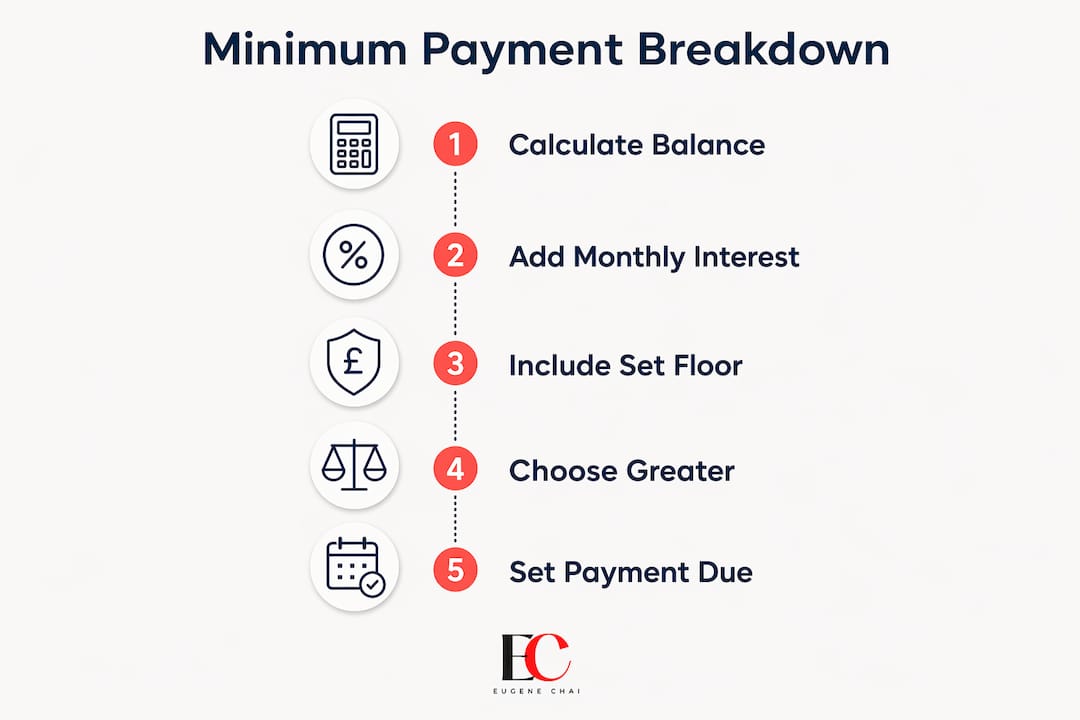
UK issuers use one of three approaches, and your card agreement will state which applies to your account.
The three common methods
- Flat percentage of the statement balance — typically a small single-digit percentage of the total balance, with interest and fees either included in or added on top of that figure, depending on the issuer’s formula.
- Percentage plus interest and fees — a lower base percentage (often around 1%) applied to the principal, with the full month’s interest and any fees added separately. This ensures the minimum always covers at least the interest charged.
- Fixed minimum floor — if either calculation above produces a figure below a set threshold (commonly £5–£25 for UK cards), the issuer charges that fixed amount instead. If your balance is less than the fixed minimum, you pay the balance in full.
The “greater of” rule governs most accounts: the issuer calculates both the percentage figure and the fixed floor, then charges whichever is higher. This protects the lender from receiving payments so small they do not even cover the month’s interest.
What components are included?

| Component | Typically included? | Notes |
|---|---|---|
| Monthly interest charged | Yes | Always included; often the largest portion |
| Account fees (annual, late) | Yes | Added to balance; minimum rises accordingly |
| Past-due amounts | Yes | Any arrears from prior months are added |
| Instalment plan repayments | Yes | Fixed monthly amounts from purchase plans |
| New purchases | Partially | Covered via the percentage calculation |
Regulatory disclosure obligations
The FCA requires issuers to display a statutory warning on every statement showing how long it would take to clear the balance if only minimum payments are made, alongside the total cost of credit. This is not optional text — it is a legal requirement designed to make the long-term cost visible before you decide how much to pay.
Worked examples: what the maths actually looks like
These examples use realistic UK assumptions. Both use a typical APR (a common representative rate for standard UK credit cards), a minimum payment of 1% of the balance plus that month’s interest, and a fixed floor of £25.
Example 1: £1,000 balance
Assumptions: £1,000 opening balance, a typical APR, minimum = 1% of balance + monthly interest, floor is a small fixed amount.
| Month | Opening balance | Monthly interest (21.9% ÷ 12) | 1% of balance | Minimum paid | Closing balance |
|---|---|---|---|---|---|
| 1 | £1,000 | £18.25 | £10 | £28.25 | — |
Notice that in month 1, only £10 of the £28.25 payment reduces the principal. The rest covers interest. At this pace, paying only the minimum on a £1,000 balance takes roughly nine years to clear and costs well over £1,000 in interest alone.
Example 2: £3,000 balance
Assumptions: £3,000 opening balance, same APR and formula.
| Month | Opening balance | Monthly interest | 1% of balance | Minimum paid | Closing balance |
|---|---|---|---|---|---|
| 1 | £3,000 | £54.75 | £30 | £84.75 | — |
A £3,000 balance paid at minimums only can take over 20 years to clear. The statutory illustration on your statement will show your issuer’s own version of this calculation — always read it.
Pro Tip: Even paying an extra £20–£30 per month above the minimum can cut years off your repayment timeline. Use your issuer’s online calculator or a free tool on MoneyHelper to model the difference before your next payment.
How APR and extra payments change the outcome
A higher APR means a larger share of each minimum payment disappears into interest, leaving less to reduce the principal. Drop the APR by switching to a 0% balance-transfer card, and the entire payment attacks the principal. Add even a modest fixed extra amount each month, and the compounding works in your favour rather than against you.

What are the real consequences of paying only the minimum?
Paying only the minimum keeps your account current, but it does not prevent interest from accruing. Interest is charged daily on the outstanding balance, so the longer the balance stays high, the more you pay. When your payment is applied, the issuer allocates it to interest and fees first, then to the principal — meaning the principal can shrink painfully slowly.
- Total cost multiplies: On a £3,000 balance at a typical APR, paying only the minimum each month can take over 20 years to clear and cost more in interest than the original balance.
- The “making progress” illusion: Because the minimum falls each month as the balance drops, it feels like progress. The balance does decline, but so slowly that the debt can persist for decades.
- Persistent debt rules: The FCA requires lenders to intervene when a consumer has paid more in interest and fees than they have repaid of the principal over an 18–36 month period. If you reach that threshold, your lender must contact you and offer remedial options.
- Credit utilisation stays high: High credit utilisation is a key driver of credit-score movement in the UK. Paying only the minimum while regularly using the card keeps your utilisation ratio elevated, which weighs on your score even if every payment is made on time.
What happens if you miss the minimum payment?
Missing a minimum payment triggers a chain of consequences that can be difficult to reverse quickly.
- Late fee: Most UK issuers charge a late fee, typically around £12, which is added to your balance and increases the next minimum.
- Penalty APR: Your card agreement may allow the issuer to raise your interest rate to a penalty rate if you miss a payment. Check your terms — this can significantly increase your ongoing credit card interest rates.
- Credit file impact: A missed payment is reported to credit reference agencies (Experian, Equifax, TransUnion) and remains on your credit file for six years. A single late event is less damaging than a pattern of missed payments, but it still affects your score.
- Default risk: Sustained missed payments can lead to a default notice, which is a serious mark on your credit file and can restrict access to mortgages, loans, and other credit products for years.
- Increased minimums: Fees added to the balance raise the balance, which raises the next minimum — a cycle that can escalate if left unaddressed.
Pro Tip: If you realise you have missed a payment, pay it as soon as possible. The sooner you pay, the less likely the issuer is to report it as a formal missed payment. Call the lender directly and explain the situation — many will waive a first-time late fee if you ask.
After a missed payment, check your credit report via a free service and contact your lender to discuss a hardship arrangement if you are struggling. StepChange offers free, confidential debt advice and can help you approach your lender constructively.
Where do you find the minimum payment on your statement or app?
UK credit card statements follow a standard layout, and the key figures are always in the same place once you know what to look for.
- “Minimum payment due” — the exact amount you must pay by the due date.
- “Payment due date” — the date by which the payment must reach your account; not the date you send it.
- “Statement balance” — the full amount owed at the statement date; paying this in full avoids all interest.
- “Amount due” — on some statements this mirrors the minimum; on others it reflects any overdue amount. Read the label carefully.
- Statutory repayment illustration — required by the FCA; shows how long repayment takes at minimums only and the total cost.
How to locate these figures step by step
- Log into your issuer’s app or online banking and open the most recent statement (usually a PDF).
- Look for the payment summary box, typically near the top of the first page.
- Note both the minimum payment due and the payment due date — these are the two numbers that matter most for avoiding penalties.
- If you cannot find the statement, call the number on the back of your card; have your account number ready.
- For Lloyds Bank and Barclaycard customers, both issuers display the minimum payment prominently in their mobile apps under the account summary screen.
Pro Tip: Screenshot your statement summary each month and save it. If there is ever a dispute about whether a payment was made on time, you have a dated record of what was due and when.
Instalment plans, overdue amounts, or account reviews can all change your minimum without warning. Checking the statement each month rather than relying on memory or a standing order set months ago is the safest habit.
How can you reduce costs and pay off your balance faster?
Paying more than the minimum is the single most effective step, and the options below give you a practical path to doing it.
Priority steps
- Increase your direct debit — switch from the minimum-only direct debit to a fixed higher amount, or to the full statement balance if your budget allows.
- Target the highest-APR card first — the debt avalanche method directs every extra pound to the most expensive debt, minimising total interest.
- Use windfalls — a tax refund, bonus, or unexpected income applied directly to the balance can cut years off repayment.
Product options
| Option | How it helps | Key trade-off |
|---|---|---|
| 0% balance-transfer card | Stops interest accruing; full payment reduces principal | Transfer fee (typically 1–3% of balance); 0% period ends |
| Personal loan consolidation | Fixed monthly payment; often lower rate than credit card | Secured loans carry asset risk; check total cost |
| Hardship or repayment plan | Lender may freeze interest or reduce payments temporarily | May affect credit file; discuss terms carefully |
A balance-transfer card from a provider such as Barclaycard or Lloyds Bank can be a genuinely powerful tool if you have a clear repayment plan before the introductory period ends. Without that plan, the balance simply reverts to the standard rate. You can compare credit cards to find current balance-transfer offers suited to your situation.
When to seek free debt advice
If you cannot meet the minimum payment consistently, that is a clear signal to seek help rather than rearrange other bills to cover it. StepChange provides free, confidential debt advice and can negotiate directly with lenders on your behalf. MoneyHelper, the UK government-backed guidance service, offers free tools including a budget planner and a debt advice locator. Neither service charges a fee, and both are independent of card issuers.
For readers who want a structured approach to managing repayments alongside a broader budget, the Debt Management Guide from eBook Warehouse offers a practical framework for prioritising payments and building a repayment plan.
Good budgeting habits are ultimately what create the headroom to pay more than the minimum each month. Tracking expenses, cutting discretionary spending, and allocating a fixed sum to debt repayment each month turns an abstract goal into a concrete habit.
Key takeaways
Paying only the minimum keeps your account current but allows interest to compound daily, meaning a £3,000 balance at a typical APR can take over 20 years to clear and cost more in interest than the original balance.
| Point | Details |
|---|---|
| Minimum payment definition | The smallest amount required by the due date to keep the account in good standing and avoid late fees. |
| How it is calculated | Typically the greater of 1–4% of the balance or a fixed floor (often £25), plus interest and fees. |
| Cost of paying only the minimum | On a £3,000 balance at a typical APR, paying only the minimum each month can take over 20 years to clear and cost more in interest than the original balance. |
| Credit score risk | High utilisation from carrying large balances harms your credit score even when every minimum is paid on time. |
| Where to get help | StepChange and MoneyHelper both offer free, independent debt advice and budget tools. |
The real cost of “just the minimum”
Most people understand, in theory, that paying only the minimum is expensive. What they underestimate is how the maths compounds against them month after month. The minimum payment is designed to keep you as a customer, not to get you out of debt efficiently. Card issuers earn more when balances persist, which is precisely why the minimum is set low enough to feel manageable.
The worked examples above are not worst-case scenarios. A £3,000 balance taking over 20 years to clear at a standard UK APR is a realistic outcome for anyone who treats the minimum as a target. The FCA’s persistent debt rules exist because this pattern is common enough to require regulatory intervention.
My honest recommendation: set up a direct debit for a fixed amount above the minimum today, even if it is only £10 or £20 more. That single habit, maintained consistently, is worth more than any financial product or strategy. If the minimum itself feels unaffordable, call your lender before you miss a payment — most have hardship options that are never advertised but are available if you ask. And if the debt feels genuinely unmanageable, StepChange and MoneyHelper are free, non-judgmental, and effective.
Useful sources for further reading
- MoneyHelper — UK government-backed guidance service; free budget planner, debt advice locator, and credit card repayment calculator.
- StepChange — leading UK debt charity; free confidential advice, debt management plans, and lender negotiation support.
- Financial Conduct Authority (FCA) — regulatory guidance on credit card pricing, persistent debt rules, and statutory statement requirements.
- MoneySuperMarket — comparison tool for balance-transfer cards and personal loans; useful for modelling transfer fees against interest savings.
- Lloyds Bank and Barclaycard — both publish clear explainers and online calculators showing repayment timelines under different payment scenarios; accessible via their respective websites.
Worked examples in this article use assumed figures (a typical APR, 1% + interest minimum, £25 floor) for illustration. Your actual minimum will depend on your issuer’s specific terms, which are set out in your credit agreement and on each monthly statement.
FAQ
How does a credit card minimum payment work?
The minimum payment is the smallest amount you must pay by the due date to keep your account current and avoid late fees. Paying it prevents penalties but does not stop interest accruing on the remaining balance.
What would the minimum payment be on a £1,000 credit card balance?
Using a typical UK formula of 1% of the balance plus monthly interest at a typical APR, the first month’s minimum on a £1,000 balance would be approximately £28.25 (£10 principal portion plus £18.25 interest).
What is the minimum payment on a £3,000 credit card balance?
Applying the same formula, the first month’s minimum on a £3,000 balance would be approximately £84.75 (£30 principal portion plus £54.75 interest). Paying only this amount each month, the balance could take over 20 years to clear.
What happens if I only pay the minimum due on my credit card?
Your account stays current and you avoid late fees, but interest continues to accrue daily on the outstanding balance. Over time, total interest paid can exceed the original balance, and high credit utilisation from a persistently large balance can also weigh on your credit score.
What should I do if I cannot afford the minimum payment?
Contact your lender before missing the payment — most UK issuers have hardship arrangements that can temporarily reduce or freeze payments. Free advice is available from StepChange and MoneyHelper, both of which can help you negotiate with your lender at no cost.
Disclaimer: This article is for informational purposes only and does not constitute financial advice. Consult an appropriately qualified financial adviser before making decisions about your credit or debt.






Leave a Reply