



Round-trip tickets are generally cheaper for international flights on legacy carriers, while one-way tickets often win on domestic routes and low-cost carrier (LCC) routes. Legacy carrier international round-trips tend to be cheaper than two separate one-ways, while LCC one-way fares often cost less than round-trips. The answer depends heavily on your route, carrier type, and how you book.
Quick summary of when each option wins:
- Round-trip is cheaper on international routes dominated by legacy carriers such as British Airways or Lufthansa, where fare class discounts apply to combined itineraries
- One-way is cheaper on domestic or short-haul routes where LCCs price each segment independently
- It’s roughly equal on routes with mixed carrier competition, where the gap narrows to around 1–2%
- The old Saturday night stay rule, which once made round-trips artificially cheaper, has largely faded from relevance in 2026
- Booking two one-ways on different airlines (a “hacker fare”) can unlock savings but carries real risk if your outbound flight is delayed
What are one-way and round-trip flights, exactly?
A round-trip flight is a single booking that covers both your outbound and return legs, usually on the same airline or alliance. A one-way flight covers only a single direction, and you can pair two of them to create a return journey, sometimes on entirely different carriers.
Historically, the Saturday night stay rule shaped this market significantly. Legacy airlines priced round-trips with a Saturday overnight stay at a leisure fare, while one-ways were treated as business travel and priced at a premium. That structure kept round-trips artificially cheap for decades. Today, dynamic pricing has largely replaced those fixed fare rules, with airlines adjusting prices in real time based on demand and competition.
A few other ticket types are worth knowing:
- Open-jaw flights: You fly into one city and depart from another. These can be booked as a single open-jaw ticket or as two one-ways.
- Multi-city flights: A single booking covering several destinations in sequence, often used for touring itineraries.
- Hacker fares: Two separate one-way tickets on different airlines, combined to create the cheapest possible return journey.
LCCs such as easyJet and Ryanair changed the game by pricing each segment independently from the start. A one-way on an LCC is typically 7–9% cheaper than a round-trip, which reflects the genuine independent pricing model.
Is it cheaper to buy one way or round trip? A detailed cost comparison
The pricing gap between one-way and round-trip tickets varies considerably by route type and carrier. The table below captures the key patterns from Q2 2026 data:

| Route type | Round-trip avg. | Two one-ways avg. | Savings winner | Avg. savings |
|---|---|---|---|---|
| Domestic, LCC route | Lower | Higher | One-way | 7–9% |
| Domestic, legacy carrier | Lower | Higher | Round-trip | ~11% |
| Domestic, mixed competition | Similar | Similar | Roughly equal | ~1–2% |
| International, legacy carrier | Lower | Higher | Round-trip | 11–17% |
| International, LCC | Higher | Lower | One-way | 7–9% |
| International, mixed | Similar | Similar | Roughly equal | ~2% |
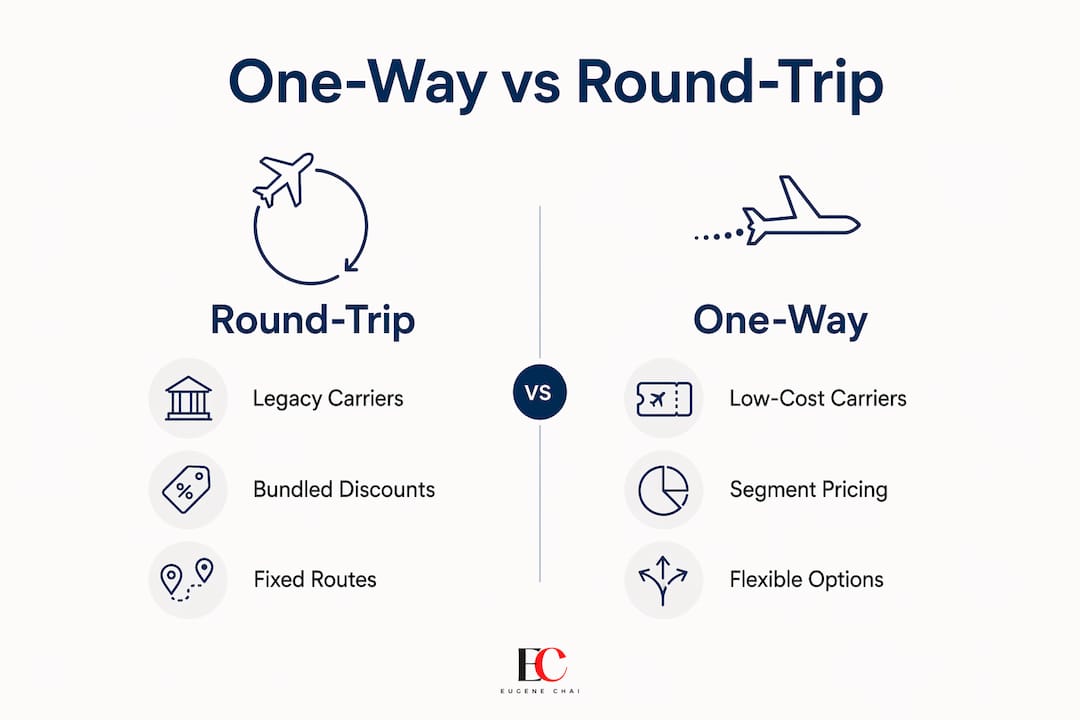
Legacy carriers apply fare class discounts to combined round-trip itineraries. When you book a return journey, the system can access a round-trip fare bucket that is typically 11–17% cheaper than the sum of two standalone one-ways. That discount simply does not exist for a single leg.
Key cost factors to weigh:
- Carrier type: LCCs price segments independently; legacy carriers bundle and discount
- Route distance: Shorter domestic routes show the smallest gap; long-haul international routes show the largest
- Mixed-carrier strategy: Booking two one-ways on different airlines can capture the cheapest outbound and return fares separately
- Timing: Round-trip tickets booked midweek can be notably cheaper than two one-ways on some routes
- Open-jaw itineraries: Flying into one city and out of another almost always favours two one-ways over a standard round-trip
One important caution: the hacker fare approach carries real risk. If your outbound flight is delayed or cancelled, the second airline has no obligation to accommodate you or refund your return ticket.
How do flexibility and convenience compare between the two options?
One-way tickets give you more control over individual legs. If your plans change, you can cancel or modify a single flight without touching the rest of your journey. That independence is genuinely useful for travellers with uncertain schedules or those combining flights from different carriers.

Round-trip bookings are simpler to manage with a single reservation and confirmation, which can be more convenient for leisure travellers with fixed dates.
Factors to consider when choosing:
- Cancellation risk: Cancelling one leg of a round-trip can sometimes void the other leg under certain fare rules, particularly with legacy carriers on restricted fares
- Loyalty programme accrual: Airlines prefer you book round-trips within their ecosystem. Some programmes, such as Delta’s, charge fewer miles for a round-trip award than two one-ways, though many major programmes now price award one-ways at half the round-trip cost, enabling greater flexibility without a price penalty in many cases.
- Itinerary complexity: Open-jaw or multi-destination trips are naturally better served by one-way or multi-city bookings, which can access special bundled fares unavailable through separate one-way searches
- No-show risk: Missing your outbound flight when you hold two separate tickets can invalidate your entire itinerary, with no recourse from the second carrier
For most leisure travellers with fixed return dates, a round-trip on a legacy carrier is both cheaper and simpler. For those with flexible plans or open-jaw itineraries, two one-ways often make more sense.
Practical booking tips to get the best flight prices in the UK
The single most effective habit is to check both options every time. The price difference can be small or it can be hundreds of pounds, and you will not know until you look.
Pro Tip: Book round-trip tickets on a Tuesday or Wednesday where possible, as midweek bookings often offer better prices than other days. The pattern holds broadly across markets.
Practical steps to apply before you book:
- Search round-trip first, then price two one-ways separately and compare the total
- Identify the dominant carrier on your route. LCC-heavy routes (think London to Edinburgh with easyJet) favour one-ways; legacy-dominated routes (London to New York with British Airways) favour round-trips
- Check for a Saturday night stay in your itinerary. Where legacy carriers still apply a version of this discount, including it can reduce your round-trip fare
- Use multi-city search tools for open-jaw or touring itineraries. A multi-city booking often accesses fares that separate one-way searches miss entirely
- Allow buffer time if mixing carriers. Booking two one-ways on different airlines means no airline will cover you if the first leg runs late
- Book at least a week ahead for one-way tickets to access below-average pricing, and further ahead for international round-trips where demand fills fare buckets quickly
For a broader look at finding cheap flight tickets, Eugenechaitf covers the full range of pricing strategies that apply across different route types.
What the 2026 research says about UK flight pricing
Aviation analysts are clear: dynamic pricing has fundamentally changed the rules. The UK Government’s own dynamic pricing review confirms that fixed fare structures like the Saturday night stay rule have been replaced by algorithms that adjust prices continuously based on demand, competition, and booking timing.
“Deciding between a round-trip ticket and separate one-way flights can significantly impact your travel budget. Since travelers often face this choice when booking, we decided to break down the costs associated with both options.” — Keri Stooksbury, editor-in-chief at Upgraded Points
The Upgraded Points study, which analysed airfare data across major domestic US routes, found that round-trip tickets averaged 33% less than two one-ways on identical routes. That figure is US-specific, but the underlying dynamic, where legacy carrier fare class structures favour combined bookings, applies equally to UK international routes.
For LCC routes, the picture flips. Q2 2026 data shows LCC one-way fares running 7–9% cheaper than the equivalent round-trip, because LCCs have always priced segments as standalone products. The gap is smaller than on legacy routes, but it is consistent.
The practical implication for UK travellers is that no single rule applies universally. Checking both options takes seconds with modern flight search tools, and the savings can be material. For travellers who want to go deeper on travel cost planning, building flight costs into a broader travel budget is the most reliable way to avoid overspending.
How airline pricing strategies and fare rules shape the one-way vs round-trip gap
Legacy carriers use a fare class matrix, sometimes called fare buckets, to manage seat inventory. Each class carries a different price and a different set of conditions. When you book a round-trip, the system evaluates the combined itinerary and can apply a round-trip discount built into certain fare classes, typically 10–20% off the base fare. That discount is structurally unavailable on a one-way booking, regardless of how far in advance you buy.
LCCs operate on a fundamentally different model. Each seat on each flight is priced independently, and there is no combined itinerary discount to unlock. This is why a one-way on easyJet is genuinely half the cost of a return, not a discounted version of a more expensive product.
Dynamic pricing adds another layer. Both legacy carriers and LCCs now adjust fares in real time as seats fill. A round-trip booked six weeks out may be significantly cheaper than the same booking made two weeks out, not because the fare class changed, but because demand filled the cheaper buckets. This makes timing as important as ticket type for managing your total flight cost.
How UK airlines approach one-way and round-trip fares differently
UK carriers fall into two clear camps, and knowing which camp your airline sits in shapes your expectations before you even search.
Legacy and full-service carriers such as British Airways and Virgin Atlantic price round-trips with bundled discounts on international routes. A one-way transatlantic fare on British Airways will typically cost considerably more than half a round-trip, because the one-way sits in a higher fare class by design. These carriers also tie round-trip bookings to loyalty programme benefits more tightly, rewarding passengers who keep their journey within a single booking.
Low-cost carriers such as easyJet and Ryanair treat every flight as a standalone product. Their one-way fares are genuinely independent, and two one-ways on the same LCC will usually cost the same as a round-trip booking. The advantage of booking two one-ways on an LCC is flexibility: you can cancel or change one leg without affecting the other. Preparing for your trip also extends beyond the ticket itself. A travel language preparation guide can help you get ready for destinations where English is not widely spoken, which is worth factoring into your overall travel planning.
How seasonal demand shifts the relative cost of each ticket type
Peak travel periods compress the pricing gap between one-way and round-trip tickets. When demand is high, such as during school holidays in July and August, or over Christmas and New Year, airlines fill their cheapest fare buckets quickly. The round-trip discount that exists in off-peak periods may effectively disappear when those discounted fare classes sell out.
During low-demand periods, particularly January and February, one-way fares on LCC routes tend to drop to their lowest levels. KAYAK data shows January as the cheapest month for one-way bookings broadly. Legacy carrier round-trips also soften in price during these periods, but the relative saving over two one-ways tends to hold, because the fare class structure remains in place regardless of season.
The practical takeaway: book early in peak season regardless of ticket type, because the cheapest fare classes sell out first. In low season, one-way fares on LCC routes offer the best absolute prices, while legacy carrier round-trips remain the better value on international routes year-round.
Do baggage fees and extras change the real cost of each ticket type?
The headline ticket price is rarely the full story. Baggage fees, seat selection charges, and other extras can shift the effective cost comparison between one-way and round-trip bookings.
On LCC routes, baggage fees are charged per flight segment. If you book two separate one-ways, you pay baggage fees twice as separate transactions, which is identical to what you would pay on a round-trip. The difference is that some LCC round-trip bookings bundle the baggage allowance across both legs at a slight discount compared to adding it to two separate one-way bookings. Always check the bundled baggage price before assuming two one-ways are cheaper.
Legacy carriers typically include checked baggage in their standard fares on international routes, particularly in Economy and above. Booking two one-ways on different legacy carriers means checking each carrier’s baggage policy independently, and you may find that one carrier’s allowance does not match the other’s. For travellers checking luggage, a single round-trip booking on one legacy carrier is often simpler and occasionally cheaper once baggage is factored in.
Real pricing examples: when each option is cheaper
These examples illustrate the patterns discussed above, using publicly available route data.
London to Edinburgh (LCC-dominated route): easyJet and Ryanair dominate this corridor. A one-way fare can be as low as £15, and two one-ways typically match or undercut a round-trip booking. This is a textbook LCC route where one-way pricing wins.
London to New York (legacy-dominated international route): British Airways and Virgin Atlantic set the tone here. A round-trip in Economy typically costs considerably less than two one-way fares on the same carrier. The fare class discount on the combined itinerary is substantial, and booking two one-ways on this route would cost materially more.
London to Madrid (mixed competition): Both legacy carriers and LCCs operate this route. The gap between round-trip and two one-ways narrows to roughly 1–2%, and the cheapest option depends on the specific dates and how far in advance you book. Checking both options is the only reliable approach.
Open-jaw: fly into Paris, return from Amsterdam: Two one-ways almost always beat a standard round-trip here, because an open-jaw round-trip carries a premium for the routing complexity. Booking a one-way to Paris and a separate one-way from Amsterdam gives you the flexibility and, typically, the lower price.
Key takeaways
Round-trip tickets are cheaper for international legacy carrier routes (saving 11–17%), while one-way tickets win on LCC domestic routes (saving 7–9%), and dynamic pricing means you should always check both options before booking.
| Point | Details |
|---|---|
| Legacy international routes | Round-trips save 11–17% over two one-ways due to fare class discounts. |
| LCC domestic routes | One-way fares run 7–9% cheaper than the equivalent round-trip. |
| Midweek booking advantage | Wednesday round-trip bookings can be notably cheaper than two one-ways. |
| Hacker fare risk | Two separate one-ways mean no airline obligation if your outbound flight is delayed. |
| Always compare both options | The price gap can be substantial; checking takes seconds and can save materially. |
FAQ
Is it always cheaper to book a round-trip flight?
No. Round-trips are cheaper on international legacy carrier routes, saving 11–17%, but one-way fares are often cheaper on LCC domestic routes. Always check both options before booking.
Are one-way flights more expensive than return tickets?
On legacy carrier international routes, yes: a one-way typically sits in a higher fare class and costs more than half a round-trip. On LCC routes, one-ways are priced independently and are often equal to or cheaper than a round-trip.
What is the trick to booking cheap flights?
Check both round-trip and two one-way prices for every search, book midweek where possible (Wednesday offers the largest savings on round-trips), and identify whether your route is dominated by legacy carriers or LCCs before assuming which ticket type will be cheaper.
Is a hacker fare worth the risk?
Booking two one-ways on different airlines can unlock savings, but if your outbound flight is delayed or cancelled, the second carrier has no obligation to accommodate you. Build in buffer time and consider travel insurance if you use this approach.
Does ticket type affect baggage fees?
On LCC routes, baggage fees generally apply per segment regardless of ticket type. On legacy international routes, a round-trip booking can simplify baggage allowances across both legs.
Flights are one of the largest single travel expenses most people face, and getting the ticket type right is one of the easiest ways to reduce that cost. For more on building a travel budget that accounts for flights, baggage, and everything in between, Eugenechaitf’s personal finance guides cover the full picture.
Disclaimer: Informational only. Consult an MAS-licensed advisor before investing.






Leave a Reply