



TL;DR:
- Financial literacy involves understanding budgeting, saving, investing, and debt management to make sound financial decisions.
- Only a third of adults worldwide are considered financially literate, and Singapore’s lack of school-based finance education worsens this gap.
- Building financial capability through consistent habits is more important than just knowing the concepts, especially for young adults.
Financial literacy is defined as the ability to understand and apply key money management skills, including budgeting, saving, investing, and managing debt, to make sound financial decisions. Only 33% of adults worldwide are considered financially literate. That figure is sobering, and for Singapore, where financial education rarely features in the school curriculum, the gap is very real. If you are a young adult or working professional here, building this knowledge is one of the most valuable things you can do for your future.
What is financial literacy and why does it matter in Singapore?
Financial literacy is the foundation of every good money decision you will ever make. It covers how you earn, spend, save, invest, and protect your money over a lifetime. Financial literacy empowers individuals to manage budgets, avoid over-indebtedness, save efficiently, and make informed investment choices. Without it, you are essentially navigating Singapore’s expensive cost of living without a map.
The stakes are high. Individuals with very low financial literacy are twice as likely to be debt-constrained and five times more likely to lack emergency savings for at least one month of expenses. That means missing a single paycheck could tip you into serious financial difficulty. In Singapore, where housing costs, CPF contributions, and MediShield Life premiums all demand careful planning, that risk is amplified.
High financial literacy strengthens economic resilience and helps individuals respond better to interest rate changes and financial risks. This matters directly when you are deciding whether to fix your HDB mortgage rate or weighing a unit trust against a CPF Ordinary Account top-up.
Why are so many young Singaporeans financially underprepared?
The gap starts early. About 20% of 15-year-olds scored at the lowest level of financial literacy in global assessments, unable to recognise basic budget value. Only 10% scored high enough to analyse complex financial products. These are global figures, but they reflect a pattern seen locally too.
Singapore’s school curriculum focuses heavily on academic subjects. Personal finance, including how to read a payslip, understand CPF contributions, or manage a credit card, is largely absent. Most young adults enter the workforce without knowing what their CPF Ordinary Account earns, how IRAS calculates income tax, or what an Integrated Shield Plan actually covers.
The consequences show up quickly. Common financial mistakes among young Singaporeans include:
- Spending without a budget, leading to month-end shortfalls despite a decent salary
- Relying on credit cards without understanding interest charges, which can exceed 25% per annum
- Ignoring CPF as a financial tool, missing out on compound growth in the Special Account
- Delaying investing because the topic feels too complex or risky
- Falling for scams, particularly investment and cryptocurrency schemes targeting younger adults online
| Challenge | Impact on young Singaporeans |
|---|---|
| No financial education in school | Poor baseline knowledge entering the workforce |
| High cost of living | Savings eroded quickly without a clear budget |
| Easy access to credit | Debt accumulation before income grows |
| Digital financial scams | Loss of savings to fraudulent platforms |
| Lack of investing knowledge | Missed wealth-building opportunities early on |
What are the core components of financial literacy?
Financial literacy includes skills in budgeting, understanding interest, saving and investing, managing debt, and digital financial skills to guard against fraud. Each of these areas connects directly to decisions you face every week in Singapore.

Budgeting is the starting point. Tracking your spending across hawker centre meals, MRT top-ups, phone bills, and weekend outings gives you a clear picture of where your money actually goes. Without that picture, you cannot make meaningful changes. A simple monthly budget separating fixed costs (rent, insurance, loan repayments) from variable spending is the first practical step. You can build one using the guide on creating your first monthly budget.
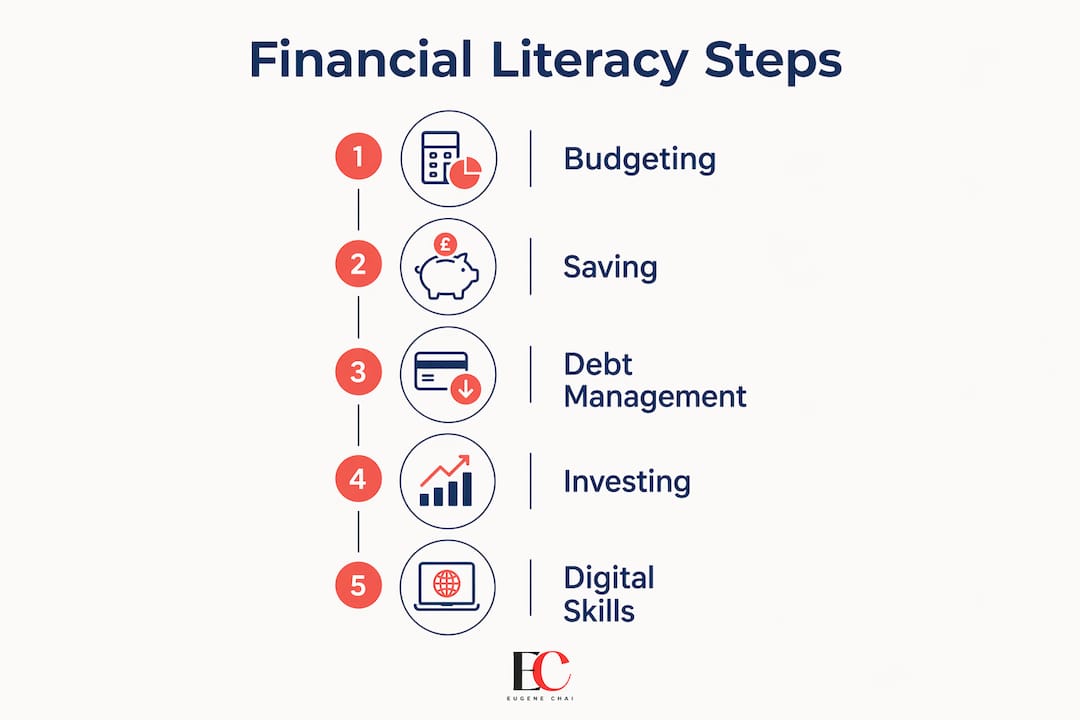
Saving and emergency funds come next. A three-to-six month emergency fund in a high-yield savings account, such as those offered by UOB One or OCBC 360, protects you from unexpected job loss or medical costs. Without this buffer, any financial shock forces you into debt.
Debt management means understanding the true cost of borrowing. Credit card interest in Singapore compounds quickly. Personal loans from licensed moneylenders carry high rates. CPF housing loans, by contrast, are pegged at a lower rate and offer more predictable repayments. Knowing the difference changes how you borrow.
Investing basics are within reach for beginners. CPF Investment Scheme accounts, Regular Savings Plans through DBS, OCBC, or POSB, and unit trusts listed on platforms like Endowus or Syfe give Singaporeans accessible entry points. You do not need a large sum to start. Investing for beginners covers these options in practical detail.
Digital financial literacy is now non-negotiable. Digital literacy is crucial to identify scams and manage online banking securely, complementing traditional financial knowledge. Recognising phishing emails, verifying investment platforms on the MAS register, and using two-factor authentication are all part of being financially literate today.
Pro Tip: Set up a free MAS Investor Alert List check before committing money to any investment platform. It takes under two minutes and protects you from unregulated schemes.
Financial literacy vs financial capability: what is the real difference?
Understanding financial concepts and actually applying them are two different things. Financial capability is defined as the practical ability to access and use financial services effectively, not just knowing what they are. You can read every article about CPF top-ups and still never act on it. That gap between knowledge and action is where most people struggle.
Most financial failures arise from emotional biases like impulsive spending rather than a lack of academic knowledge. Knowing that you should not spend $200 on a Saturday night out does not automatically stop you from doing it. Behaviour, habit, and consistency matter more than theoretical understanding.
Building financial capability requires four practical steps:
- Set a written financial goal. A vague intention to “save more” does not work. A specific target, such as saving $10,000 for an emergency fund by december 2026, gives you a measurable outcome. Start with setting financial goals early to build this habit.
- Automate your savings. Transfer a fixed amount to a separate savings account on the day your salary arrives. Removing the decision removes the temptation.
- Review your finances monthly. A 30-minute monthly review of your spending, savings balance, and investment performance builds the habit of active money management.
- Practise digital security. Discerning genuine investment platforms from scams is a critical skill. Check every platform against the MAS register before transferring funds.
Financial literacy is more about behavioural change and lifelong habit-building than complex mathematical knowledge. That is genuinely reassuring. You do not need a finance degree. You need consistent, small actions repeated over time.
Pro Tip: Treat your monthly budget review like a standing appointment. Block 30 minutes in your calendar at the end of each month. Consistency builds the habit faster than motivation alone.
How to improve financial literacy as a young adult in Singapore
Building financial knowledge is a gradual process. Building financial literacy is a lifelong, iterative process requiring habit formation and adjustment, not an overnight skill acquisition. The good news is that the resources available to Singaporeans today are better than ever.
Here are the most effective ways to start:
- Read local personal finance content. Sites like Seedly, DollarsAndSense, and MoneySmart publish Singapore-specific guides on CPF, HDB, and investing. Eugenechaitf covers practical topics from budgeting for young adults to saving strategies tailored for local readers.
- Use government resources. MoneySense, Singapore’s national financial education programme, offers free guides on budgeting, insurance, and retirement planning. CPF Board’s website explains every account type clearly.
- Talk about money openly. Financial literacy is best viewed as a language of money, practised through open conversations that dismantle socio-economic and knowledge gaps. Discussing money with friends, colleagues, or family normalises the topic and accelerates learning.
- Apply what you learn immediately. Reading about budgeting without creating a budget changes nothing. Apply each concept within a week of learning it.
- Avoid financial scams. Singapore sees a high volume of investment scams targeting young adults. Always verify schemes through the MAS register and treat guaranteed-return promises as a red flag.
| Resource | Best for |
|---|---|
| MoneySense (moneysense.gov.sg) | Foundational financial education, free and Singapore-specific |
| CPF Board website | Understanding CPF OA, SA, MA, RA, and CPF LIFE |
| Seedly (seedly.sg) | Community reviews, product comparisons, personal finance Q&A |
| Eugenechaitf | Practical guides on budgeting, saving, and investing for Singaporeans |
| MAS Investor Alert List | Verifying investment platforms before committing funds |
Students with higher financial literacy are significantly more likely to save money and compare prices before purchases. That behaviour compounds over years into meaningfully better financial outcomes.
Key takeaways
Financial literacy is the single most important skill young Singaporeans can build outside the classroom, and it requires consistent practice, not just reading.
| Point | Details |
|---|---|
| Financial literacy defined | The ability to understand and apply budgeting, saving, investing, and debt management skills. |
| Low global literacy rates | Only 33% of adults worldwide are financially literate, highlighting a widespread gap. |
| Core skills to master | Budgeting, saving, debt management, investing basics, and digital financial security. |
| Capability over knowledge | Applying financial knowledge through consistent habits matters more than theoretical understanding. |
| Singapore-specific resources | MoneySense, CPF Board, Seedly, and Eugenechaitf offer practical, locally relevant guidance. |
Why I believe financial literacy should be taught before anything else
I did not learn about CPF, budgeting, or investing in school. Nobody did. When I started working, I had no idea what my CPF Ordinary Account earned, what MediShield Life actually covered, or why putting money into a savings account with 0.05% interest was essentially losing ground to inflation. That ignorance cost me years of compounding growth I will never recover.
The uncomfortable truth is that Singapore’s education system produces graduates who can solve calculus problems but cannot read a payslip. That is a serious mismatch. The financial decisions you face in your 20s, whether to rent or buy, how much to invest, whether to top up your CPF Special Account, have consequences that follow you for decades.
What I have found, both personally and from writing about personal finance, is that most people are not bad with money because they are careless. They are bad with money because nobody ever taught them the basics. Once you understand how compound interest works, why an emergency fund matters, and how to read a basic investment prospectus, the decisions become far less intimidating.
You do not need to become a financial expert. You need enough knowledge to ask the right questions and avoid the most common mistakes. Start small, stay consistent, and use the resources available to you. The knowledge gap is real, but it is entirely closeable.
— Eugene
Start building your financial knowledge with Eugenechaitf
Eugenechaitf is a Singapore-focused personal finance blog built for exactly this situation. Whether you are creating your first budget, figuring out how much to save, or ready to start investing, the guides here are written with the local context in mind. Explore budgeting tips for Singaporeans to get your spending under control, or head to the investing for beginners guide to understand your options. Every article is grounded in real experience and designed to give you a clear, practical next step. Visit Eugenechaitf to explore the full range of personal finance content written for Singaporeans, by a Singaporean.
FAQ
What is financial literacy in simple terms?
Financial literacy is the ability to understand and manage your money effectively. It covers budgeting, saving, investing, and avoiding debt.
Why is financial literacy not taught in Singapore schools?
Singapore’s curriculum focuses on academic subjects, leaving personal finance largely uncovered. Organisations like MoneySense and CPF Board fill part of this gap through public education programmes.
How do I start improving my financial literacy as a beginner?
Start by creating a simple monthly budget and reading one Singapore-focused personal finance resource each week. Applying what you learn immediately, rather than waiting until you feel ready, builds knowledge fastest.
What is the difference between financial literacy and financial capability?
Financial literacy is knowing financial concepts. Financial capability is the practical ability to act on that knowledge consistently, including accessing and using financial products like CPF accounts or savings plans.
How does poor financial literacy affect Singaporeans specifically?
Low financial literacy leads to under-utilised CPF accounts, high credit card debt, inadequate emergency savings, and vulnerability to investment scams. These outcomes are avoidable with foundational financial education.
Disclaimer: Informational only. Consult an MAS-licensed advisor before investing.






Leave a Reply