



TL;DR:
- Starting to invest early allows your money to benefit from compound growth over time. Delaying investing can significantly reduce future wealth, requiring higher contributions to catch up. Consistent, modest investments and leveraging Singapore’s CPF and SRS schemes help build wealth efficiently from a young age.
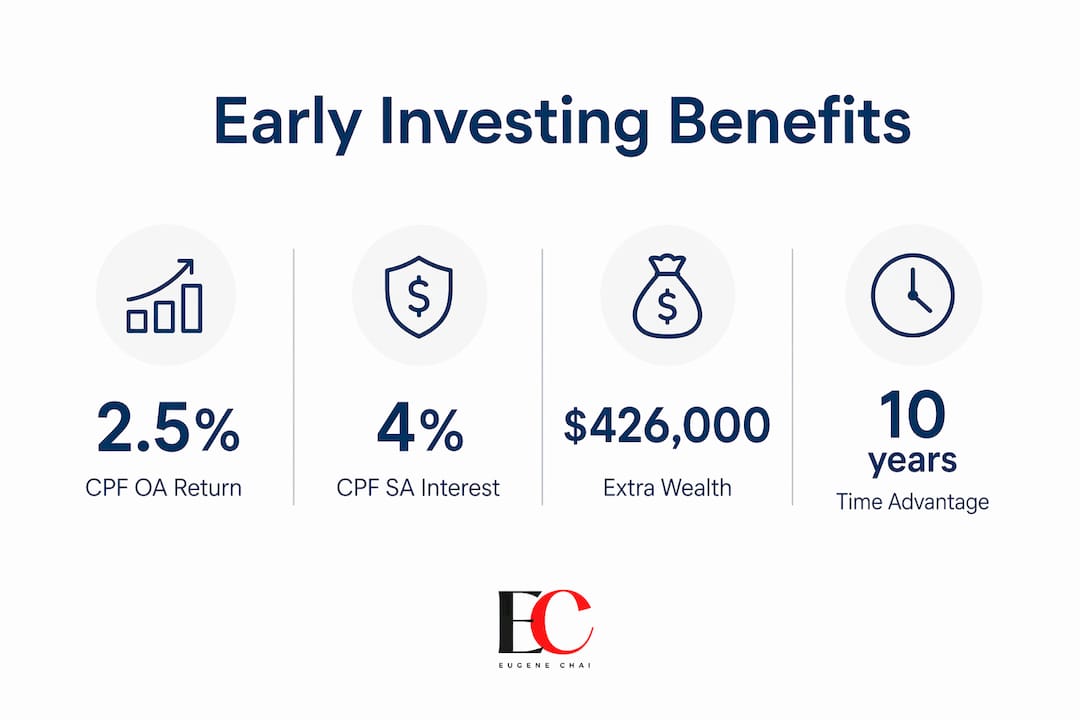
Early investing is defined as putting money to work in financial assets as soon as you begin earning, rather than waiting until you feel “ready.” Starting to invest at age 25 instead of 35 results in an extra $426,000 by age 65, purely because of compound interest and time advantage. That single figure explains why start investing early is the most important financial decision a young Singaporean can make. The principle is not complex: time multiplies money, and every year you delay costs you more than you realise. This guide covers how compounding works, what the specific benefits of early investing are for young adults, and how to begin practically within Singapore’s financial system today.
Why start investing early: the compound interest effect
Compound interest is the process by which your investment returns generate their own returns over time. Think of it as a snowball rolling downhill. A small ball gains size slowly at first, then accelerates as it picks up more snow with each rotation. The same logic applies to your portfolio.
Early small contributions outweigh later large contributions because time, not income, is the critical ingredient. A 25-year-old who invests $5,000 annually will accumulate dramatically more than a 35-year-old who starts the same habit, even if both stop at the same age. The 10-year head start means the early investor’s money compounds through an additional decade of market growth.
The table below shows how the same annual contribution grows differently depending on when you start, assuming a consistent annual return.
| Starting age | Annual contribution | Approximate balance at 65 |
|---|---|---|
| 25 | $5,000 | Significantly higher |
| 35 | $5,000 | Substantially lower |
| 35 | ~$10,000 | Roughly equivalent to starting at 25 with $5,000 |
The third row is the uncomfortable truth: a 10-year delay means you need to contribute roughly double annually just to reach the same end balance. That is not a minor inconvenience. It is a fundamental change in how hard you must work to achieve the same outcome.
Singapore’s CPF system adds another layer to this. Your Ordinary Account (OA) earns a guaranteed 2.5% per annum, and your Special Account (SA) earns 4% per annum. These are risk-free, government-backed returns. The Supplementary Retirement Scheme (SRS) goes further, offering tax relief on contributions while allowing your money to grow in a range of investment products. Both schemes reward those who engage with them early.
Pro Tip: Top up your CPF SA voluntarily each year before 31 december to maximise the 4% interest and claim tax relief from IRAS on the same contribution.
What are the specific benefits of starting investments in your 20s?
Young investors hold one advantage that no amount of money can buy later: time. A longer investment horizon means you can afford to ride out market downturns without panic-selling. Volatility that terrifies a 55-year-old is simply noise for a 25-year-old with 40 years ahead.
The benefits of early investing for young adults in Singapore include:
- Higher risk capacity. Younger investors can hold more equities and growth assets because they have time to recover from short-term losses.
- Habit formation. Investing regularly in your 20s builds financial discipline that compounds alongside your portfolio.
- Inflation protection. Cash sitting in a savings account loses purchasing power each year. Invested assets, particularly equities and diversified funds, historically outpace inflation over long periods.
- Employer contributions. Some Singapore employers contribute to CPF beyond the mandatory rate. Capturing every dollar of employer contribution is effectively free money added to your retirement balance.
- Tax efficiency. SRS contributions reduce your chargeable income for IRAS purposes, meaning you pay less tax now while your investments grow.
- Psychological advantage. Investors who start young develop comfort with market fluctuations. They are far less likely to make emotional decisions during downturns.
The importance of early investment also shows up in career flexibility. A well-funded portfolio by your mid-30s gives you genuine options: the ability to take a pay cut for a more fulfilling role, start a business, or take time off without financial catastrophe.
Pro Tip: Even if you can only set aside $100 per month right now, start. The habit and the compounding both begin on day one, not when your salary increases.
How to practically start investing early in Singapore
The most common reason young Singaporeans delay investing is the belief that they need more money, more knowledge, or zero debt before they begin. This belief is expensive. Delaying investing until all debt is cleared can cost you irreplaceable early compounding years. A one-month emergency buffer alongside modest monthly contributions beats waiting years to build a perfect financial cushion.

CPF and SRS: your tax-advantaged foundation
Your CPF OA and SA are already working for you through mandatory employer and employee contributions. The next step is to use them more actively. You can invest your CPF OA balance (above the first $20,000) in approved unit trusts, ETFs, and Singapore Government Securities through the CPF Investment Scheme (CPFIS). Your SA earns 4% guaranteed, so voluntary top-ups there are often the lowest-risk, highest-certainty move available.
SRS is the second pillar. Contributions to your SRS account reduce your taxable income dollar-for-dollar, up to the annual cap for Singapore citizens and PRs. You can invest SRS funds in stocks, ETFs, unit trusts, and insurance products. The tax saving alone makes SRS contributions worth considering even before you factor in investment returns.
Beginner-friendly investment vehicles in Singapore
| Vehicle | Risk level | Minimum to start | Key benefit |
|---|---|---|---|
| CPF SA top-up | Very low | $1 | 4% guaranteed return + tax relief |
| SRS account | Low to medium | $1 | Tax deduction on contributions |
| Broad market ETFs | Medium | ~$100–$300 | Low fees, diversification |
| Regular savings plans | Medium | $100/month | Automated, disciplined investing |
| Singapore Savings Bonds | Very low | $500 | Capital guaranteed, flexible |
Broad market index funds and ETFs offer diversified exposure with low expense ratios, making them ideal for beginners who do not want to pick individual stocks. The key is low cost and broad exposure, not complexity.
Automate your investments immediately after payday. Set up a standing instruction from your bank account to your brokerage or regular savings plan on the same day your salary arrives. This removes the temptation to spend first and invest what remains.
If you are a young professional building your financial foundation, the guide on financial goals in your 20s at Eugenechaitf covers how to sequence your priorities across CPF, SRS, and market investments in a structured way.
What strategies help maximise early investment growth?
The most effective strategy for young investors is dollar-cost averaging (DCA). DCA means investing a fixed amount at regular intervals, regardless of market conditions. Dollar-cost averaging reduces the risk of investing a lump sum at a market peak by spreading purchases across different price points. When prices fall, your fixed contribution buys more units. When prices rise, you hold more units that are now worth more.
The strategies that consistently produce results for early investors include:
- Invest regularly, not perfectly. Missing the best market days over decades significantly harms returns. Staying invested through automated contributions captures growth that market-timers miss.
- Keep costs low. Choose funds with low expense ratios. A 1% annual fee difference compounds into a significant drag on returns over 30 years.
- Increase contributions with income. Each time your salary rises, direct a portion of the increase into your investments before lifestyle inflation absorbs it.
- Diversify broadly. Spread across asset classes and geographies. A Singapore-only portfolio concentrates risk unnecessarily when global ETFs are accessible and affordable.
- Do not wait for the perfect moment. Automating monthly transfers immediately after payday is more effective than any attempt to time the market.
Young investors who are also building their skills can consider using SkillsFuture Credit to fund financial literacy courses, which strengthens both earning capacity and investment knowledge simultaneously.
The single biggest risk for a young investor is inaction. A diversified portfolio of low-cost index funds, built through consistent monthly contributions, outperforms the vast majority of active strategies over a 20-year period. The advantages of starting investments young are not theoretical. They are mathematical certainties given enough time.
Key takeaways
Starting to invest early in Singapore is the single most effective way to build lasting wealth, because compound interest rewards time above all else.
| Point | Details |
|---|---|
| Time beats income | Starting at 25 instead of 35 can produce $426,000 more by 65 on the same annual contribution. |
| CPF and SRS first | Use CPF SA top-ups and SRS contributions for guaranteed returns and immediate tax relief from IRAS. |
| Automate contributions | Set up a standing instruction post-payday to remove behavioural bias and stay consistently invested. |
| Dollar-cost averaging works | Regular fixed contributions reduce timing risk and keep you invested through market fluctuations. |
| Start small, start now | A one-month emergency buffer alongside modest monthly investments beats waiting for perfect conditions. |
Why I believe the biggest investing mistake is waiting
I have spoken with many young Singaporeans who tell me they plan to start investing “once things settle down.” Once the student loan is cleared. Once they get a promotion. Once the market dips. I understand the logic, but I have watched it cost people dearly.
The young adults I have seen build genuine financial security share one trait: they started before they felt ready. They began with $100 a month into a regular savings plan or a CPF SA top-up. They did not wait for a windfall or a perfect market entry point. They simply started.
The fear of getting it wrong is real. But the cost of inaction is far greater than the cost of an imperfect first investment. A low-cost, broadly diversified ETF bought today and held for 30 years will almost certainly outperform cash sitting in a savings account, regardless of when in the market cycle you bought it.
My honest view is this: the investing for beginners guide at Eugenechaitf exists precisely because formal education in Singapore does not teach you this. Schools teach you to earn. They do not teach you to make your earnings work for you. That gap is where most young adults lose years of compounding they can never recover.
Start with what you have. Increase as you earn more. Stay consistent. That is the entire strategy.
— Eugene
Personal finance resources at Eugenechaitf
Building an early investing habit is straightforward when you have the right guidance for Singapore’s specific financial system.
Eugenechaitf covers the full picture: from CPF strategies and SRS contributions to beginner ETF portfolios and budgeting frameworks built for young Singaporeans. Eugene Chai Teng Fong’s investment tips and strategies page is a practical starting point for anyone who wants to move from knowing they should invest to actually doing it. For a broader view of personal finance in Singapore, the Eugenechaitf home brings together guides on saving, budgeting, and investing in one place. The resources are free, locally relevant, and written from real experience.
FAQ
Why start investing early rather than later?
Starting early gives your money more time to compound, meaning returns generate their own returns over decades. A 10-year delay requires roughly double the annual contribution to reach the same retirement balance.
How early should you start investing in Singapore?
The best time to start is as soon as you receive your first regular income. Even $100 per month into a CPF SA top-up or a regular savings plan begins compounding immediately and builds the habit of consistent investing.
What is the best first investment for a young Singaporean?
A CPF SA voluntary top-up is the lowest-risk starting point, offering a 4% guaranteed return and tax relief from IRAS. Broad market ETFs through a regular savings plan are the next step for those comfortable with moderate market exposure.
Can I invest while still repaying debt or building savings?
Yes. Maintaining a small emergency buffer while making modest monthly investments is mathematically superior to waiting until all debt is cleared, because early compounding years cannot be recovered.
What is dollar-cost averaging and why does it matter?
Dollar-cost averaging means investing a fixed amount at regular intervals regardless of market conditions. It reduces the risk of poor timing and keeps you consistently invested to capture long-term market growth.
Disclaimer: Informational only. Consult an MAS-licensed advisor before investing.






Leave a Reply