


TL;DR:
- A valid will in Singapore follows strict formal requirements, including being written, signed, and witnessed properly. CPF savings and jointly owned property are outside the will and require separate nominations or legal considerations. Regularly reviewing and coordinating wills, CPF nominations, and asset ownership protects your estate plan and prevents costly disputes.
A will is a legally binding document that dictates how your estate is distributed and who manages that process after your death. In Singapore, the role of wills in estate planning is governed by the Wills Act 1838, which sets out the formal requirements every testator must satisfy. Without a valid will, the Intestate Succession Act 1967 takes over, distributing your assets according to a fixed statutory formula that may bear no resemblance to your actual wishes. Understanding how wills work alongside CPF nominations, joint ownership, and the probate process is the foundation of sound Singapore estate planning.
What are the legal requirements for a valid will in Singapore?

A valid will in Singapore must meet strict formal criteria under the Wills Act 1838. Failure to meet any single requirement renders the will invalid, and intestacy rules then apply automatically. That outcome can leave your family in a difficult position, especially if your estate is complex.
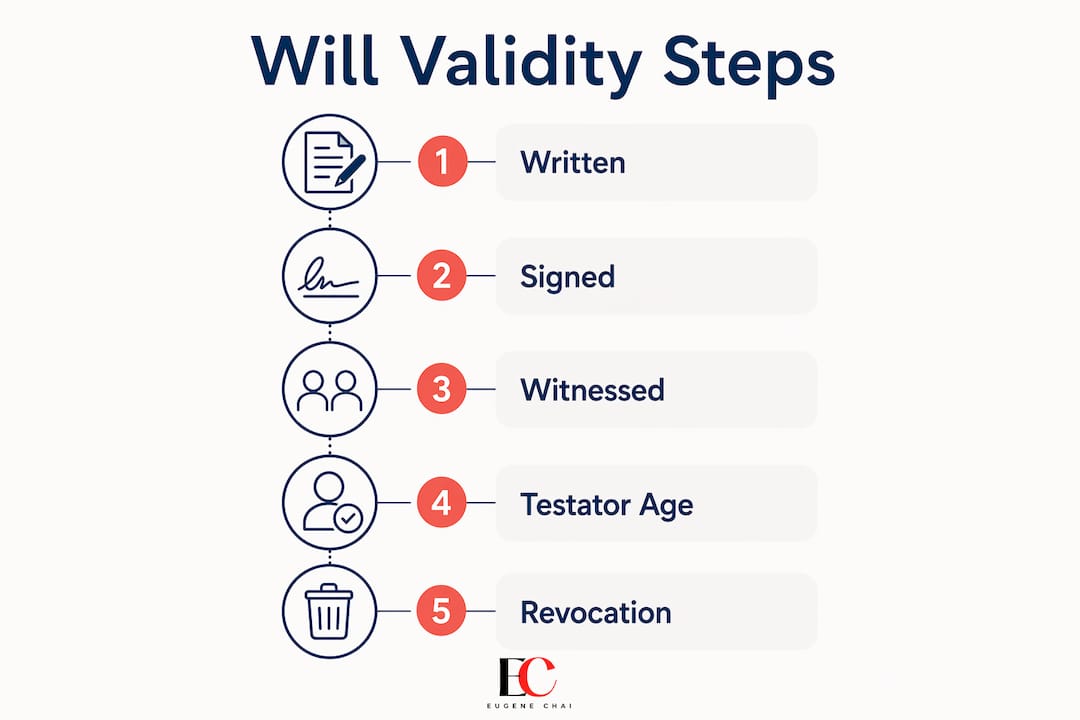
The core requirements are straightforward:
- In writing. The will must be a written document. Oral wills are not recognised.
- Testator age. You must be at least 21 years old to make a valid will in Singapore.
- Signed at the foot. The testator must sign at the bottom of the will in the presence of two witnesses.
- Two independent witnesses. Both witnesses must sign the will in the testator’s presence.
- Witnesses cannot benefit. A witness who is also a beneficiary, or the spouse of a beneficiary, loses their entitlement under the will. The will itself remains valid, but that gift fails.
One lesser-known provision is that if the testator physically cannot sign, another person may sign on their behalf, provided it is done in the testator’s presence and at their direction. This maintains will validity under the Act.
Pro Tip: Never ask a family member who stands to inherit to witness your signature. Even if they are your most trusted person, their gift under the will is voided the moment they sign as a witness.
The table below summarises the validity checklist at a glance.
| Requirement | Detail |
|---|---|
| Form | Must be in writing |
| Testator age | Minimum 21 years old |
| Signature | Signed at the foot by the testator |
| Witnesses | Two or more independent witnesses who sign in the testator’s presence |
| Witness eligibility | Cannot be a beneficiary or spouse of a beneficiary |
| Alternative signing | A third party may sign if the testator is physically unable to do so |
How does a will work alongside CPF nominations in Singapore?
The single biggest misconception in Singapore estate planning is that a will covers everything you own. It does not. CPF savings are not governed by wills but by a separate CPF nomination you file directly with the CPF Board. Your will has no authority over your CPF Ordinary Account, Special Account, MediSave Account, or Retirement Account balances.
If you die without a CPF nomination, the CPF Board transfers your savings to the Public Trustee, who then distributes them according to intestacy rules. That process takes time and adds cost. A valid CPF nomination bypasses this entirely and pays out directly to your nominated beneficiaries.
The same logic applies to jointly owned property. Assets held under joint tenancy pass automatically to the surviving owner by the right of survivorship. Jointly owned properties fall outside normal will provisions and require separate legal consideration. Your will cannot override that outcome.
Key points to align your estate plan:
- File a CPF nomination and review it after major life events such as marriage, divorce, or the birth of a child.
- Confirm whether your property is held under joint tenancy or tenancy in common. Only tenancy in common shares can be directed by a will.
- Coordinate the will and CPF nominations so that both reflect the same overall distribution intent.
Pro Tip: Treat your will and your CPF nomination as two parts of one plan. Review both documents at the same time, every three to five years, or after any significant life change.
What roles do executors play and how does probate work?
An executor is the person you name in your will to carry out your instructions after death. The executor’s authority is not automatic. They must first apply to the Family Justice Courts for a Grant of Probate, which is the court order that formally recognises their legal power to administer the estate.
Once the Grant of Probate is issued, the executor’s responsibilities follow a clear sequence:
- Collect and value assets. The executor identifies all assets covered by the will, including bank accounts, investments, and property held under tenancy in common.
- Pay debts and expenses. All outstanding liabilities, funeral costs, and administration fees must be settled before any distribution to beneficiaries.
- Distribute the estate. Only after debts are cleared does the executor transfer assets to beneficiaries as directed by the will.
- Handle statutory compliance. Executors must manage any special legal requirements, including the disposal of residential property where a foreign beneficiary is involved.
On that last point: foreign beneficiary interests in residential property must be disposed of within five years unless specific approval is obtained. Missing this deadline creates legal complications and can delay the entire estate administration.
Pro Tip: Always name at least one alternate executor in your will. If your primary executor has died, lost mental capacity, or simply refuses to act, a backup executor prevents the estate from stalling in court.
Appointing an alternate executor is standard practice among experienced estate lawyers in Singapore. It costs nothing to include and can save your family months of delay.
Key drafting considerations that affect how your will operates
A technically valid will can still cause significant problems if it is poorly drafted. The clauses you include, and those you omit, determine how smoothly your estate is administered. Good drafting practices reduce ambiguity and the risk of family disputes during what is already a difficult time.
The most important clauses to include are:
- Revocation clause. This nullifies all previous wills and codicils. Without it, earlier documents may create conflicting instructions.
- Residuary clause. This catches any assets not specifically mentioned in the will, including assets acquired after the will was written or gifts that lapse because a beneficiary has predeceased you.
- Guardian appointment. If you have minor children, name a guardian and at least one alternate. Courts will consider your nomination, though they are not bound by it.
- Trust clause. For minor or special needs beneficiaries, a trust clause holds assets until the beneficiary reaches a specified age or condition, rather than distributing a lump sum immediately.
- Alternate beneficiaries. Name a substitute for each gift in case the primary beneficiary dies before you do.
Precise drafting of residuary clauses and guardian appointments greatly reduces probate disputes in Singapore practice. The table below compares common will clauses and their functions.
| Clause | Function |
|---|---|
| Revocation clause | Cancels all prior wills and codicils |
| Residuary clause | Distributes remaining assets not otherwise covered |
| Executor appointment | Names the person authorised to administer the estate |
| Guardian appointment | Nominates a carer for minor children |
| Trust clause | Holds assets for minors or special needs beneficiaries |
| Alternate beneficiary | Provides a substitute if the primary beneficiary predeceases you |
A comprehensive asset and liability schedule attached to the will also helps. It gives your executor a clear starting point and reduces the time spent locating accounts and property titles.
Key takeaways
A will is the legal foundation of Singapore estate planning, but it must work in coordination with CPF nominations and an understanding of joint ownership to fully protect your wishes.
| Point | Details |
|---|---|
| Wills Act 1838 governs validity | A will must be written, signed by a testator aged 21 or over, and witnessed by two independent non-beneficiaries. |
| CPF sits outside your will | File a separate CPF nomination or the Public Trustee distributes your savings under intestacy rules. |
| Grant of Probate is required | Executors need a court-issued Grant of Probate before they can legally administer your estate. |
| Drafting quality matters | Include revocation, residuary, and guardian clauses to prevent disputes and cover all assets. |
| Appoint alternate executors | A backup executor prevents administration delays if your primary executor cannot act. |
My honest view on wills after years of financial planning in Singapore
I have spoken with many Singaporeans who believe their will covers everything they own. That assumption is the most costly mistake I see in estate planning. CPF balances, jointly owned HDB flats, and insurance policies with named nominees all sit outside the will entirely. A beautifully drafted will can still leave a family in difficulty if those other pieces are not aligned.
The second issue I encounter is ambiguity in executor appointments. People name a single executor, often a spouse, without considering what happens if that person dies first or loses mental capacity. The estate then enters a legal process to appoint an administrator, which takes time and money. Naming an alternate executor costs nothing and solves this problem completely.
My practical advice is to treat will drafting as one part of a broader legacy planning exercise. Review your CPF nomination, confirm your property ownership structure, and check your insurance beneficiary designations at the same time. Do this every few years, not just once.
For complex estates involving business interests, foreign assets, or special needs dependants, consulting a qualified wills lawyer in Singapore is the right call. The cost of professional advice is small compared to the cost of a disputed or invalid estate. Start early, be specific, and update regularly.
— Eugene
Planning your estate with Eugenechaitf
Estate planning is one of the most practical steps you can take for the people you care about. A well-drafted will, a current CPF nomination, and a clear understanding of your asset structure give your family certainty at the hardest possible time.

Eugenechaitf covers the full picture of personal finance for Singaporeans, from financial security planning to investment strategy and legacy building. If you want practical, Singapore-specific guidance on estate planning and broader wealth management, the Eugenechaitf financial planning hub is a good place to start. The resources there are written for real Singaporeans navigating real financial decisions, without the jargon.
FAQ
What is the role of wills in Singapore estate planning?
A will legally directs how your estate is distributed and names executors to manage that process. Without one, the Intestate Succession Act 1967 determines distribution, which may not reflect your wishes.
Does a will cover CPF savings in Singapore?
No. CPF savings are distributed via a separate CPF nomination, not by your will. If no nomination exists, the Public Trustee distributes the funds under intestacy rules.
What makes a will legally valid in Singapore?
A valid will must be in writing, signed at the foot by a testator aged at least 21, and witnessed by two people who are not beneficiaries or spouses of beneficiaries.
What is a Grant of Probate and why does it matter?
A Grant of Probate is a court order that gives an executor the legal authority to administer an estate. Without it, executors cannot access bank accounts, transfer property, or pay debts on behalf of the estate.
How often should I update my will in Singapore?
Review your will after every major life event, including marriage, divorce, the birth of a child, or a significant change in assets. Align your CPF nomination and insurance beneficiary designations at the same time.
Disclaimer: Informational only. Consult an MAS-licensed advisor before making financial or legal decisions.






Leave a Reply