



TL;DR:
- Robo-advisor investing in Singapore involves automated portfolio management based on your risk profile.
- Choosing a MAS-licensed platform, preparing the right documents, and funding with sufficient capital are essential steps.
Robo-advisor investing is defined as automated portfolio management where an algorithm builds and rebalances a diversified portfolio on your behalf, based on your risk profile. To start robo-advisor investing in Singapore, you select a Monetary Authority of Singapore (MAS) licensed platform, complete a digital risk questionnaire, fund your account, and let the system handle the rest. Platforms charge management fees ranging from 0.20% to 0.80% annually, making them far more accessible than traditional fund managers. For young Singaporeans looking to put their CPF Ordinary Account (OA) savings or monthly income to work without spending hours on research, robo-advisors offer a practical and cost-effective entry point into wealth building.
What do you need before starting robo-advisor investing in Singapore?

Preparation makes the sign-up process smooth and avoids delays. Having the right documents and accounts ready before you open a robo-advisor account saves time and prevents frustration.
What you need to have ready:
- Singpass and MyInfo access. All MAS-licensed platforms use Singpass for digital identity verification. MyInfo auto-fills your personal details, cutting sign-up time significantly.
- A local bank account. You need a DBS, OCBC, or UOB account to fund your portfolio via FAST transfer. Most platforms credit funds within one to three business days.
- CPF or SRS account details (if applicable). If you plan to invest CPF OA or Supplementary Retirement Scheme (SRS) funds, confirm your account numbers and check which platforms support these options.
- A realistic starting budget. While some platforms accept no minimum deposit, starting with S$1,000–S$5,000 gives the algorithm enough capital to diversify and rebalance efficiently. Smaller amounts limit how well the portfolio can spread risk.
- An understanding of your risk tolerance. Every platform asks you to complete a risk questionnaire before investing. Think honestly about how you would react to a 20% portfolio drop before you answer.
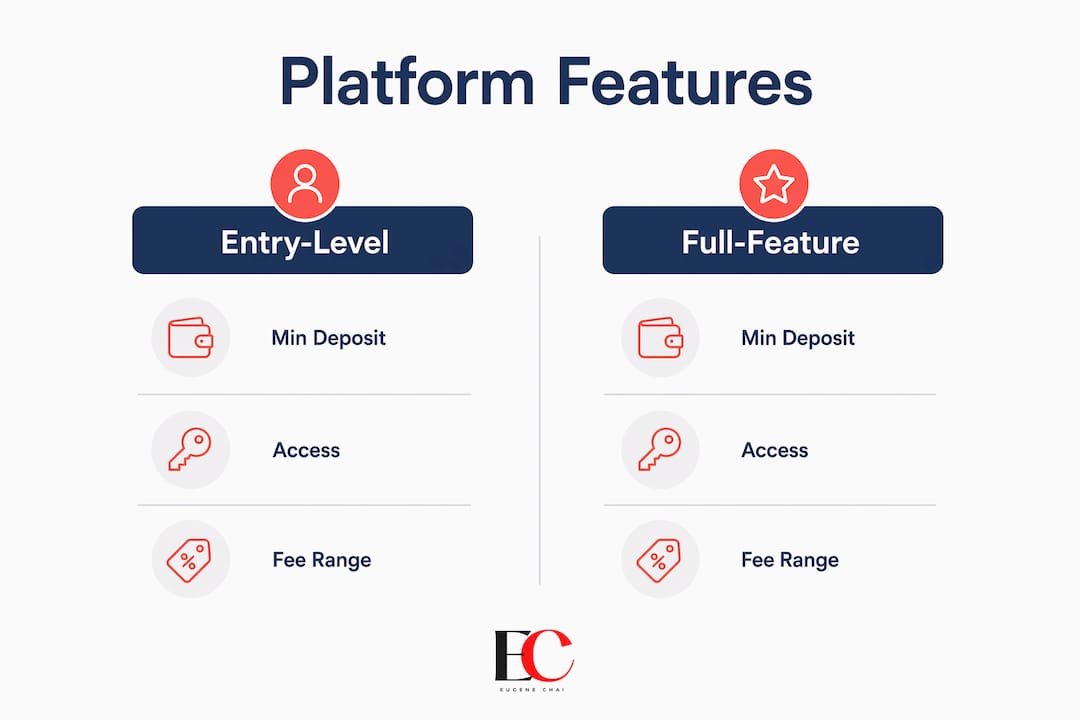
Platform access comparison by feature:
| Feature | Entry-level platforms | Full-feature platforms |
|---|---|---|
| Minimum deposit | None | None to S$1,000 |
| CPF OA investment | Not available | Available on select platforms |
| SRS investment | Available | Available |
| Management fee range | 0.20%–0.65% | 0.20%–0.80% |
| Underlying ETF costs | Separate expense ratio | Separate expense ratio |
Pro Tip: Before you open any account, check whether the platform is listed on the MAS Financial Institutions Directory. This takes under two minutes and confirms the platform is properly regulated.
How do you open and fund a robo-advisor account step by step?
Account set-up is digital and typically takes 10–20 minutes from start to finish. The process is paperless, and most platforms walk you through each step clearly.
- Download the app or visit the platform website. Most platforms operate through mobile apps. Create an account using your email address and set a strong password.
- Verify your identity with Singpass. Log in via Singpass and authorise MyInfo to share your NRIC details, address, and tax residency status. This replaces manual form-filling entirely.
- Complete the risk assessment questionnaire. Answer questions about your investment horizon, income stability, and reaction to market drops. The platform uses your answers to assign a recommended portfolio. Be honest rather than optimistic.
- Review and accept your recommended portfolio. Check the asset allocation before confirming. Look at the geographic spread, equity-to-bond ratio, and the underlying funds used. You can usually adjust the risk level up or down by one or two notches.
- Link your bank account. Add your DBS, OCBC, or UOB account for FAST transfers. Some platforms also allow PayNow.
- Fund your account. Transfer your chosen amount. Funds typically appear in your investment account within one to three business days, after which the platform executes your initial trades automatically.
- Set up a recurring contribution (optional but recommended). Automating a monthly transfer, even as little as $100, activates dollar-cost averaging and removes the temptation to time the market.
After funding, the platform allocates your capital across its chosen ETFs and begins automatic rebalancing. You do not need to take any further action to maintain the portfolio.
Pro Tip: If you plan to invest CPF OA funds, confirm the platform’s CPF Investment Scheme (CPFIS) approval before signing up. Not all platforms are approved for CPF OA investments, and the approval status can change.
How do you choose the right robo-advisor platform for your goals?
Choosing a platform is not simply about picking the one with the lowest fee. The right choice depends on your funding source, investment goals, and how much control you want over your portfolio.
MAS licensing is non-negotiable. Every platform you consider must hold a Capital Markets Services (CMS) licence from MAS. This protects your assets and ensures the platform meets regulatory standards for fund management.
CPF and SRS access varies significantly. The three main robo-advisors in Singapore differ in CPF access and minimum requirements, with fees from 0.20% to 0.80%. Only one major platform currently allows investment of both CPF OA and CPF Special Account (SA) funds. If CPF investing is your priority, this distinction matters enormously. SRS investing is more widely supported across platforms.
Understand the full cost, not just the headline fee. Total annual costs include both the platform management fee and the underlying ETF expense ratios. A platform charging 0.40% in management fees may hold ETFs with expense ratios of 0.10%–0.25% on top. That brings your true annual cost closer to 0.50%–0.65%. Always add both figures together before comparing platforms.
Evaluate the portfolio construction philosophy. Investors should check that the platform’s investment framework aligns with their risk preferences, asset allocations, and geographic exposure. Some platforms use a passive, market-cap-weighted approach. Others tilt toward factors like value or quality. Neither is universally better, but you should understand what you own and why.
Key criteria to evaluate when comparing platforms:
- Geographic diversification across US, developed markets, and emerging markets
- Rebalancing frequency and methodology (threshold-based vs. calendar-based)
- Dividend reinvestment vs. payout options
- Access to institutional-grade funds not available to retail investors directly
- Quality of the mobile app and portfolio reporting tools
- Customer support responsiveness
For readers who want to weigh robo-advisors against self-directed investing, the robo-advisor vs. DIY ETF guide on Eugenechaitf covers the trade-offs in detail.
What mistakes do beginners make with robo-advisors in Singapore?
Most early mistakes with robo-advisors come from misunderstanding what these platforms are designed to do. Avoiding them from the start protects both your capital and your confidence.
- Treating robo-advisors as trading platforms. New investors often mistake robo-advisors for active trading tools. They are not. Robo-advisors are built for disciplined, automated, long-term investing. Logging in daily to check performance and making reactive changes defeats the purpose entirely.
- Ignoring the expense ratio on top of the management fee. Investors must distinguish between platform management fees and underlying fund expense ratios to understand true investment costs. Many beginners compare only the headline management fee and underestimate what they actually pay each year.
- Starting with too little capital. While no-minimum platforms are convenient, smaller amounts limit diversification and rebalancing effectiveness. A $50 starting balance produces a portfolio that cannot spread risk meaningfully.
- Investing money you may need soon. Robo-advisors are MAS-licensed but should be treated as long-term investment vehicles, not liquidity pools. Liquidating a portfolio early disrupts compounding and may trigger losses if markets are down at the time.
- Never revisiting your risk profile. Life changes. A risk profile set at 22 may be completely wrong at 28 after you have taken on a mortgage or started a family. Review your questionnaire answers at least once a year.
“The biggest risk in robo-advisor investing is not market volatility. It is the investor who panics, withdraws during a downturn, and locks in a loss that the algorithm would have recovered from automatically.”
Pro Tip: Keep at least three to six months of living expenses in a liquid savings account, completely separate from your robo-advisor portfolio. This prevents you from being forced to sell investments at the wrong time.
For a broader look at common investment mistakes in Singapore, Eugenechaitf has a dedicated guide worth reading before you commit capital.
How do you maintain and grow your robo-advisor portfolio over time?
Opening an account is the easy part. Sustained wealth building requires consistent habits and periodic reviews.
- Automate monthly contributions. Set up a recurring FAST transfer to your robo-advisor account each month. Automation prevents emotional decisions during market volatility and activates dollar-cost averaging, which smooths out the impact of market fluctuations over time.
- Review your risk questionnaire annually. Log in once a year and re-answer the risk assessment. If your income, dependants, or financial goals have changed, your portfolio allocation should reflect that.
- Maximise CPF OA and SRS contributions where applicable. If your platform supports CPFIS, directing CPF OA funds into a robo-advisor portfolio can generate returns above the standard 2.5% OA interest rate, depending on market conditions. SRS contributions also reduce your taxable income under IRAS rules, adding a tax efficiency layer to your investing.
- Understand dividend reinvestment vs. payout. Most robo-advisor portfolios reinvest dividends automatically, which accelerates compounding. If you need income, check whether your platform offers a payout option and how frequently distributions occur.
- Use portfolio reports to track progress. Review your quarterly or annual portfolio report to check whether your actual returns align with your expected risk-adjusted return. Do not benchmark against the Straits Times Index alone; compare against the specific asset mix your portfolio holds.
- Plan withdrawals carefully. If you are approaching a goal, such as a house deposit or retirement income, begin shifting to a lower-risk allocation six to twelve months before you need the funds. Withdrawing during a market downturn without a plan can significantly reduce your final payout.
Key takeaways
Robo-advisor investing in Singapore works best when you choose a MAS-licensed platform, understand the full cost structure, fund consistently, and treat the portfolio as a long-term wealth-building tool rather than a short-term savings account.
| Point | Details |
|---|---|
| Prepare before signing up | Have Singpass, a local bank account, and CPF or SRS details ready before starting. |
| Start with enough capital | Aim for S$1,000–S$5,000 to allow effective diversification and rebalancing from day one. |
| Know your true annual cost | Add the management fee and the underlying ETF expense ratio together for the real total cost. |
| Keep emergency funds separate | Maintain three to six months of expenses in cash outside your robo-advisor portfolio at all times. |
| Review your risk profile yearly | Update your questionnaire answers whenever your income, dependants, or financial goals change. |
My experience using robo-advisors as a seasoned investor
I have been investing for many years, and I still use a robo-advisor for part of my portfolio. That might surprise people who assume experienced investors manage everything themselves. The truth is that simplicity has real value, especially for the portions of a portfolio where I want consistent, low-maintenance exposure without the overhead of picking and rebalancing individual ETFs.
My primary use for robo-advisors is CPF OA investing and income generation. Directing CPF OA funds through a CPFIS-approved platform gives those funds a chance to grow beyond the standard 2.5% floor, and the automated rebalancing means I am not constantly monitoring allocation drift. For income, I use a platform that offers dividend payout options, which provides a predictable cash flow without me having to sell units.
What I have learned is that robo-advisors suit beginners precisely because they remove the two biggest obstacles: decision paralysis and emotional trading. The algorithm does not panic when markets fall. It rebalances, reinvests, and keeps the portfolio aligned with your goals. For young Singaporeans just starting out, that discipline is worth more than any individual stock pick.
My honest advice: use a robo-advisor to build your foundation. Once you understand how diversification and rebalancing work in practice, you will be far better equipped to make decisions about more complex investments later.
— Eugene
Build your financial foundation with Eugenechaitf
Starting to invest is only one part of building lasting financial security. A solid budget and a clear savings plan make your investment contributions consistent and sustainable.

Eugenechaitf covers the full picture for young Singaporeans, from beginner investing guides to practical budgeting frameworks that free up money to invest each month. Whether you are setting up your first robo-advisor account or trying to work out how much you can realistically contribute, the personal finance resources on the site are built specifically for the Singaporean context. No generic advice, no US-centric frameworks. Just clear, localised guidance from someone who has been through the same financial decisions you are facing now.
FAQ
What is the minimum amount to start robo-advisor investing in Singapore?
Several platforms accept no minimum deposit, but S$1,000–S$5,000 is the practical starting range for effective diversification and rebalancing. Smaller amounts limit how well the algorithm can spread your risk across asset classes.
Can I use my CPF to invest with a robo-advisor in Singapore?
CPF OA and SA funds can be invested through CPFIS-approved platforms, but not all robo-advisors hold this approval. Check the MAS Financial Institutions Directory and the platform’s own CPF eligibility page before signing up.
How long does it take to set up a robo-advisor account in Singapore?
Account set-up takes 10–20 minutes using Singpass and MyInfo for digital verification. Funds are typically invested within one to three business days after your transfer clears.
Are robo-advisors in Singapore safe and regulated?
All legitimate robo-advisors operating in Singapore must hold a Capital Markets Services licence from MAS. Confirm any platform’s licence status on the MAS Financial Institutions Directory before depositing funds.
What fees should I expect when using a robo-advisor in Singapore?
Management fees range from 0.20% to 0.80% annually, but the true cost also includes the underlying ETF expense ratios. Always add both figures together to understand what you actually pay each year.
Disclaimer: Informational only. Consult an MAS-licensed advisor before investing.






Leave a Reply