



TL;DR:
- Singapore property investment involves purchasing real estate to earn rental income and capital gains within a highly regulated market. Investors face substantial costs such as stamp duties, taxes, and ongoing fees, which significantly reduce net returns; understanding these expenses is essential. Using strategies like long-term buy-hold, upgrading from HDB to private condos, and combining direct property with REITs helps build a balanced portfolio and mitigate risks.
Singapore property investment is the process of purchasing residential or commercial real estate in Singapore to generate rental income and capital appreciation within one of Asia’s most regulated markets. The Urban Redevelopment Authority (URA), Housing and Development Board (HDB), Monetary Authority of Singapore (MAS), and Inland Revenue Authority of Singapore (IRAS) all shape the rules investors must follow. Common property types include HDB flats, Executive Condominiums (ECs), and private condominiums. Understanding the full cost picture, from Buyer’s Stamp Duty (BSD) to Additional Buyer’s Stamp Duty (ABSD), is the starting point for any serious investor. This guide covers everything you need to make a clear-eyed decision in 2026.
What are the main costs and taxes in Singapore property investment?
The true cost of investing in Singapore real estate goes well beyond the purchase price. BSD, ABSD, Seller’s Stamp Duty (SSD), property tax, and ongoing maintenance fees all reduce your net return significantly.

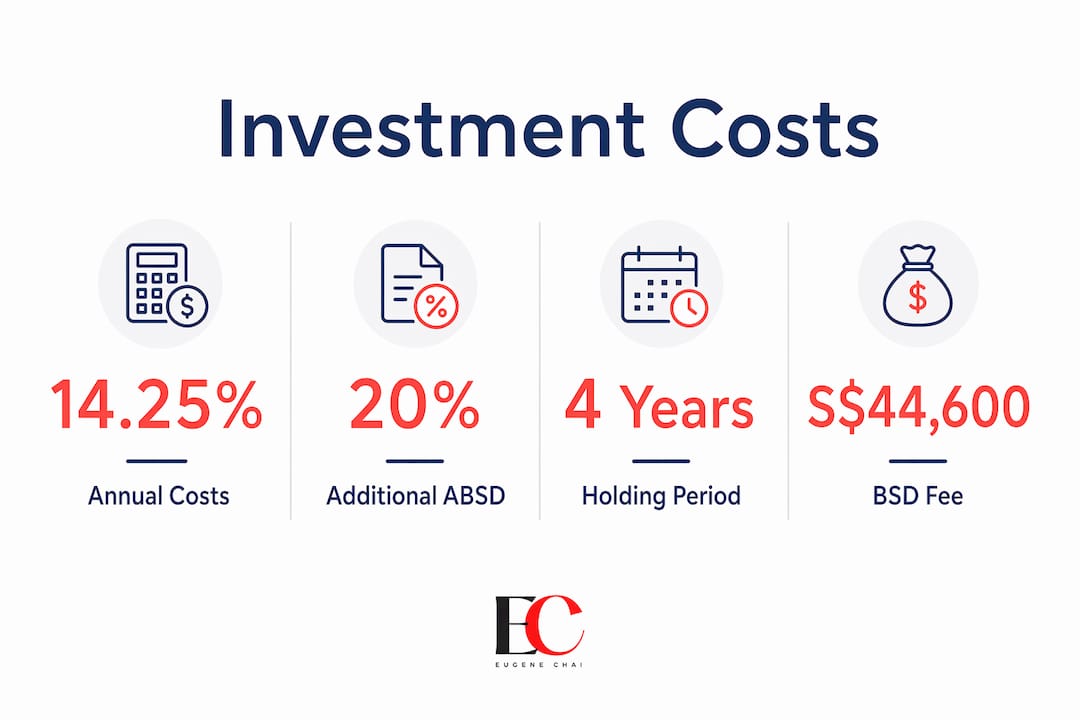
BSD is progressive. On a S$1.5 million property, BSD totals S$44,600, calculated at 1% on the first S$180,000, rising to higher rates on each subsequent band up to 6% above S$3 million. That is a meaningful upfront cost before you even consider ABSD.
ABSD is where costs escalate sharply for investors. Singapore citizens pay 20% ABSD on a second property purchase. On a S$1.5 million condominium, that equals S$300,000 in additional stamp duty alone. Permanent Residents and foreigners face even higher rates.
SSD penalises short holding periods. Selling within two years incurs 12% SSD, which on a S$2 million property equals S$240,000. The minimum holding period to avoid SSD was extended to four years in july 2025, making quick exits extremely costly.
Ongoing costs add further pressure:
- Property tax is based on the Annual Value set by IRAS and applies every year.
- MCST fees (Management Corporation Strata Title) cover building maintenance and can run into hundreds of dollars monthly.
- Vacancy and repair costs are unpredictable but real.
Holding costs including MCST fees, property tax, vacancies, and repairs can reduce rental yields by 10–15% annually. That means a gross yield of 4% could shrink to 3.4% or lower in practice.
Pro Tip: Always calculate your net yield after all holding costs before comparing properties. A higher-priced unit in a prestigious district may deliver a lower net return than a mid-range property with lower fees and stronger rental demand.
How do financing limits and loan regulations affect property investment?
Financing rules in Singapore directly limit how much you can borrow and how much cash you must set aside. Understanding these constraints before you commit is non-negotiable.
- Loan-to-Value (LTV) limits. For a first property with no outstanding loans, the LTV is up to 75% for bank loans, meaning you need at least 25% in cash and CPF. For a second property, the LTV drops to 45%, requiring a 55% downpayment. A third property reduces LTV further to 35%.
- Total Debt Servicing Ratio (TDSR). TDSR caps total monthly debt payments at 55% of gross monthly income. This includes your mortgage, car loan, credit card debt, and any personal loans. A household earning S$10,000 per month can service at most S$5,500 in total monthly debt obligations.
- CPF Ordinary Account (OA) usage. You can use CPF OA funds for downpayments and monthly mortgage repayments on eligible properties. However, CPF usage is capped based on the property’s Valuation Limit and Withdrawal Limit, so cash top-ups are often required.
- Progressive Payment Scheme for new launches. Initial cash outlay is typically 5% for new launches, but a substantial lump sum is due at the Temporary Occupation Permit (TOP) stage. Investors must plan for this liquidity requirement well in advance.
Pro Tip: Before applying for a mortgage, total up every existing debt obligation including your car loan and any outstanding credit card balances. Many investors are surprised to find TDSR already limits their borrowing capacity before they factor in a new property loan.
What strategies can investors use to build a Singapore property portfolio?
The most reliable approach to investing in Singapore real estate is the buy-hold-rent strategy. You purchase a property, hold it through the SSD period, rent it out for steady income, and benefit from long-term capital appreciation. This approach suits the current regulatory environment, where investment horizons have shifted from short-term flipping to medium and long-term holding.
The HDB-to-condo upgrade path
Many Singaporean investors begin with an HDB flat and upgrade to a private condominium after fulfilling the Minimum Occupation Period (MOP) of five years. After MOP, you can sell the HDB flat and use the proceeds as a downpayment on a private property, avoiding ABSD on the first private purchase. This path is one of the most tax-efficient routes available to Singapore citizens.
Executive Condominiums as a stepping stone
ECs are a hybrid between public and private housing. They are subject to HDB eligibility rules initially, privatise after ten years, and become fully accessible to foreigners after that. Buying an EC at launch price and holding through privatisation has historically delivered strong capital gains for eligible buyers.
Decoupling to manage ABSD
Decoupling involves one spouse transferring their share of a jointly owned property to the other, so the first spouse becomes a first-time buyer again for ABSD purposes. This can reduce stamp duty costs significantly. However, decoupling without a genuine ownership change may be flagged by IRAS as tax avoidance, leading to penalties. Always consult a qualified legal adviser before proceeding.
| Strategy | Best suited for | Key benefit |
|---|---|---|
| Buy-hold-rent | Most investors | Steady rental income and capital growth |
| HDB-to-condo upgrade | Singapore citizens post-MOP | ABSD savings on first private purchase |
| EC investment | Eligible first-timers | Launch price discount, privatisation upside |
| Decoupling | Married couples with legal advice | Reduces ABSD on second property |
Pro Tip: Always maintain a liquidity buffer of at least six months of mortgage repayments in cash. Property is illiquid, and unexpected vacancies or repairs can create serious cash flow pressure if you are fully leveraged.
How does investing in Singapore REITs compare with direct property ownership?
Singapore REITs (S-REITs) and direct property ownership both offer exposure to real estate, but they work very differently. Choosing between them depends on your capital, risk appetite, and how hands-on you want to be.
S-REITs typically provide a 4–7% yield and are legally required to distribute at least 90% of their taxable income to unit holders. Distributions are tax-free for individual investors in Singapore. REITs trade on the Singapore Exchange (SGX) daily, so you can buy or sell within minutes. There is no BSD, no ABSD, and no SSD.
Direct property offers leverage. With a 75% LTV bank loan, a S$650,000 condominium requires only around S$162,500 in cash and CPF upfront, amplifying your return on equity if prices rise. However, S-REITs tend to offer higher effective yields of around 6.5% compared to direct property at around 3.5% after costs. Direct ownership also carries management overhead: tenant sourcing, repairs, and regulatory compliance all require your time.
| Factor | S-REITs | Direct property |
|---|---|---|
| Minimum capital | Low (from S$200 per lot) | High (25%+ downpayment) |
| Effective yield | ~6.5% after costs | ~3.5% after costs |
| Liquidity | Daily via SGX | Months to sell |
| Stamp duties | None | BSD, ABSD, SSD apply |
| Leverage | Limited | Up to 75% LTV |
| Management burden | None | Active involvement required |
Most Singapore investors combine direct property and REITs in a core-and-satellite portfolio. Direct property forms the core for capital appreciation and leverage, while REITs provide liquid, income-generating exposure without the stamp duty burden. This approach balances risk and return more effectively than either option alone. For a broader view of how REITs fit alongside other assets, the best investment options for beginners on Eugenechaitf is a useful starting point.
What risks and mistakes should Singapore property investors avoid?
Property investment in Singapore carries real risks, and the regulatory environment in 2026 leaves little room for error. The most common mistakes are avoidable with proper planning.
- Over-leveraging under TDSR. Borrowing to the maximum TDSR limit leaves no buffer for income disruption. IRAS and MAS enforce strict measures around TDSR and ownership transparency. Financial distress from over-leveraging is a real outcome for investors who ignore this.
- Flipping new launches. Flipping strategies became significantly riskier after the SSD holding period was extended to four years in july 2025. Selling before four years triggers substantial penalties that can wipe out any price gain.
- Underestimating holding costs. Many investors focus on gross rental yield and ignore MCST fees, property tax, vacancy periods, and repair bills. These costs reduce net returns materially every year.
- Dubious tax avoidance schemes. Decoupling arrangements that lack genuine ownership transfer are treated as tax evasion by IRAS. Penalties include mandatory reversion of the transaction and financial fines. For guidance on spotting schemes that cross legal lines, the Eugenechaitf guide on avoiding investment scams covers the warning signs clearly.
Pro Tip: Keep cash savings covering at least six months of mortgage repayments plus estimated maintenance costs. This buffer protects you during vacancy periods and prevents forced selling at the wrong time.
Key takeaways
Singapore property investment rewards disciplined, long-term investors who account for all stamp duties, financing limits, and holding costs before committing capital.
| Point | Details |
|---|---|
| Stamp duties are substantial | BSD, ABSD, and SSD can add hundreds of thousands of dollars to your total cost. |
| TDSR caps borrowing at 55% | All debts count toward this limit, so calculate your full debt load before applying for a mortgage. |
| SSD requires a four-year hold | Selling before four years triggers penalties that can eliminate capital gains entirely. |
| REITs offer higher effective yields | S-REITs deliver around 6.5% after costs versus 3.5% for direct property, with full liquidity. |
| Core-and-satellite portfolios work best | Combining direct property and REITs balances leverage, income, and liquidity effectively. |
My honest view on Singapore property in 2026
I have watched the Singapore property market go through multiple cooling measure cycles, and the 2025 SSD extension was the clearest signal yet that regulators are serious about discouraging speculation. The investors I see struggling are those who bought new launches expecting to flip at TOP. The ones doing well are those who bought with a ten-year horizon and treated the property as a long-term income asset.
The ABSD burden on second properties is real and painful. A S$300,000 stamp duty bill on a S$1.5 million condo means you need significant capital appreciation just to break even. That is why I believe REITs deserve more attention from Singaporean investors than they typically receive. The tax-free distributions, zero stamp duties, and daily liquidity make S-REITs a genuinely attractive complement to direct property, not a consolation prize.
My advice is straightforward. Do your sums honestly. Factor in every cost, not just the purchase price. Use the tax-efficient investing checklist on Eugenechaitf to stress-test your numbers. And if you are considering decoupling or any ownership restructuring, speak to a MAS-licensed adviser and a qualified solicitor before signing anything. The regulatory environment in 2026 rewards patience and penalises shortcuts.
— Eugene
Planning your finances around property investment
Property investment is one part of a broader personal finance picture. Getting your budget right before you commit to a mortgage is the foundation everything else rests on.
Eugenechaitf covers the full range of personal finance topics that matter to Singaporean investors, from budgeting strategies that free up capital for downpayments, to guides on investment tips and strategies that help you build a portfolio suited to your goals. Whether you are planning your first property purchase or weighing up REITs alongside direct ownership, the resources on Eugenechaitf give you the practical grounding to move forward with confidence. Consult a MAS-licensed financial adviser for personalised recommendations tailored to your situation.
FAQ
What is the ABSD rate for Singapore citizens buying a second property?
Singapore citizens pay 20% ABSD on a second property purchase. On a S$1.5 million condominium, this equals S$300,000 in additional stamp duty.
How long must I hold a property to avoid Seller’s Stamp Duty?
The minimum holding period is four years, following the extension introduced in july 2025. Selling within two years incurs 12% SSD.
Are S-REIT distributions taxable for individual investors in Singapore?
S-REIT distributions are tax-free for individual investors in Singapore, making them a tax-efficient source of passive income compared to rental income from direct property.
What is the TDSR limit for property loans in Singapore?
TDSR caps total monthly debt repayments at 55% of gross monthly income. All debts, including car loans and credit card balances, count toward this limit.
Can I use my CPF Ordinary Account to buy an investment property?
Yes, CPF OA funds can be used for eligible property purchases, but usage is subject to the Valuation Limit and Withdrawal Limit set by the CPF Board. Cash top-ups are often required beyond these caps.
Disclaimer: Informational only. Consult a MAS-licensed adviser before investing.






Leave a Reply