



TL;DR:
- Setting early financial goals in Singapore allows young adults to benefit from the power of compounding across CPF, housing, and investments. Establishing specific, measurable targets and automating savings are vital for building lasting financial security. Avoid common mistakes by prioritizing emergency funds, securing insurance early, and maintaining a disciplined, structured approach.
Setting financial goals early is the single most powerful step a young adult in Singapore can take to build lasting financial security. The difference between starting at 22 versus 32 is not just a decade of savings. It is the compounding effect of time working in your favour across CPF contributions, HDB down payments, MediShield Life coverage, and investment portfolios. In 2026, with Singapore’s cost of living rising and housing prices remaining high, establishing financial plans early gives you the structure to hit life milestones without scrambling. This guide covers exactly how to set clear objectives, budget your income, automate your progress, and avoid the mistakes that derail most young professionals.
Why you should set financial goals early in your career
The importance of early financial goals comes down to one word: compounding. Starting to invest at 22 with $500 per month grows significantly more by age 65 than starting at 30, even with fewer total contributions. That gap is not a small rounding error. It represents hundreds of thousands of dollars in retirement wealth.

Author and personal finance educator Erin Lowry makes this point directly: time in your 20s and 30s is your single greatest financial asset. Most young professionals undervalue this advantage and delay investing until they feel “ready.” Waiting is the most expensive mistake you can make.
In Singapore, this urgency is amplified by specific financial milestones. CPF contributions begin the moment you start working, and your CPF Special Account (SA) earns up to 5% interest per year. Every year you delay topping up your SA is a year of compounding you cannot recover. The same logic applies to securing an HDB BTO flat, where ballot eligibility and financial readiness must align.
What are realistic financial goals for young adults?
Financial goal setting is the process of defining specific, measurable, and time-bound targets that guide your saving and spending decisions. The industry standard framework is SMART goals: Specific, Measurable, Achievable, Relevant, and Time-bound. “Save more money” is not a goal. “Save $10,000 in my CPF OA for an HDB down payment by December 2027” is a goal.
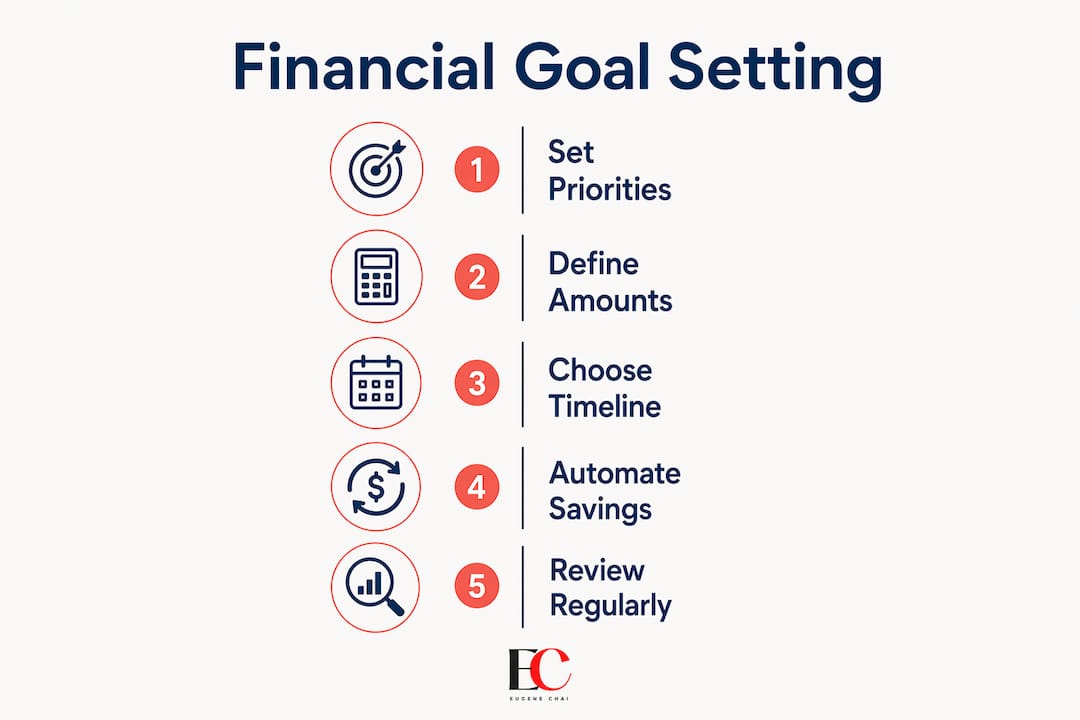
For young adults in Singapore, realistic goals fall into three time horizons:
Short-term goals (0–2 years):
- Build a $3,000–$6,000 emergency fund covering 3–6 months of essential expenses
- Pay off any student loans or study loans from banks like DBS or OCBC
- Set up MediShield Life top-ups or an Integrated Shield Plan (IP) with a private insurer
Medium-term goals (2–5 years):
- Accumulate enough in your CPF OA for an HDB BTO down payment (typically 10–20% of flat price)
- Build a Supplementary Retirement Scheme (SRS) account for tax relief
- Start a regular savings plan with brokers like Syfe, StashAway, or through POSB Invest-Saver
Long-term goals (5+ years):
- Maximise CPF SA contributions to hit the Full Retirement Sum (FRS) ahead of schedule
- Build a diversified investment portfolio through low-cost index funds or ETFs
- Secure life and critical illness insurance early to lock in lower premiums before health conditions develop
The specificity of these goals matters enormously. Financial planners recommend granular monthly automation actions rather than vague wishes. Knowing you need to transfer $400 per month to a savings account is actionable. Wanting to “save more” is not.
How to budget your income to hit your goals
The 50/30/20 rule is the most widely used budgeting framework for young adults learning how to set financial objectives. It allocates 50% of take-home pay to needs, 30% to wants, and 20% to savings and debt repayment. In Singapore, this framework needs a local adjustment because CPF contributions are mandatory and come off your gross salary before you see your take-home pay.
Here is how to adapt the 50/30/20 rule for a Singaporean context in 2026:
- Calculate your take-home pay after CPF. Your employer contributes 17% and you contribute 20% of your gross salary to CPF. Your budgeting starts from the cash you actually receive.
- Allocate 50% to needs. This covers rent or HDB mortgage, utilities, MRT transport, hawker centre meals, and MediShield Life or IP premiums.
- Allocate 20% to savings and investments. Experts recommend automating 10–15% of gross income to savings and retirement accounts. In Singapore, your CPF contributions already count toward this target.
- Allocate 30% to wants. Dining out, entertainment, travel, and lifestyle spending sit here. This is the category most young adults overspend on.
- Review monthly. Adjust allocations as your salary grows, especially after annual increments or bonuses.
The critical distinction here is between needs and wants. Financial education research confirms that developing a critical mindset to separate needs from wants is the foundation of sound adult financial decision-making. A $6 hawker meal is a need. A $25 brunch at a café in Orchard Road every weekend is a want.
Pro Tip: Use the Seedly app or a simple Google Sheets budget tracker to categorise every transaction for 30 days. Most young adults are surprised to find their “wants” spending is 40–50% of take-home pay, not 30%.
What tools and strategies help you track and automate goals?
Automation is the primary driver of saving success. Vague goals fail without consistent monthly action, and automation removes the need for willpower. Set it up once, and your savings happen before you can spend the money.
Here are the key tools and tactics for young adults in Singapore:
- GIRO transfers: Set up automatic transfers from your DBS, OCBC, or UOB account to a dedicated savings account on the day your salary arrives. Treat savings as a fixed expense, not an afterthought.
- CPF Voluntary Contributions: Top up your CPF SA voluntarily under the Retirement Sum Topping-Up Scheme (RSTU) to earn up to 5% interest and receive IRAS tax relief.
- Regular Savings Plans (RSPs): POSB Invest-Saver, Syfe, and StashAway all offer RSPs starting from $50–$100 per month. These automate index fund investing without requiring you to time the market.
- SRS contributions: Open an SRS account with DBS, OCBC, or UOB to reduce your taxable income while building a retirement nest egg outside CPF.
Pro Tip: Set your GIRO transfer date for the day after your salary credit date. This “pay yourself first” approach means your savings goal is funded before discretionary spending begins.
The table below compares three popular goal-tracking and savings tools available to young adults in Singapore:
| Tool | Best For | Monthly Minimum | Key Feature |
|---|---|---|---|
| Seedly | Budget tracking and expense categorisation | Free | Syncs with Singapore bank accounts |
| StashAway | Automated investing with risk-adjusted portfolios | $0 (no minimum) | Goal-based portfolio allocation |
| POSB Invest-Saver | Beginner index fund investing | $100 | Invests in Nikko AM STI ETF or ABF Bond ETF |
Reviewing your goals every quarter keeps you on track. As your income grows through salary increments or promotions, increase your savings rate proportionally. A 1% increase in your savings rate each year compounds into a significant difference over a decade.
What mistakes should you avoid when setting financial goals?
The most common mistake young adults make is skipping the emergency fund and jumping straight to investing. A tiered savings approach prevents this error. Build a $1,000 liquid buffer first, then address high-interest debt, then build a full 3–6 month emergency fund, and only then focus on long-term investing.
Other critical mistakes to avoid:
- Setting vague goals. “Save more” or “spend less” are intentions, not goals. Every goal needs a dollar amount and a deadline.
- Delaying insurance. Buying insurance in your 20s locks in lower premiums than purchasing the same coverage in your 30s or 40s. Delaying costs you more money over your lifetime. Review the 5 types of insurance every young adult should hold.
- Ignoring CPF SA growth. Many young Singaporeans treat CPF as a “government thing” and ignore it. The SA earns up to 5% per year, which is a guaranteed return that most investments cannot reliably match.
- Lifestyle inflation without a plan. When your salary increases, spending tends to rise at the same rate. Without a deliberate plan, higher income does not translate to faster goal achievement.
Successful saving creates a positive reinforcement loop that reinforces financial control and reduces reliance on credit cards. Each time you hit a savings milestone, your confidence grows and your financial habits strengthen. Small, consistent steps build the discipline that sustains long-term financial planning for young adults.
Key takeaways
Setting financial goals early, combined with automation and a structured budget, is the most reliable path to long-term financial security for young adults in Singapore.
| Point | Details |
|---|---|
| Start with compounding | Beginning at 22 instead of 30 can mean hundreds of thousands more at retirement due to compounding. |
| Use SMART goals | Replace vague intentions with specific, measurable targets tied to CPF, HDB, or investment milestones. |
| Automate savings first | Set GIRO transfers on salary day so savings are funded before discretionary spending begins. |
| Build emergency fund before investing | Follow the tiered approach: $1,000 buffer, then debt, then full 3–6 month fund, then invest. |
| Get insurance early | Securing coverage in your 20s locks in lower premiums and protects your financial plan from disruption. |
Why i believe starting early changed everything for me
I did not fully grasp the power of early financial planning until I sat down and ran the numbers on my own CPF SA balance. Seeing how a few years of voluntary top-ups had compounded quietly in the background was genuinely surprising. That moment shifted how I thought about money entirely.
The honest truth is that most of us in Singapore are not taught this in school. We learn about the quadratic formula but not about how to read a CPF statement or why an HDB BTO requires financial preparation years before you ballot. That gap in formal education is exactly why I started writing at Eugenechaitf.
What I have found works is starting simple and staying consistent. You do not need a perfect plan. You need a savings account that fills automatically, a rough budget that you review monthly, and a clear target for your next financial milestone. The compound interest effect does the heavy lifting once you build the habit.
My one piece of advice: do not wait until you earn more. The habit of saving 20% of $3,000 is the same habit as saving 20% of $8,000. Build it now, and scaling it later becomes automatic.
— Eugene
Start building your financial foundation today
If you are ready to move from intention to action, Eugenechaitf has the resources to help you take the next step with confidence.
Start with the budgeting tips and frameworks that show you exactly how to apply the 50/30/20 rule to your Singapore salary. Then explore the beginner investing guide to understand how to grow your money beyond CPF. If you want to deepen your financial literacy further, the courses at Storehouse Firm cover budgeting, saving, and investing fundamentals in a structured format. Every resource is built for young adults who want practical, Singapore-specific guidance without the jargon.
FAQ
What does it mean to set financial goals early?
Setting financial goals early means defining specific, measurable savings and investment targets in your 20s or early career, before major expenses like housing or family costs arrive. It gives compounding time to work and builds disciplined financial habits.
How much should a young adult in singapore save each month?
Experts recommend automating 10–15% of gross income to savings and retirement accounts. In Singapore, your mandatory CPF contributions count toward this target, so additional voluntary savings of 5–10% of take-home pay is a strong starting point.
What is the first financial goal a young adult should set?
The first goal is building a liquid emergency fund of at least $1,000, then growing it to cover 3–6 months of essential expenses. This safety net prevents you from taking on high-interest debt when unexpected costs arise.
How does CPF fit into financial planning for young adults?
CPF is the foundation of Singapore’s retirement and housing system. Your Ordinary Account (OA) funds HDB purchases, your Special Account (SA) earns up to 5% interest for retirement, and your MediSave Account (MA) covers healthcare costs. Topping up your SA voluntarily also reduces your IRAS taxable income.
When should a young adult in singapore buy insurance?
Buying insurance in your 20s secures lower premiums than purchasing the same coverage later in life. Start with MediShield Life and an Integrated Shield Plan, then add term life and critical illness coverage as your income and dependants grow.
Disclaimer: Informational only. Consult an MAS-licensed advisor before investing.






Leave a Reply