



TL;DR:
- Creating a family budget helps families control spending, build savings, and achieve shared financial goals. It involves planning for variable child costs, emergency funds, and regular reviews to adapt to life stages. Consistent communication and automated savings are essential for long-term financial success.
A family budget is a financial plan that combines all household income and expenses to give you clear control over your money and your future. Without one, most families spend reactively, missing savings targets and accumulating debt without realising it. The importance of family budgeting becomes obvious the moment an unexpected expense, like a medical bill or a car repair, wipes out a month’s worth of income. This guide explains why create a family budget matters, how it differs from personal budgeting, and the practical steps to build one that works for your household in Singapore.
Why create a family budget in the first place?
A family budget is defined as a structured plan that balances income, expenses, savings, and investments across an entire household. This definition matters because it shifts the focus from individual spending to collective financial health. When every dollar has a purpose, your family stops reacting to money and starts directing it.

The benefits of a family budget go beyond tracking spending. A budget creates a shared financial language for the household. It reduces arguments about money, aligns priorities, and gives every family member a role in achieving shared goals. Open communication and shared goals reduce financial stress and improve budgeting success. That outcome alone makes the effort worthwhile.
Spending consistently less than you earn is the foundation of financial independence. A budget is the tool that makes that discipline automatic rather than accidental.
What are the main benefits of creating a family budget?
The tangible advantages of family budgeting fall into five clear areas:
- Spending control: You see exactly where money goes each month. This visibility stops small leaks, like unused subscriptions or impulse hawker centre splurges, from quietly draining your account.
- Emergency preparedness: A dedicated emergency fund inside your budget protects the household from sudden costs. Only 37% of working Americans maintain an emergency fund covering 3–6 months of expenses. Singapore families face the same risk without one.
- Debt avoidance: Budgeting prevents the cycle of spending first and paying later. Families with a plan are far less likely to rely on credit cards to cover routine costs.
- Goal achievement: Whether you are saving for a BTO flat, your child’s university fees, or a family holiday, a budget turns vague wishes into funded targets with timelines.
- Stronger family communication: Money conversations become structured and productive rather than reactive and emotional.
“Managing money without a budget is like travelling without a map. You may eventually arrive somewhere, but probably not where you intended.”
The emotional benefit is real. Families that budget report lower financial anxiety and better cooperation on major decisions, from upgrading to a larger HDB flat to deciding on Integrated Shield Plans (IPs) for the children.
How does a family budget differ from an individual budget?
A personal budget tracks one income and one set of expenses. A family budget is structurally more complex, and that complexity requires a different approach.
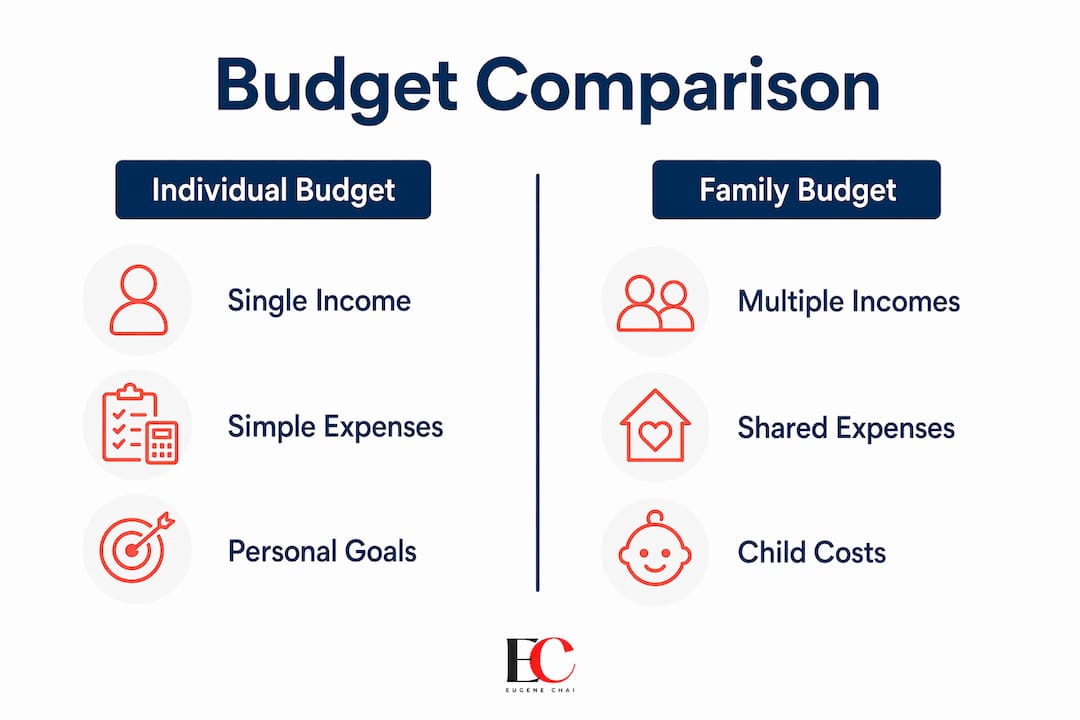
| Factor | Individual Budget | Family Budget |
|---|---|---|
| Income sources | One salary or freelance income | Two or more incomes, possibly irregular |
| Decision-makers | One person | Two adults, sometimes with different priorities |
| Expense variability | Relatively predictable | High variability due to children and life stages |
| Emergency fund size | 3 months of expenses | 3–6 months, larger for two-income dependency |
| Budget reviews | Quarterly or as needed | At minimum annually, often more frequently |
A family budget must involve both partners to succeed, include buffers for unpredictable child expenses, and reflect two-income dependency. This is the single biggest reason generic budgets fail families. They are designed for one person making one set of decisions.
Child-related costs add significant unpredictability. Annual childcare costs range from approximately $6,868 to $28,356 per year. In Singapore, infant care and childcare centre fees can easily reach $1,500 to $2,500 per month before government subsidies. Budgeting for this range requires a dedicated buffer category, not a rough estimate.
Two-income households also face a specific risk. If one partner loses their job or takes parental leave, the household income drops sharply. A larger emergency fund of 3–6 months of total expenses is the correct response to that risk.
Pro Tip: Track your combined take-home pay, not your gross salaries. CPF contributions, income tax, and other deductions mean your actual spending power is significantly lower than your headline salary figures suggest.
What are the practical steps to build a family budget?
Building a household budget follows a clear sequence. Follow these steps to get started:
-
Calculate combined take-home income. Add all net salaries, freelance income, rental income, and any government payouts like CDC vouchers. Use take-home pay, not gross income, as your baseline.
-
List all fixed expenses. These include HDB mortgage or rent, utilities, MRT passes, insurance premiums, MediShield Life top-ups, and loan repayments. Fixed costs do not change month to month.
-
Track variable expenses honestly. Groceries, dining at hawker centres, children’s activities, clothing, and entertainment all fluctuate. Review three months of bank and credit card statements to get realistic averages.
-
Apply the 50/30/20 rule as a starting framework. The 50/30/20 budgeting rule allocates 50% of income to needs, 30% to wants, and 20% to savings and debt repayment. This is a guide, not a rigid formula. Singapore families with high housing costs may need to adjust the needs category upward.
-
Set specific savings targets. Include an emergency fund, CPF top-ups, SRS contributions, children’s education savings, and any investment goals. Treat savings as fixed expenses, not money left over after spending.
-
Create a buffer for irregular costs. School fees, back-to-school supplies, medical co-payments, and family trips are predictable in category but unpredictable in timing. Set aside a fixed monthly amount for these.
-
Schedule monthly budget reviews. Sit down with your partner at the end of each month. Compare actual spending against the plan. Adjust categories where needed.
Pro Tip: Your first three months of budgeting will be inaccurate. That is normal. Initial budget estimates require refinement, especially for variable categories like groceries and children’s activities. Treat month one as a data-gathering exercise, not a test you can fail.
For a detailed walkthrough of building your first monthly plan, the monthly budget guide on Eugenechaitf covers the full process step by step.
How should your family budget change over time?
A family budget that worked when you were a couple of DINKs (dual income, no kids) will not work once you have a toddler, a school-age child, and a parent to support. Life stage transitions require deliberate budget adjustments.
Here are the key life stages and the budget shifts each one demands:
- New baby: Add infant care fees, medical costs, and a larger emergency fund. One partner may take extended leave, reducing household income temporarily.
- Primary school years: School fees, enrichment classes, and uniforms create new fixed costs. Budget for these before the school year starts.
- Secondary and tertiary education: Tuition fees, transport, and devices become significant. Start a dedicated education savings fund early.
- Empty nest: Child-related expenses drop, but retirement planning should accelerate. Redirect freed-up cash into CPF SA top-ups or SRS contributions.
- Supporting ageing parents: Parental allowances and medical costs for elderly parents can be substantial. The Eugenechaitf guide on parental allowance planning addresses this specific challenge for Singapore families.
Families should review their budgets annually, particularly before major expense cycles like the back-to-school season. An annual review catches outdated assumptions before they cause shortfalls.
| Life Stage | Key Budget Shift | Priority Action |
|---|---|---|
| New baby | Add childcare and medical costs | Build 6-month emergency fund |
| School-age children | Add education and activity costs | Open education savings account |
| Teenage years | Add tuition and device costs | Review and increase savings rate |
| Empty nest | Remove child costs | Accelerate CPF and SRS contributions |
| Supporting parents | Add parental allowance | Budget for medical and care costs |
The family financial plan guide on Eugenechaitf provides a broader framework for aligning your budget with long-term financial goals at each stage.
Key takeaways
A family budget works because it turns shared income and expenses into a deliberate plan, replacing reactive spending with funded goals and financial confidence.
| Point | Details |
|---|---|
| Start with take-home pay | Use combined net income, not gross salaries, to set a realistic spending baseline. |
| Treat savings as fixed costs | Schedule savings transfers on payday so they are never treated as optional. |
| Budget for variable child costs | Allocate a monthly buffer for unpredictable expenses like school fees and medical co-payments. |
| Review annually at minimum | Adjust the budget before major expense cycles and after any life stage change. |
| Both partners must participate | Joint ownership of the budget reduces conflict and improves follow-through. |
My take on why most family budgets fail early
I have seen this pattern repeatedly. A couple sits down, builds a detailed budget, feels great about it, and then quietly abandons it by month two. The reason is almost never a lack of discipline. It is a lack of realistic expectations.
Most families underestimate their variable costs by 20–30% in the first draft. Groceries cost more than you think. Children’s activities add up faster than you expect. The budget feels broken, so people stop using it. The fix is simple: treat your first three months as calibration, not failure.
The second common mistake is treating savings as optional. If your budget says “save $500 this month,” but that $500 sits in your current account until the 30th, it will get spent. Automate the transfer on payday. Make savings disappear before you can touch them.
For Singapore families specifically, I recommend using the 50/30/20 framework as a starting point, then adjusting for your actual housing costs and CPF obligations. The 50% needs category will likely need to be higher for families with HDB mortgages and childcare fees. That is fine. The framework is a compass, not a cage.
The families I have seen succeed long-term share one habit: they talk about money regularly and without blame. A monthly budget review does not need to be a formal meeting. It can be a 20-minute conversation over dinner. What matters is that both partners stay aligned on where the money is going and why.
— Eugene
Start building your family budget today
If you are ready to move from financial stress to financial clarity, Eugenechaitf has the resources to help you get there. The budgeting tips and strategies section covers practical methods for Singapore families, from setting up your first budget to managing irregular expenses and building an emergency fund.
The content on Eugenechaitf is written specifically for Singaporean readers, covering CPF planning, HDB costs, and the real financial pressures that local families face. Whether you are just starting out or refining a budget that has stopped working, you will find guidance grounded in real experience. Explore the smart saving strategies section to complement your budgeting plan with targeted savings goals.
FAQ
What is the purpose of a family budget?
A family budget is a plan that combines all household income and expenses to control spending, build savings, and achieve shared financial goals. It replaces reactive money management with a deliberate, structured approach.
How much should a family save each month?
The 50/30/20 rule recommends allocating 20% of take-home income to savings and debt repayment. Singapore families should also factor in CPF contributions and SRS top-ups as part of their total savings rate.
How large should a family emergency fund be?
A family emergency fund should cover 3–6 months of total household expenses. Two-income households should target the higher end of that range to protect against the risk of one partner losing their income.
How often should a family review its budget?
Families should review their budget monthly to track spending and at least once a year to adjust for life stage changes. Major transitions like a new baby, a school enrolment, or a job change require an immediate budget review.
What is the biggest mistake families make when budgeting?
The most common mistake is treating savings as leftover money rather than a fixed expense. Families that automate savings transfers on payday consistently build stronger emergency funds and reach financial goals faster.
Disclaimer: Informational only. Consult an MAS-licensed advisor before investing.






Leave a Reply