



TL;DR:
- Rent in Singapore should be kept at or below 30 percent of net income to avoid financial strain.
- Choosing affordable housing types and locations, timing lease negotiations carefully, and sharing living spaces can greatly reduce costs.
Saving money on rent in Singapore is achievable through informed choices, and this guide shows you exactly how. Rent is typically the single largest expense for young adults and working professionals here, so getting it right matters enormously. The standard financial benchmark is the 30% income rule: keep rent at or below 30% of your net monthly income. Beyond that benchmark, the biggest levers are housing type, location, lease timing, and whether you share accommodation. I am fortunate enough not to need to rent right now, as staying with my parents is a short-term arrangement. But several of my friends have moved out to rent while waiting for their BTO flats, and watching them navigate the process has given me a clear view of what works and what costs more than it should.
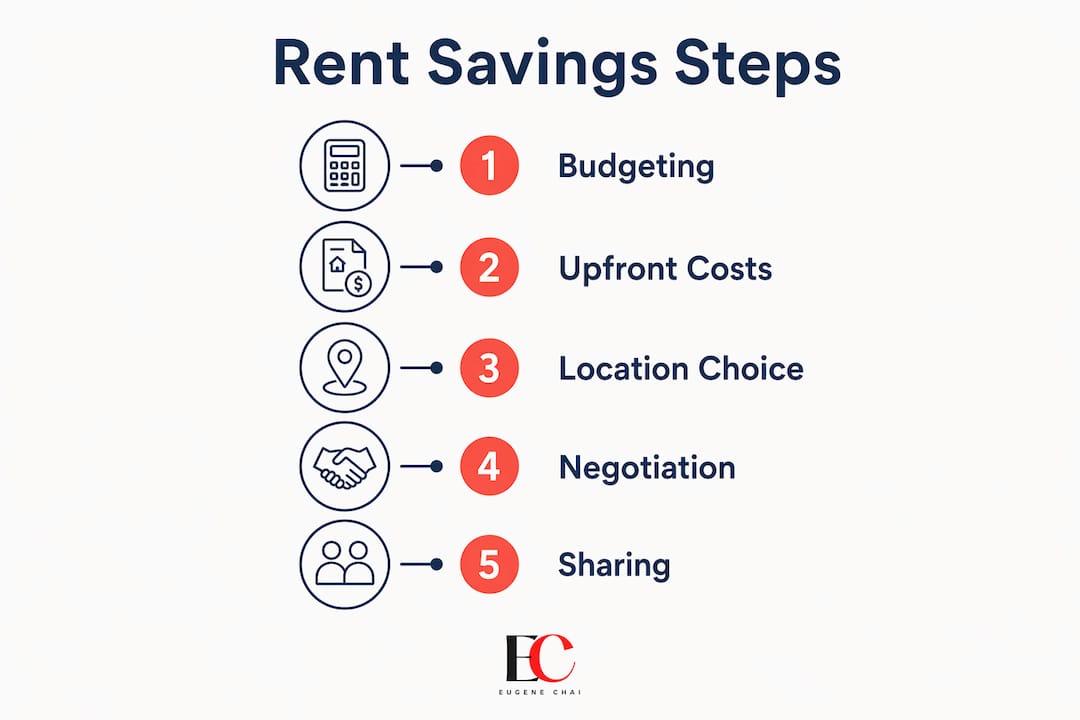
What budget should you allocate for rent in Singapore?
The 30% rule is the most widely cited benchmark for rental budgeting in Singapore. For a net monthly income of S$4,400, that means a maximum rent of S$1,320. Staying within this range protects your ability to save, invest, and cover daily expenses without strain.
The 30% figure is a ceiling, not a target. Aiming for 25% gives you more breathing room, especially when you factor in Singapore’s cost of living across transport, food, and utilities.
Upfront costs catch many renters off guard
Before you even move in, you need to budget for 3–4 months’ rent upfront. This covers your first month’s rent, a security deposit of one to two months, stamp duty payable to IRAS, and potentially an agent’s commission. For a unit renting at S$3,800 per month, total upfront costs can reach between S$13,000 and S$17,000. That is a significant sum to have ready before you sign anything.
The security deposit is refundable at the end of your tenancy, provided you return the unit in good condition. Stamp duty is approximately 0.4% of the average annual rent for leases of up to four years, and the tenant typically pays this. Agent fees vary but generally run between half a month and one full month’s rent plus GST.
| Cost item | Typical amount |
|---|---|
| First month’s rent | S$1,500–S$3,800+ |
| Security deposit | 1–2 months’ rent |
| Stamp duty (IRAS) | ~0.4% of annual rent |
| Agent commission | 0.5–1 month’s rent + GST |
| Estimated total upfront | S$5,000–S$17,000+ |
Pro Tip: Build your upfront rental fund separately from your emergency savings. Mixing the two leaves you financially exposed if something goes wrong after you move in.
How can choosing location and housing type save you rent costs?
The choice between an HDB flat and a private condo is the single largest cost lever available to you. HDB rooms typically cost between S$500 and S$1,200 per month, while private condos generally start at S$2,800 and can reach S$4,500 or more. That gap is substantial, and for most young professionals, an HDB room or flat offers the most cost-effective entry point into the rental market.

Location within Singapore makes a measurable difference
Moving one MRT stop further from a central area can save approximately S$200 per month, or S$2,400 annually. The Newton and Novena area averages around S$1,793 per month, while nearby Balestier averages S$1,595. That S$198 monthly difference buys you very little in lifestyle terms but adds up to a meaningful annual saving.
Estates like Jurong East, Woodlands, Tampines, and Sengkang consistently offer lower rents than central or city-fringe areas. These locations are well-served by MRT lines, so commuting remains practical. A monthly public transport budget of around S$120–S$160 is far more manageable than the S$15,000-plus annual cost of owning a car. Choosing housing near an MRT station in a non-central estate gives you the best of both worlds.
| Neighbourhood | Avg monthly rent (room/flat) | MRT access |
|---|---|---|
| Orchard / River Valley | S$2,200–S$4,500+ | Excellent |
| Novena / Newton | ~S$1,793 | Good |
| Balestier | ~S$1,595 | Moderate |
| Jurong East | S$1,200–S$2,200 | Excellent |
| Woodlands / Sembawang | S$900–S$1,800 | Good |
| Tampines / Pasir Ris | S$1,000–S$2,000 | Good |
Pro Tip: Calculate your total housing cost as rent plus commute. A cheaper flat that adds S$150 in monthly transport costs is not always the saving it appears to be.
When and how should you time and negotiate your lease?
Timing your rental search correctly can save you hundreds of dollars without any negotiation at all. Peak rental season runs from may through august, when demand is highest and landlords have little reason to negotiate. Renting during this window means more competition, fewer choices, and less leverage on price.
The fourth quarter of the year and early Q1 are the best times to search. Supply is higher, landlords are more motivated to fill vacancies, and you are more likely to secure a better rate or additional perks.
How to negotiate effectively with your landlord
- Offer a longer lease. Landlords prefer 24-month contracts because vacancy costs them one to two months of lost rent per tenant turnover. Committing to a longer lease can secure a 3–5% reduction in monthly rent or extras like aircon servicing.
- Ask for inclusions, not just price cuts. Requesting that the landlord cover quarterly aircon servicing or replace ageing appliances costs them less than a rent reduction but adds real value to you.
- Come prepared with comparable listings. Showing a landlord two or three similar units at lower prices in the same estate is the most direct way to justify a lower offer.
- Negotiate the diplomatic clause. If you are on an employment pass, ensure the tenancy agreement includes a diplomatic clause allowing early termination with one to two months’ notice. This protects you if your employment situation changes.
- Confirm the tenancy agreement is stamped. Stamp with IRAS within 14 days of signing. An unstamped agreement offers no legal protection if a dispute arises.
Stamp duty on a tenancy agreement is approximately 0.4% of the average annual rent for leases up to four years. It is a small cost relative to the legal protection it provides.
Pro Tip: Never rely on a verbal agreement. Every concession a landlord makes, whether it is a rent reduction, included utilities, or aircon servicing, must appear in the signed tenancy agreement.
What are the cost-saving alternatives to renting alone?
Sharing accommodation is the most direct way to cut rental costs. Sharing reduces your rent by 30%–50% compared to renting a unit alone. HDB rooms start from around S$500 per month, making shared HDB living the most affordable budget rental option available to young professionals in Singapore.
The trade-offs are real. Shared living means less privacy, shared common areas, and the need to align on household rules. In HDB flats, subletting rules apply: the flat owner must obtain HDB approval before renting out rooms, and the total number of occupants is capped. Verify these conditions before signing anything.
Renting directly from landlords
Engaging a landlord directly, without using a tenant’s agent, saves you the agent’s commission of 0.5–1 month’s rent plus GST. On a S$2,500 per month flat, that is a saving of S$1,250–S$2,500 upfront. The catch is that the landlord’s agent represents the landlord’s interests, not yours. You need to read the tenancy agreement carefully and understand every clause before signing.
Pros and cons of renting without a tenant’s agent:
- Pro: Saves 0.5–1 month’s rent in commission fees
- Pro: Direct communication with the landlord can speed up decisions
- Con: No professional to review the tenancy agreement on your behalf
- Con: Landlord’s agent is not obligated to flag issues that disadvantage you
- Con: Less negotiating support if disputes arise during the tenancy
Pro Tip: If you choose to rent without your own agent, verify that any agent involved is registered with the Council for Estate Agencies (CEA). You can check this on the CEA public register at cea.gov.sg.
Key takeaways
The most effective way to reduce rental costs in Singapore is to combine the right housing type, a non-central but well-connected location, off-peak lease timing, and a willingness to share or negotiate directly.
| Point | Details |
|---|---|
| Apply the 30% rule | Keep rent at or below 30% of net monthly income to avoid financial overextension. |
| Budget upfront costs carefully | Set aside 3–4 months’ rent before searching, covering deposit, stamp duty, and agent fees. |
| Choose location over prestige | Moving one MRT stop from a central area saves approximately S$200 per month. |
| Time your search off-peak | Searching in Q4 or early Q1 gives you more supply and greater negotiating leverage. |
| Share or go direct | Sharing accommodation cuts costs by 30%–50%; renting directly saves agent commission. |
My honest view on renting in Singapore
I am fortunate not to be renting right now. Staying with my parents is a short-term arrangement, and I am aware that not everyone has that option. Several of my friends have moved out to rent while still waiting for their BTO flats, and watching them manage the financial side has been instructive.
The most common mistake I see is underestimating upfront costs. People budget for the monthly rent but forget that moving in requires a lump sum of S$10,000 or more. That catches a lot of young professionals off guard, especially those who have not yet built up a solid savings buffer.
The second thing I notice is how much location flexibility matters. Friends who were willing to live in Jurong or Tampines instead of Toa Payoh or Bishan saved meaningfully every month. That saving, redirected into a savings plan or CPF top-up, compounds over the two or three years they spend waiting for their BTO. The financial literacy gap here is not about knowing the 30% rule. Most people have heard of it. The gap is in applying it consistently when you are excited about a flat and tempted to stretch your budget.
Renting is a temporary phase for most Singaporeans. Treat it as such. Keep costs controlled, build your savings, and use the period productively to grow your financial foundation.
— Eugene
Personal finance resources for renters in Singapore
Managing rent is just one part of your broader financial picture. If you are renting while waiting for your BTO or building your savings as a working professional, having a clear budget framework makes the whole process less stressful.
Eugenechaitf covers the full range of personal finance topics relevant to Singaporeans at this stage of life, from budgeting your monthly expenses to building long-term savings habits. The personal finance resource hub is a practical starting point if you want to build a plan that accounts for rent, CPF contributions, and savings goals together. Getting these foundations right early makes every subsequent financial decision easier.
FAQ
What is the 30% rule for rent in Singapore?
The 30% rule means keeping your monthly rent at or below 30% of your net take-home income. For a net income of S$4,400, the maximum recommended rent is S$1,320.
How much should I save before renting in Singapore?
Budget for 3–4 months’ rent upfront to cover your first month, security deposit, stamp duty, and any agent fees. For a S$3,800 per month unit, this can total between S$13,000 and S$17,000.
When is the best time to look for cheaper apartments in Singapore?
The fourth quarter of the year and early Q1 offer the best conditions for renters. Off-peak periods bring more supply, fewer competing tenants, and landlords who are more open to negotiation.
Does sharing an HDB room really save money?
Yes. Sharing accommodation reduces rental costs by 30%–50% compared to renting alone. HDB rooms start from around S$500 per month, making shared living the most affordable option for young professionals.
Do I need to stamp my tenancy agreement in Singapore?
Yes. The tenancy agreement must be stamped with IRAS within 14 days of signing. An unstamped agreement provides no legal protection if a dispute arises between tenant and landlord.
Disclaimer: Informational only. Consult an MAS-licensed advisor before investing.






Leave a Reply