



TL;DR:
- A financial recovery plan is a structured process that helps individuals and families manage money, pay bills, and reduce debt after financial difficulties. It involves assessing finances, prioritizing obligations, creating a repayment strategy, and tracking progress over time. Recovery typically takes 9-18 months, with regular reviews and adjustments to ensure sustainable financial stability.
A financial recovery plan is a strategic, documented process that helps individuals and families manage money, pay bills, and reduce debt after a period of financial difficulty. The Texas Office of Consumer Credit Commissioner defines the core framework as four steps: assess your finances, prioritise obligations, create a repayment strategy, and track progress. This guide walks you through each stage, explains realistic timeframes, and shows you how to build a plan that actually holds up under pressure. Whether you are dealing with job loss, unexpected medical bills, or mounting credit card debt, a structured financial recovery strategy gives you a clear path forward.
What is a financial recovery plan and what does it include?
A financial recovery plan is built on one non-negotiable first step: a complete picture of where you stand financially. Effective recovery requires assessing 100% of your bank balances, obligations, and hidden cash drains within 48 hours of deciding to act. That urgency matters because every day without a clear baseline is a day you are making decisions with incomplete information.
The plan itself typically contains four core components:
- Financial assessment. List every source of income, every fixed expense, every debt balance, and every irregular cost. Include CPF contributions, HDB loan repayments, MediShield Life premiums, and any Integrated Shield Plan (IP) premiums. Leave nothing out.
- Prioritisation of obligations. Rank your debts and bills by consequence. Housing, utilities, and food come first. Discretionary spending comes last. The 3-5 rule narrows your focus to the highest-impact priorities for the first 30–90 days, preventing paralysis from trying to fix everything at once.
- Budget and repayment strategy. Divide your expenses into four buckets: essential (rent, utilities, groceries), discretionary (dining out, subscriptions), reserve (emergency fund contributions), and strategic (debt repayment above minimum). A practical starting point is the 50/30/20 budgeting framework, which allocates 50% to needs, 30% to wants, and 20% to savings and debt.
- Progress tracking. Set monthly milestones. Review your net position every four weeks. Adjust when income or expenses shift.
Pro Tip: Set a recurring calendar reminder every four weeks to review your plan. Consistency in reviewing beats intensity in planning every time.
The Government Finance Officers Association stresses that recovery plans must be concise and clearly communicated. A plan that is too complex rarely gets followed. Keep yours to one page if possible, with clear numbers and deadlines attached to each action.

How long does financial recovery take?
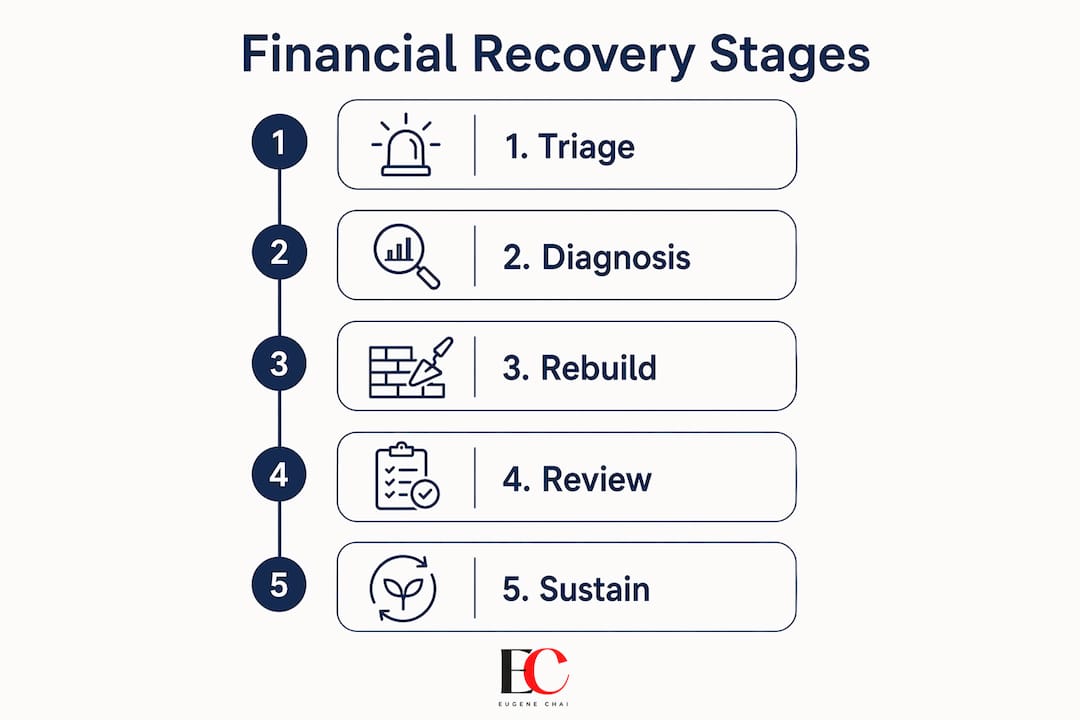
Successful financial recovery typically spans 9–18 months, with the first 30–90 days being the most critical period for stopping financial deterioration. Understanding the phases helps you set realistic expectations and avoid discouragement when progress feels slow.
| Phase | Timeframe | Primary goal |
|---|---|---|
| Cash triage | Days 1–30 | Stop the financial bleed; identify urgent obligations |
| Diagnosis and restructuring | Months 1–3 | Understand root causes; cut discretionary overhead |
| Stabilisation | Months 3–6 | Reach break-even; build a small emergency buffer |
| Rebuild and growth | Months 6–18 | Form sustainable habits; reduce debt systematically |
The triage phase is where most people make their biggest mistake. They focus on cutting costs before they have stabilised cash flow. Most financial struggles result from decisions made under stress without complete data. Stabilising cash first, then restructuring, produces better outcomes than ad hoc cuts.
The diagnosis phase is about understanding why the crisis happened. Was it a sudden income drop, overspending, or a structural mismatch between income and fixed costs? The answer shapes every decision that follows.
The rebuild phase, spanning months 6–18, is where sustainable habits form. This is when you start making extra CPF Ordinary Account (OA) top-ups, rebuilding your emergency fund to three to six months of expenses, and considering whether your SRS contributions can resume.
Pro Tip: Stress-test your plan quarterly by asking: “If my income dropped 20% next month, which obligations would I cut first?” Having that answer ready prevents panic decisions later.
Recovery plans must be reviewed and stress-tested at least every six months or after any major financial change. A plan that was accurate in january may be obsolete by july if your income, rent, or family obligations have shifted.
What mistakes should you avoid in a financial recovery plan?
The most common error in financial recovery is cutting costs without first stabilising cash flow. A common pitfall is slashing expenses while ignoring the root cause of the shortfall, which leads to repeated failure. Cost reduction is a tool, not a strategy.
Here are the key mistakes to avoid:
- Delaying action. Failure to establish activation criteria for shifting into recovery mode delays action and worsens outcomes. Define your trigger: “If my savings fall below $2,000, I activate my recovery plan.” Do not wait until the crisis peaks.
- Trying to fix everything at once. The 3-5 rule exists for a reason. Narrowing focus to three to five high-impact priorities prevents overwhelm and keeps essential tasks from being neglected.
- Ignoring cash flow. Tracking your bank balance once a month is not enough during recovery. Review cash flow weekly, especially in the first 90 days.
- Skipping the root cause analysis. If you do not know why you ran into financial difficulty, you will repeat the same patterns. Was it lifestyle inflation, a one-off event, or a structural income problem?
- Failing to update the plan. Failing to update plans leads to obsolescence and reduced effectiveness when circumstances change.
“Recovery is more than cutting costs. It involves cash flow management, scenario modelling, and aligned strategic decisions. Short-term survival must be balanced with long-term financial health.” — Dallas Alford IV, CPA, financial recovery expert
Pro Tip: Use a simple spreadsheet to model two scenarios each month: one where your income stays the same, and one where it drops by 15%. Knowing both outcomes in advance removes the emotional charge from financial decisions.
How do you adapt a financial recovery plan for families?
Families face a layer of complexity that single-income households do not. Multiple income sources, dependants, school fees, and shared financial goals all need to fit into one coherent plan. The good news is that the core framework remains the same. The adaptation is in the detail.
Here is how to tailor your financial recovery strategy for a family context:
- Map all income sources. Include your salary, your partner’s salary, any freelance income, rental income, and government support such as CDC vouchers or Baby Bonus payments. Irregular income needs a conservative estimate, not an optimistic one.
- Account for dependants. Children’s school fees, enrichment classes, and medical costs are non-negotiable expenses. List them explicitly in your essential bucket so they are never accidentally cut.
- Communicate openly. Recovery plans work best when all parties understand and support the strategy. Hold a monthly family finance meeting. Keep it short, factual, and solution-focused.
- Prioritise housing above all else. Your HDB loan or private condo mortgage is the obligation with the most severe consequence if missed. It comes before everything discretionary.
- Manage discretionary spending together. Agree as a family on which subscriptions, dining habits, or leisure activities to pause. Shared decisions create shared commitment.
Families with fluctuating incomes, such as those where one partner is self-employed or on commission, should build their budget around the lower income estimate. Any income above that estimate goes directly to debt repayment or the emergency fund. This approach, sometimes called envelope budgeting, assigns every dollar a job before it is spent.
Overcoming the emotional friction of family finance discussions is often harder than the numbers themselves. Practical guidance on budgeting challenges can help you and your household navigate those conversations constructively.
Key takeaways
A financial recovery plan works because it replaces reactive, stress-driven decisions with a structured, sequenced process that addresses both immediate cash needs and the root causes of financial difficulty.
| Point | Details |
|---|---|
| Start with a full assessment | List every income source, debt, and expense within 48 hours of deciding to act. |
| Use the 3-5 rule | Focus on three to five high-impact priorities for the first 30–90 days to prevent overwhelm. |
| Expect 9–18 months | Recovery is a phased process; the first 30 days stabilise cash, the next 12–18 months rebuild it. |
| Review every six months | Update your plan after any major change in income, expenses, or family obligations. |
| Communicate clearly | Share the plan with everyone in your household so all parties understand and support the goals. |
What I have learned from watching families rebuild their finances
I have seen a pattern repeat itself more times than I can count. A family hits a financial wall, panics, and immediately starts cutting every expense in sight. The streaming subscriptions go. The gym membership goes. Sometimes even the family’s MediShield Life top-ups get paused. And yet, three months later, they are in the same position, or worse.
The problem is never the subscriptions. The problem is that they skipped the diagnosis. They treated the symptom without identifying the disease. The families I have seen recover well are the ones who sat down, listed everything, and asked the uncomfortable question: “Why did this happen?” That conversation is harder than any spreadsheet, but it is the one that actually changes behaviour.
Discipline matters, but so does flexibility. A plan that cannot bend when life changes is a plan that gets abandoned. The families who succeed treat their recovery plan as a living document, not a one-time exercise. They review it, adjust it, and keep going even when progress is slow.
Recovery is genuinely achievable with structured effort. I have seen Singaporean families clear significant debt, rebuild their CPF balances, and reach financial stability within 18 months. The plan is not magic. It is just a decision, made clearly and followed consistently.
— Eugene
Practical resources to support your financial recovery
Building a financial recovery plan is the first step. Putting it into practice is where the real work begins.
Eugenechaitf offers a library of practical, Singapore-specific guides to help you move from plan to action. Whether you need to build your first budget, understand how to track your spending, or find ways to cut costs without sacrificing quality of life, the resources are free and written specifically for Singaporean households. Start with the budgeting tips and tricks guide, which covers practical methods for managing money on any income level. You will also find guides on saving, investing, and building long-term financial resilience, all grounded in real Singapore costs and conditions.
FAQ
What is a financial recovery plan in simple terms?
A financial recovery plan is a documented, step-by-step process for regaining financial stability. It covers assessing your finances, prioritising debts, creating a budget, and tracking progress over time.
How long does a financial recovery plan take to work?
Recovery typically takes 9–18 months. The first 30–90 days focus on stabilising cash flow, while the following months address debt reduction and rebuilding savings.
What should I include in a financial recovery plan?
Include a full list of income, expenses, and debts; a prioritised list of obligations; a monthly budget with repayment targets; and a schedule for reviewing progress at least every six months.
How do I start a financial recovery plan if I have no savings?
Start by listing all income and expenses to identify where cash is going. Focus the first 30 days on stopping unnecessary spending and covering essential obligations. Even a small emergency buffer of $500 provides meaningful protection.
How often should I review my financial recovery plan?
Review your plan at least every six months, or immediately after any significant change in income, expenses, or family circumstances. Regular reviews prevent the plan from becoming outdated and ineffective.
Disclaimer: Informational only. Consult an MAS-licensed advisor before investing.






Leave a Reply