



TL;DR:
- The Supplementary Retirement Scheme offers Singaporeans and foreigners a tax-efficient way to grow retirement savings through tax relief and free investment growth.
- Investors should actively manage their funds in stocks, bonds, or ETFs to maximize long-term returns, as idle cash earns minimal interest.
The Supplementary Retirement Scheme (SRS) is one of the most tax-efficient tools available to Singaporeans, Permanent Residents, and foreigners working here. Every dollar you contribute reduces your taxable income, investment returns grow tax-free inside the account, and when you withdraw at retirement, only 50% of the amount is taxable. For anyone earning above the basic tax threshold, that combination is genuinely hard to beat.
Here is what the SRS delivers in 2026:
- Tax relief on every dollar contributed, up to the annual cap
- Tax-free growth on all investment returns prior to withdrawal
- 50% tax concession on withdrawals made at or after the statutory retirement age
- Flexibility to invest in shares, ETFs, unit trusts, bonds, fixed deposits, and selected insurance products
- One account per person, managed through DBS, OCBC, or UOB
The annual contribution caps set by the Ministry of Finance (MOF) for 2026 vary between Singapore Citizens, PRs, and foreigners, with distinct limits for each category. All contributions are subject to the overall personal income tax relief cap of $80,000, as administered by the Inland Revenue Authority of Singapore (IRAS).

Who can open an SRS account, and how do you do it?
Eligibility is straightforward. You can open an SRS account if you meet all of the following:
- You are at least 18 years old
- You are not an undischarged bankrupt
- You are capable of managing your own affairs
- You do not already hold an SRS account (including a suspended one) with any operator
- You have no pending SRS application with another operator
Singapore Citizens, Permanent Residents, and foreigners are all eligible. You may hold only one SRS account at any time. Opening accounts with more than one operator is an offence under IRAS rules.
SRS accounts are managed exclusively by three bank operators: DBS, OCBC, and UOB. You can approach any of them to open an account, either in branch or via their digital platforms. Before proceeding, you must declare that you do not hold an existing SRS account elsewhere.
Documents you will need:
- Your identity card or passport
- For foreigners: a completed Declaration Form for SRS (available from the bank operator)
If you later wish to switch operators, you can request a Transfer of Account Form from the new operator, who will coordinate the transfer with your existing bank.
SRS contributions and tax relief benefits
The tax relief mechanics are simple but worth understanding clearly. Every dollar you contribute to your SRS account reduces your chargeable income for that year of assessment, subject to the annual cap and the $80,000 overall personal income tax relief ceiling.
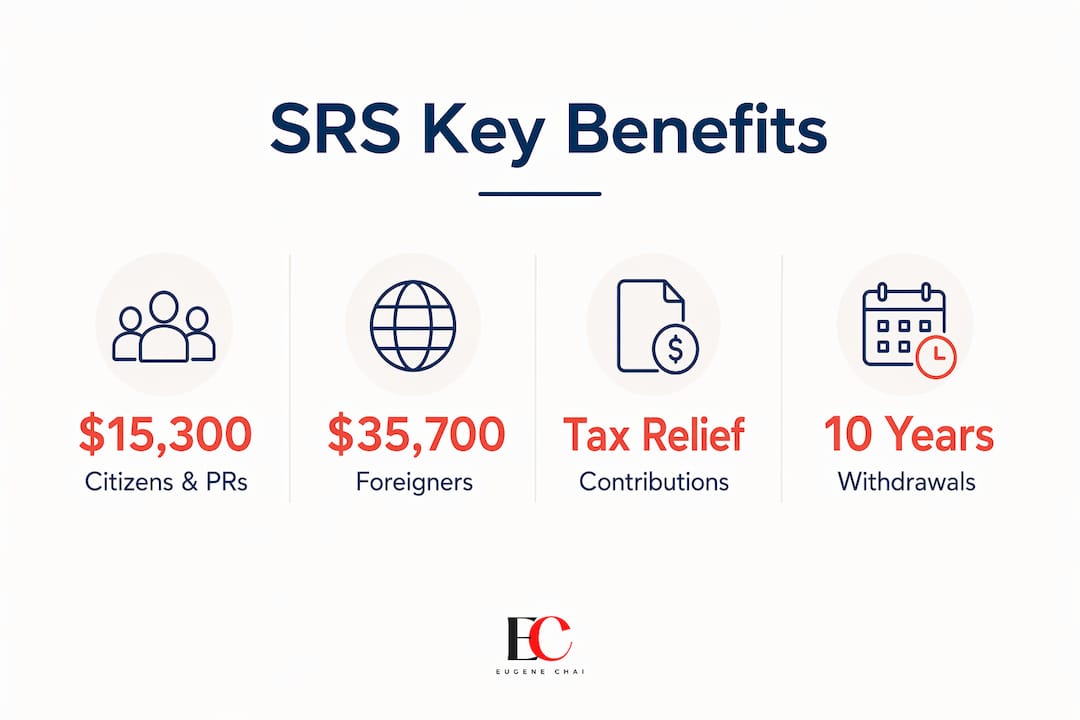
| Category | Annual contribution cap | Tax relief (max) |
|---|---|---|
| Singapore Citizens and PRs | $15,300 | Up to $15,300 |
| Foreigners | $35,700 | Up to $35,700 |
| Overall relief cap (all reliefs combined) | N/A | $80,000 |
Key points on contributions and relief:
- Contributions must be made by 31 December each year to qualify for SRS relief in the following Year of Assessment (YA)
- You can contribute multiple times throughout the year, in any amount, up to the cap
- Your employer may also contribute on your behalf; those amounts count as part of your remuneration but still qualify for relief
- Once you begin penalty-free withdrawals at retirement age, you can no longer make new contributions
- IRAS applies the relief automatically; you do not need to claim it manually in your tax return
Pro Tip: Check your total reliefs before topping up. If you are already close to the $80,000 cap through CPF contributions, course fee relief, or NSman relief, additional SRS contributions may not yield further tax savings.
What can you invest your SRS funds in?
Leaving money idle in your SRS account earns just 0.05% interest per annum. That rate will not keep pace with inflation over a 20-year horizon. The real power of the SRS lies in investing those funds.
Eligible investment options include:
- Shares listed on the Singapore Exchange (SGX)
- Unit trusts and managed funds
- Bonds, including Singapore Savings Bonds
- Fixed deposits with the SRS operator
- Exchange Traded Funds (ETFs), including STI ETFs
- Selected life insurance products, subject to limits
All investment returns, including capital gains and dividends (with the exception of Singapore dividends), accumulate tax-free before withdrawal. That tax-free compounding over decades is what makes the SRS far more than a simple savings account. For readers newer to investing, the best beginner investment options in Singapore include several instruments that are SRS-eligible.
Direct property investments are not permitted within the SRS.
Withdrawal rules and how to manage your tax bill
You can withdraw from your SRS account at any time, but the timing determines the tax treatment entirely.
Before statutory retirement age:
- The full amount withdrawn is taxable
- A 5% penalty applies on top of the tax
At or after statutory retirement age (or on medical grounds):
- Only 50% of the amount withdrawn is taxable
- You can spread withdrawals over 10 years to keep each annual withdrawal small and minimise the tax bracket you fall into
On death or terminal illness:
- Up to $400,000 of SRS funds may be withdrawn tax-exempt
The 10-year withdrawal window is one of the most underused features of the scheme. By spreading withdrawals over several years, only a portion of the withdrawn amount is taxable annually, which can reduce the tax burden for retirees. At current tax rates, that amount falls below the taxable threshold for most retirees. For a detailed look at how retirement age affects your SRS timing, the retirement age planning guide at Eugenechaitf covers this well.
Once the 10-year window opens, subsequent withdrawals still enjoy the 50% concession, but careful planning is needed to avoid pushing income into a higher tax bracket.
Is the SRS right for you? A practical perspective
The SRS is genuinely worth using, but it rewards those who go in with a clear plan rather than those who treat it as a passive savings pot.
The scheme is most beneficial for taxpayers with a marginal rate of 7% or above. At that level, the tax relief on contributions delivers real, measurable savings each year. Lower earners should weigh the liquidity trade-off carefully: your money is effectively locked in until retirement age, and early withdrawal triggers both a penalty and full taxation.
The single biggest mistake I see is people opening an SRS account, making a contribution, and then leaving the funds in cash. At 0.05% per annum, inflation erodes the real value of those savings year after year. The account is a vehicle for investing, not just saving. Pairing your SRS contributions with a tax-efficient investing checklist helps you deploy those funds purposefully.
Spreading withdrawals across the full 10-year window at retirement is equally important. Many people withdraw too quickly, push themselves into a higher tax bracket, and lose a portion of the benefit they spent decades building. Think of the withdrawal phase as its own financial planning exercise, not an afterthought.
The SRS complements CPF rather than replacing it. CPF covers your basic retirement income, housing, and healthcare through MediShield Life and Integrated Shield Plans. The SRS gives you a separate, flexible layer of retirement wealth that you control entirely.
Key takeaways
The SRS is a voluntary retirement savings scheme that reduces your tax bill today, grows your investments tax-free, and taxes only half your withdrawals at retirement.
| Point | Details |
|---|---|
| Contribution caps (2026) | $15,300 for Citizens and PRs; $35,700 for foreigners, subject to the $80,000 overall relief cap. |
| Tax relief is automatic | IRAS applies SRS relief without a manual claim; contributions must be made by 31 december each year. |
| Invest, do not save | Idle SRS funds earn only 0.05% p.a.; eligible investments include shares, ETFs, unit trusts, and bonds. |
| 50% withdrawal concession | Withdrawals at or after statutory retirement age are only 50% taxable; spread over 10 years to minimise tax. |
| Early withdrawal costs | Withdrawing before retirement age triggers a 5% penalty and full taxation of the amount. |
FAQ
What are the disadvantages of an SRS account?
The main drawbacks are illiquidity and the early withdrawal penalty. Withdrawing before the statutory retirement age incurs a 5% penalty and full taxation on the amount, making the SRS unsuitable as an emergency fund. Lower-income earners may also find the tax relief benefit too small to justify the lock-in.
What happens to an SRS account after 10 years?
The 10-year window refers to the period after you begin penalty-free withdrawals at retirement age. If you have not fully withdrawn your funds within that window, subsequent withdrawals still enjoy the 50% tax concession, but you will need to plan carefully to avoid higher tax brackets.
Can foreigners open an SRS account in Singapore?
Yes. Foreigners who are at least 18 years old, not bankrupt, and capable of managing their affairs are eligible. Their annual contribution cap is $35,700, compared with $15,300 for Citizens and PRs. Foreigners must submit a Declaration Form for SRS to their chosen operator each year.
What can I do with the money in my SRS account?
You can invest in shares, ETFs, unit trusts, bonds, fixed deposits, and selected life insurance products. All investment returns accumulate tax-free before withdrawal. Direct property purchases are not permitted within the SRS.
Disclaimer: Informational only. Consult an MAS-licensed advisor before investing.






Leave a Reply