



TL;DR:
- A family financial plan in Singapore integrates income, expenses, savings, insurance, and long-term goals into a coherent strategy. It emphasizes building an emergency fund, optimizing CPF usage, and regularly reviewing progress, especially after life events. A structured, connection-based approach helps families achieve housing, education, and retirement goals effectively.
A family financial plan is a systematic, goal-based process that coordinates your household income, expenses, savings, insurance, and long-term goals into one coherent roadmap. For Singaporean families, this means weaving together CPF contributions, HDB milestones, MediShield Life coverage, and children’s education funding into a plan that works across every life stage. Without this structure, most families end up managing each financial priority in isolation, which leads to gaps, missed opportunities, and unnecessary stress. The good news is that building a solid plan does not require a financial degree. It requires clarity, the right local tools, and the discipline to review your progress regularly.
What are the essential components of a family financial plan?
A well-built family financial plan covers six core areas. Each one connects to the others, and neglecting any single component creates a weak link in your overall financial security.
Budgeting framework
The 50/30/20 rule allocates 50% of take-home income to needs, 30% to wants, and 20% to savings and debt repayment. For Singapore families, “needs” typically includes HDB mortgage instalments, utilities, groceries, MRT transport, and childcare fees. The 20% savings portion should be split deliberately across your emergency fund, CPF voluntary top-ups, and investment accounts rather than left as a vague target.

Emergency fund
Households with dependents and a mortgage should hold six months of expenses as an emergency reserve. This is not a suggestion. A family with a $3,000 monthly mortgage and two children needs at least $18,000 in liquid savings before directing money toward any investment goal. Keep this in a high-yield savings account such as UOB One or OCBC 360 to earn interest while maintaining accessibility.
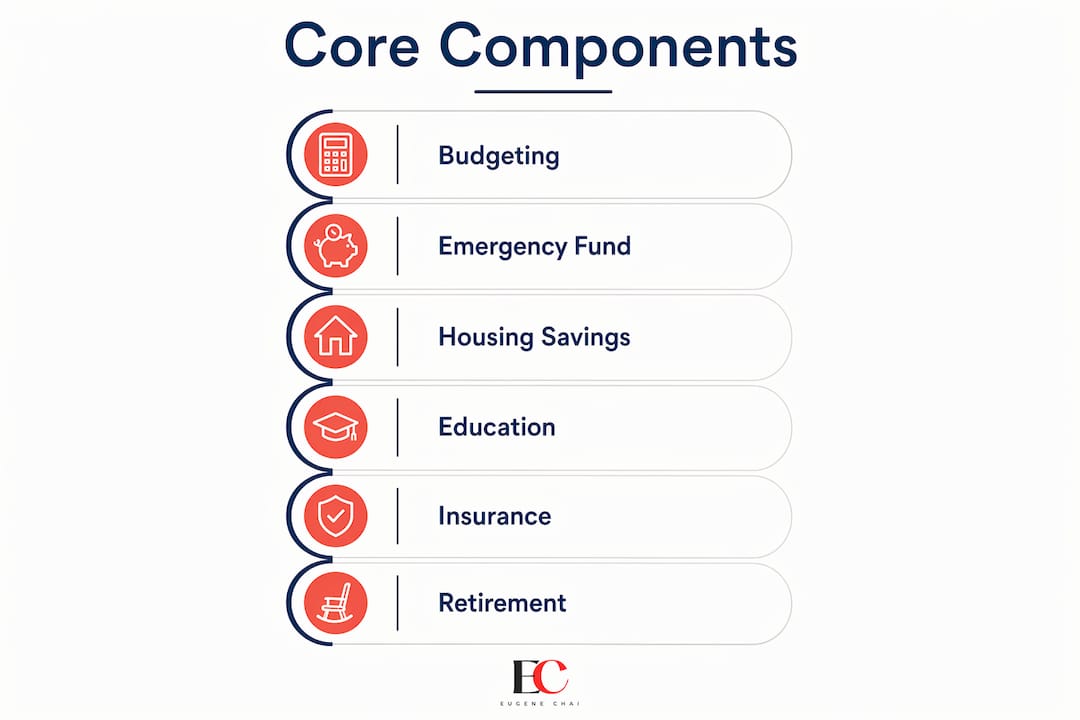
Housing savings and CPF usage
Your CPF Ordinary Account (OA) is your primary tool for funding an HDB BTO or Resale purchase. The OA can cover your downpayment, monthly mortgage instalments, and stamp duties. The critical trade-off most families miss is that every dollar used from your OA for housing is a dollar not compounding at 2.5% per annum toward retirement. The CPF PLAN tool helps you model this trade-off explicitly before committing to a property price.
Children’s education savings
Education savings and insurance protection are foundational for growing families. Primary and secondary school fees in Singapore are manageable, but enrichment classes, tuition, and tertiary education costs accumulate quickly. Starting a dedicated education savings account or endowment plan when your child is young gives compound growth time to work in your favour.
Insurance coverage
| Insurance type | Purpose | Key consideration |
|---|---|---|
| MediShield Life | Basic hospitalisation coverage | Mandatory for all Singapore citizens and PRs |
| Integrated Shield Plan (IP) | Upgraded ward and private hospital coverage | Choose a plan that matches your preferred hospital tier |
| Life insurance | Income replacement for dependents | Term life is cost-effective for most families |
| Critical illness | Lump sum on diagnosis of major illness | Cover should equal 3 to 5 years of annual income |
| Disability income | Monthly payout if unable to work | Often overlooked but critical for sole breadwinners |
Retirement planning
Your CPF Special Account (SA) earns 4% per annum and forms the base of your retirement savings. Voluntary cash top-ups to your SA or your spouse’s SA qualify for IRAS tax relief of up to $8,000 per year. The goal is to hit the Full Retirement Sum (FRS) by age 55 so that CPF LIFE provides a reliable monthly payout from age 65 onward.
Pro Tip: Use the CPF PLAN calculators to model your retirement shortfall today. Most families discover they need to top up their SA or start an SRS account earlier than expected.
How to create and manage a family budget plan effectively?
Building a family budget plan that actually holds up requires more than listing your income and expenses. It requires a structured process that accounts for Singapore’s specific cost patterns.
-
Calculate your true household income. Include both spouses’ take-home pay after CPF deductions, any rental income, and side income. Use net figures, not gross, since CPF contributions are not spendable cash.
-
List every fixed expense. Mortgage or rent, utilities, phone bills, insurance premiums, childcare fees, and car loan instalments (if applicable, including COE-related costs) belong here. These are non-negotiable monthly outflows.
-
Track variable expenses for 60 days. Groceries, hawker centre meals, transport, and entertainment vary month to month. Most families underestimate these by 20 to 30% when budgeting from memory alone.
-
Incorporate irregular expenses. School term fees, dental check-ups, annual insurance renewals, and holiday travel are real costs that many families forget to budget for. Divide annual irregular costs by 12 and set aside that amount monthly into a sinking fund.
-
Assign every dollar a purpose. After fixed expenses and irregular sinking funds are covered, split the remainder between wants (dining out, entertainment) and savings goals (housing downpayment, education fund, investment accounts).
-
Review and adjust after the first 90 days. Budget plans often underestimate irregular child-related expenses. Your first budget is a hypothesis. Real spending data from the first three months will reveal where to recalibrate.
Apps like Seedly or DBS NAV Planner connect to your bank accounts and categorise spending automatically, making this tracking step far less tedious. For a detailed walkthrough, the monthly budget guide on Eugenechaitf covers the full process step by step.
Pro Tip: Create a shared Google Sheet or use a budgeting app that both spouses can access. Visibility reduces financial disagreements and keeps both partners accountable to the same goals.
Why is regular review and updating of your plan crucial?
A family financial plan is a living document, not a one-time exercise. Reviewing and updating your plan should happen at least annually and immediately after any major life event.
Life events that trigger a mandatory plan review include:
- Marriage or divorce: Income, expenses, and CPF nominations all change.
- Birth or adoption of a child: Insurance coverage, education savings, and emergency fund targets need to increase.
- Job change or income loss: Your budget allocations and savings rate must be recalibrated.
- Property purchase or upgrade: CPF OA usage, TDSR limits, and retirement projections all shift.
- Death or critical illness of a family member: Beneficiary nominations, insurance claims, and estate planning become urgent.
The CPF Board’s PLAN with CPF platform supports members aged 21 to 64 with tools covering housing, retirement, healthcare, and legacy planning. It also handles co-ownership scenarios, which is useful when both spouses are contributing CPF to the same property.
“Peace of mind in family financial planning comes not only from the plan itself but from open communication and family participation in planning conversations.”
Families that skip annual reviews often discover cash shortfalls only when they arrive, whether that is a gap in the education fund when school fees are due, or a retirement shortfall that surfaces too late to correct. Scheduling a fixed annual review, perhaps every January after the year-end bonus is received, turns maintenance into a habit rather than a crisis response.
What are the unique benefits of family financial planning for Singaporean families?
Financial planning for families in Singapore delivers benefits that go well beyond having a budget. The AIA Live Better Study in 2024 found that approximately 62% of Singapore residents prioritise savings, 57% prioritise stable income, 52% prioritise emergency funds, and 48% prioritise insurance for long-term planning. This data shows that Singaporean families already understand the priorities. What most lack is a structured plan that connects all four.
The specific benefits of a well-built family financial plan include:
- Balancing housing and retirement without sacrificing either. CPF strategies that model the OA housing trade-off allow families to buy the right-sized home without depleting retirement savings.
- Funding children’s education without derailing retirement. Dedicated education savings started early, even at $200 per month from birth, can accumulate meaningfully by the time university fees arrive.
- Reducing financial stress through transparency. Families that discuss finances openly report lower anxiety and stronger alignment on spending decisions.
- Protecting against unexpected events. A complete insurance stack covering life, critical illness, and disability income means a single health event does not wipe out years of savings.
- Achieving long-term family financial goals on schedule. Aligning short-term goals like emergency funds with long-term aspirations such as retirement and education prevents financial drift as life circumstances change.
Singapore’s cost of living, property prices, and CPF system create a unique financial environment. A generic financial plan built on overseas frameworks misses the nuances of HDB eligibility rules, CPF contribution rates, and MediShield Life coverage gaps. A plan built specifically for Singapore families accounts for all of these.
Key takeaways
A family financial plan built around CPF, HDB milestones, and Singapore-specific insurance coverage is the most effective way for local families to achieve housing, education, and retirement goals simultaneously.
| Point | Details |
|---|---|
| Define your six core components | Cover budgeting, emergency fund, housing, education, insurance, and retirement in every plan. |
| Use CPF tools to model trade-offs | The PLAN with CPF platform shows how housing decisions affect retirement readiness before you commit. |
| Review at least once a year | Update your plan after every major life event to prevent cash shortfalls and missed savings targets. |
| Start education savings early | Even $200 per month from birth compounds significantly by the time university fees are due. |
| Open family conversations reduce risk | Shared financial visibility lowers anxiety and keeps both partners aligned on long-term goals. |
My honest view on family financial planning in Singapore
I have spoken with many Singapore families over the years, and the pattern I see most often is this: both spouses are working hard, CPF is being contributed automatically, and the HDB mortgage is being paid on time. On the surface, everything looks fine. But when you sit down and map out the numbers, the education fund is empty, the insurance coverage is inadequate, and the retirement projection assumes a property sale that may never happen.
The biggest mistake I see is treating CPF as a passive system that handles retirement automatically. It does not. The OA earns 2.5% and gets depleted by housing. The SA earns 4% but has contribution limits. Without deliberate top-ups and a clear strategy, many families arrive at 55 with a CPF balance that falls short of the Full Retirement Sum. That gap is hard to close in five years.
The second mistake is siloing financial decisions. Housing is discussed separately from retirement. Insurance is reviewed only when a policy lapses. Education savings are started only when the child is already in primary school. A proper family financial plan forces all of these conversations to happen together, which is where the real value lies.
My advice is to start with a single honest spreadsheet. List your income, your CPF balances, your insurance coverage, and your savings goals. Then use the CPF PLAN tool to see where you stand on retirement. That one exercise will tell you more about your financial health than any amount of reading. You can explore financial conversations at home as a starting point for getting the whole family aligned.
— Eugene
Start building your family financial plan today
If reading this article has made you realise your family’s finances need a clearer structure, you are already ahead of most. The next step is practical: start with a budget that reflects your actual Singapore household costs, then layer in your CPF strategy, insurance review, and education savings plan.
Eugenechaitf has built a library of practical, Singapore-specific resources to help you do exactly this. The budgeting tips guide covers frameworks like the 50/30/20 rule with local examples, while the early insurance planning guide walks you through building the right coverage stack for your family’s stage of life. Both are free, practical, and written specifically for Singaporean families navigating the same financial milestones you are facing right now.
FAQ
What is a family financial plan in simple terms?
A family financial plan is a structured roadmap that coordinates your household income, expenses, savings, insurance, and long-term goals. It covers budgeting, housing, children’s education, and retirement in one connected strategy.
How much should a Singapore family save each month?
The 50/30/20 rule recommends allocating 20% of take-home income to savings and debt repayment. For a family earning $8,000 per month after CPF, that means setting aside at least $1,600 monthly across emergency funds, education savings, and investment accounts.
How does CPF fit into a family financial plan?
CPF is central to Singapore family financial planning. The Ordinary Account funds housing downpayments and mortgage instalments, the Special Account builds retirement savings at 4% per annum, and the Medisave Account covers healthcare costs. Voluntary top-ups to the SA qualify for IRAS tax relief of up to $8,000 per year.
When should I review my family financial plan?
Review your plan at least once a year and immediately after major life events such as marriage, the birth of a child, a job change, or a property purchase. Skipping reviews leads to cash shortfalls and missed savings targets.
How do I start a family financial plan with no prior experience?
Begin by listing your household income, fixed expenses, and CPF balances in a single spreadsheet. Then use the CPF PLAN tool to check your retirement projection. From there, identify gaps in your emergency fund, insurance coverage, and education savings, and address them one at a time.
Disclaimer: Informational only. Consult an MAS-licensed advisor before investing.






Leave a Reply