



TL;DR:
- By age 35, Singaporeans should aim to have saved one to two times their annual income, including CPF balances and cash savings. Having a six-month emergency fund and no high-interest debt is essential for a complete, resilient savings plan that supports long-term retirement goals. Consistently saving 15% to 20% of gross income and strategically leveraging CPF and SRS contributions help achieve financial security by retirement age.
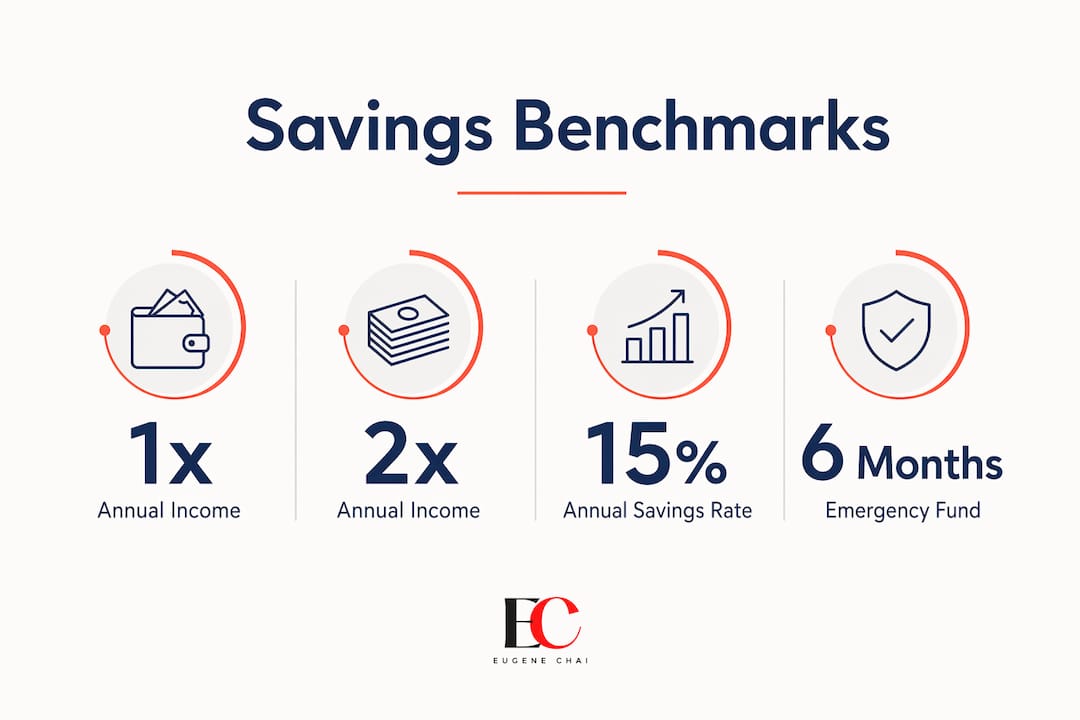
By age 35, the recommended savings benchmark is to have between one and two times your annual income set aside, supported by a fully funded emergency fund and no high-interest consumer debt. This target, widely cited by financial planners and institutions such as The Motley Fool and SmartAsset, gives Singaporean working professionals a concrete number to aim for rather than a vague sense of “saving more.” If you earn $72,000 a year, your savings goal for 35 sits between $72,000 and $144,000, inclusive of your CPF balances and cash savings. Knowing this figure matters because it determines whether your retirement at 65 is comfortable or compromised.
What does the 1x to 2x salary benchmark actually mean at 35?
The savings multiple framework is the standard industry term for measuring retirement readiness by age. It works by comparing your total accumulated savings to your current annual income, giving you a ratio that scales with your earnings rather than a fixed dollar figure.

A widely accepted target at age 35 is between 1x and 2x your annual salary. This means that if you earn $60,000 a year, you should have between $60,000 and $120,000 saved. The 2x figure is the more ambitious and more appropriate target if you want to retire comfortably by 65 to 67.
For Singaporeans, this total includes your CPF Ordinary Account (OA), Special Account (SA), and any cash savings or investments held outside CPF. Many people underestimate their CPF balances as part of their savings picture. Your CPF SA alone, growing at 4% per annum, is a meaningful retirement asset that counts toward this benchmark.
| Annual income | 1x target | 2x target |
|---|---|---|
| $48,000 | $48,000 | $96,000 |
| $60,000 | $60,000 | $120,000 |
| $72,000 | $72,000 | $144,000 |
| $90,000 | $90,000 | $180,000 |
The gap between median reality and the recommended target is significant. Median retirement savings for the 35 to 44 age group sits at roughly $43,000, well below the $120,000 to $160,000 benchmark for average earners. This tells you that most people are behind, which is both a warning and an opportunity to act now.
Pro Tip: Count your CPF SA balance separately from your OA when assessing retirement savings. The SA’s 4% interest rate makes it a powerful long-term asset, and many Singaporeans forget to include it in their savings multiple calculation.
How do emergency funds and debt management fit into ideal savings at 35?
A complete savings picture at 35 is not just about retirement funds. A comprehensive savings plan at 35 includes a six-month emergency fund and zero high-interest consumer debt. These two elements protect your retirement savings from being raided during a crisis.
Your emergency fund target is calculated simply: multiply your essential monthly expenses by six. If your rent, food, transport, and insurance total $3,500 per month, your emergency fund target is $21,000. This cash must be accessible within days, not weeks.
Here is what a sound emergency and debt strategy at 35 looks like:
- Emergency fund: Three to six months of essential expenses held in a high-yield savings account such as a UOB One or OCBC 360 account, where your money earns interest while remaining liquid.
- Separation from retirement savings: Emergency funds held separately in liquid accounts prevent you from withdrawing CPF or investment funds during unexpected financial shocks, which would derail long-term growth.
- High-interest debt elimination: Credit card debt in Singapore typically carries interest rates of 25% to 28% per annum. Carrying this debt while trying to save is counterproductive. Pay it off before increasing your savings rate.
- Structured debt payoff: Use the avalanche method, directing extra cash to the highest-interest debt first, then rolling that payment to the next debt once cleared.
The logic is straightforward. If you have $20,000 in credit card debt at 26% interest, no investment return will outpace that cost. Clearing the debt is the highest-return financial move available to you at 35.
Pro Tip: Place your emergency fund in a separate bank account from your daily spending account. Naming it “Emergency Only” in your banking app creates a psychological barrier that reduces the temptation to dip into it for non-emergencies.
What personal factors influence how much savings is ideal at 35?
Savings benchmarks are guides, not rigid rules. Individual circumstances, including lifestyle expectations, retirement age, and financial obligations, strongly influence what the right target is for you specifically.
Consider retirement age first. If you plan to retire at 55 rather than 65, you have ten fewer years of compounding and ten more years of drawdown. That changes your savings multiple from 2x to closer to 3x or 4x by age 35. Conversely, if you expect to work part-time into your 70s, a 1x target at 35 may be sufficient.
Housing obligations also reshape the picture. A Singaporean couple servicing a $500,000 HDB mortgage has less disposable income for savings than a couple who bought a smaller BTO flat. The Total Debt Servicing Ratio (TDSR) framework limits your mortgage repayments to 55% of gross monthly income, but even within that limit, a large mortgage compresses your savings capacity significantly.
Children add another layer. Each child in Singapore costs an estimated $200,000 to $400,000 from birth to university, depending on schooling choices. Parents of young children at 35 may find themselves temporarily below the 1x benchmark, which is understandable, provided they have a clear plan to accelerate savings once school fees stabilise.
Savings rate as a percentage of income is often more actionable than a total savings figure. Targeting 15% to 20% of your gross income saved each month, including CPF contributions, gives you a behaviour to track today rather than a historical number you cannot change.
What practical strategies can help you meet your savings goal at 35?
Meeting the ideal savings at 35 requires deliberate habits, not just good intentions. Here are the most effective strategies for Singaporeans in their 30s:
-
Automate your savings first. Set up a standing instruction on your salary credit date to transfer a fixed amount to a separate savings or investment account. Automating removes the decision entirely and prevents lifestyle spending from absorbing what should be saved.
-
Apply the 50/50 rule to every pay rise. Allocating half of any raise directly to savings prevents lifestyle inflation from consuming income growth. If your salary increases by $400 per month, $200 goes to savings and $200 improves your lifestyle. Over five years, this habit compounds meaningfully.
-
Maximise CPF contributions strategically. Your CPF SA earns 4% per annum, guaranteed. Consider Voluntary CPF Top-Ups to your SA under the Retirement Sum Topping-Up Scheme, which also provides IRAS tax relief of up to $8,000 per year. This is one of the most tax-efficient savings moves available to Singaporeans.
-
Open a Supplementary Retirement Scheme (SRS) account. SRS contributions reduce your taxable income dollar for dollar, up to $15,300 per year for Singapore citizens and PRs. Funds in SRS can be invested in unit trusts, ETFs, or Singapore Savings Bonds, allowing your retirement savings to grow beyond CPF.
-
Invest the surplus beyond your emergency fund. Cash sitting idle in a standard savings account loses purchasing power to inflation. Use platforms such as Endowus or Syfe to invest in diversified, low-cost portfolios aligned with your risk tolerance and time horizon.
-
Audit lifestyle creep annually. Review your monthly expenses each January. Subscriptions, dining habits, and transport costs tend to expand silently. A yearly audit identifies where spending has crept up without a corresponding improvement in quality of life.
How to recover if you are behind on your savings target at 35?
Being behind on your savings goal at 35 is common. The greatest risk is having zero savings. Starting or accelerating now still gives you approximately 30 years of compound growth before a typical retirement age of 65. That is a powerful runway.
The right approach is incremental and sustainable. Attempting to save 40% of your income overnight leads to burnout and reversal. Instead, increase your savings rate by 2% to 3% every six months until you reach your target rate.
| Scenario | Savings at 35 | Recommended action |
|---|---|---|
| Less than 0.5x salary | Below $30,000 on $60k income | Prioritise emergency fund, then maximise CPF SA top-ups |
| 0.5x to 1x salary | $30,000 to $60,000 on $60k income | Increase savings rate by 3% every six months |
| 1x salary | $60,000 on $60k income | On track; focus on investment growth and SRS contributions |
| 2x salary or above | $120,000+ on $60k income | Ahead of schedule; review retirement age and lifestyle goals |
Catch-up plans should prioritise employer contributions before increasing personal savings. If your employer offers any matching contributions through group insurance or benefit schemes, capture that fully before directing extra cash elsewhere. It represents an immediate return on your savings effort.
The power of compound interest is your greatest ally when recovering from a slow start. A $500 monthly contribution invested at 6% per annum from age 35 grows to approximately $474,000 by age 65. Starting at 40 with the same contribution produces roughly $335,000. The five-year difference costs you $139,000 in final wealth. Every month of delay has a real price.
Key takeaways
By age 35, the most reliable savings benchmark is one to two times your annual income, supported by a six-month emergency fund and no high-interest debt, with a savings rate of 15% to 20% of gross income as the most actionable daily metric.
| Point | Details |
|---|---|
| Savings multiple target | Aim for 1x to 2x your annual salary by 35, including CPF and cash savings. |
| Emergency fund first | Hold three to six months of essential expenses in a liquid, high-yield account. |
| Eliminate high-interest debt | Clear credit card debt before increasing your savings rate, as interest costs outpace investment returns. |
| Use CPF and SRS strategically | SA top-ups and SRS contributions offer guaranteed returns and IRAS tax relief. |
| Savings rate over total amount | Target 15% to 20% of gross income saved monthly as a behaviour you can control today. |
My honest reflection on savings anxiety and why goals changed everything
I will be candid: I spent a significant portion of my late 20s feeling genuinely stressed about savings milestones. I was constantly checking where I stood against benchmarks, comparing my CPF balance to what I thought I should have, and feeling behind even when I was making progress.
What changed things for me was setting a specific, numeric goal: $100,000 before turning 30. That single target transformed how I thought about money. Instead of vague anxiety, I had a number. I could calculate exactly how much I needed to save each month, track progress, and feel the satisfaction of closing the gap. I reached that goal ahead of schedule, largely because having a clear target made every spending decision feel connected to something meaningful.
The benchmarks in this article, the 1x to 2x salary framework, the six-month emergency fund, the 15% savings rate, are not meant to make you feel inadequate. They are meant to give you the same thing that $100k before 30 gave me: a concrete destination. Personalise them to your income, your HDB mortgage, your family situation. But use them. A goal you can measure is a goal you can reach.
— Eugene
Start building your savings plan today
If reading this article has made you want to take action, the next step is building a savings and budgeting system that works for your specific income and lifestyle.
At Eugenechaitf, we have put together practical, Singapore-specific resources to help you move from knowing the benchmarks to actually hitting them. Whether you are starting from scratch or looking to accelerate, our savings tips and strategies cover budgeting frameworks, CPF optimisation, and investment options tailored for Singaporeans in their 30s. You can also explore our guide on saving vs investing to understand how to grow your money once your emergency fund is in place. For those who want structured financial literacy coaching, Storehouse Firm offers financial literacy courses designed for working adults at exactly this stage of life.
FAQ
How much savings should I have at 35 in Singapore?
The recommended savings benchmark at 35 is between one and two times your annual income, including CPF OA, SA, and cash savings. For a Singaporean earning $72,000 per year, this means having between $72,000 and $144,000 saved.
Does CPF count towards my savings target at 35?
Yes. Your CPF OA and SA balances count as part of your retirement savings multiple. The SA in particular, earning 4% per annum, is a meaningful retirement asset that should be included in your total savings calculation.
What if I have less than 1x my salary saved at 35?
Start by securing a three to six month emergency fund, then increase your savings rate by 2% to 3% every six months. With roughly 30 years of compound growth still available, consistent contributions from age 35 can still produce a comfortable retirement outcome.
What savings rate should I target at 35?
Financial experts recommend saving 15% of your pre-tax income annually, including employer contributions. For a $72,000 salary, this equals approximately $10,800 contributed per year across CPF and personal savings.
Should my emergency fund be separate from my CPF savings?
Yes. Emergency funds should be held in a separate, high-liquidity account such as a UOB One or OCBC 360 account. Keeping them separate from CPF prevents you from disrupting long-term retirement growth during unexpected financial events.
Disclaimer: Informational only. Consult an MAS-licensed advisor before investing.






Leave a Reply