



TL;DR:
- Singapore’s median household income reached S$12,446 in 2025, growing 6.8% in real terms, indicating wage improvements beyond inflation. Median income per household member increased to S$4,160, serving as a useful benchmark for individual financial assessment. Profession-specific earnings vary significantly, with teachers, nurses, and doctors earning different amounts, all influenced by considerations like bonuses, CPF contributions, and sector differences.
The median income in Singapore is defined as the midpoint of the income distribution for resident workers, meaning exactly half of all employed residents earn above this figure and half earn below it. For 2026, this benchmark matters more than ever. I’ll be honest: I first looked up these numbers out of pure curiosity, wanting to know how my own earnings stacked up against my peers. What I found was genuinely illuminating, and if you are a young adult or working professional asking the same question, this guide gives you the full picture, including the latest household and individual figures, profession-specific comparisons, and practical steps to use this data for your own financial planning.
What is the median income in Singapore right now?
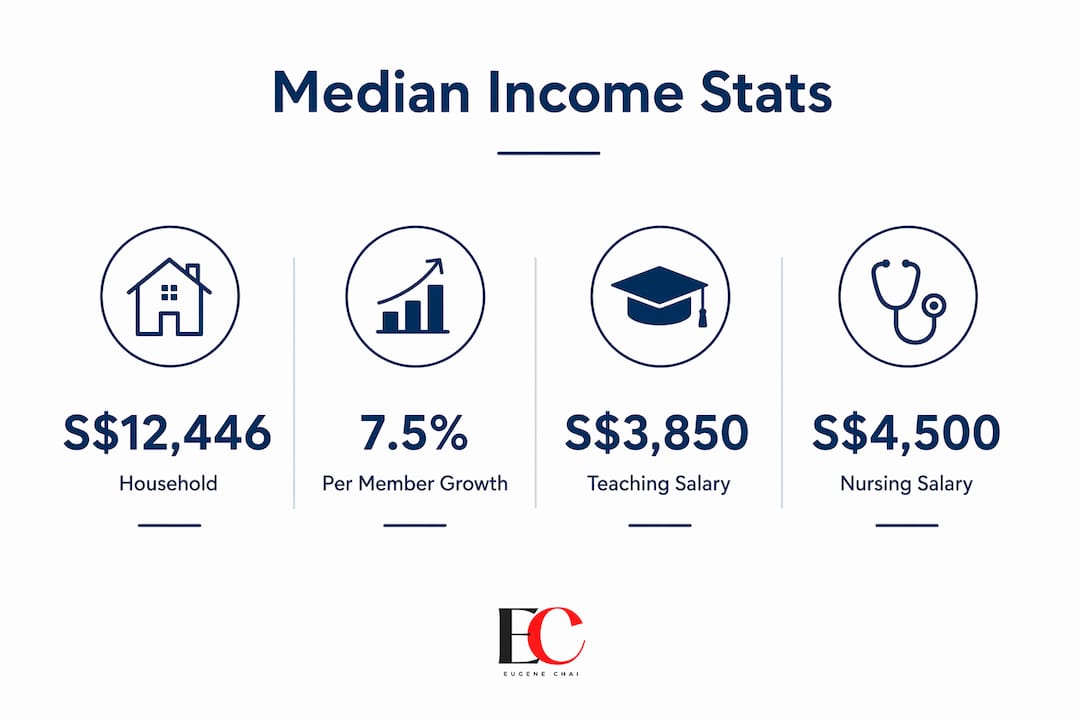
The median monthly household market income for resident households in Singapore reached S$12,446 in 2025, crossing the S$12,000 mark for the first time. This represents a 7.7% nominal increase and a 6.8% real growth from the 2024 figure of S$11,558, meaning wages are genuinely rising faster than inflation. For most working Singaporeans, this is an encouraging signal about the direction of the labour market.
The per-member figure tells an equally important story. Median income per household member rose 7.5% in real terms to S$4,160 in 2025, up from S$3,837 in 2024. This per-member figure is arguably more useful for individuals assessing their own financial standing, since it accounts for household size rather than treating a single-earner family the same as a dual-income couple.
It is worth understanding what “market income” actually covers in these reports. From 2025, Singapore’s definition of household income now includes non-employment sources such as rental income, investment returns, and CPF regular payouts, not just wages. This change means the 2025 figures are not directly comparable to earlier years, and the headline number is somewhat higher than a pure wage-based comparison would show.
For individual workers, the Ministry of Manpower publishes median gross monthly income by occupation for full-time employed residents, with the latest breakdown released in January 2026. This is the most granular data available and the most useful for comparing your own salary against peers in the same field.
| Metric | 2024 | 2025 | Real growth |
|---|---|---|---|
| Median household market income | S$11,558 | S$12,446 | 6.8% |
| Median income per household member | S$3,837 | S$4,160 | 7.5% |
Pro Tip: When comparing your salary to the median, use the per-member household figure rather than the total household figure. A household of four earning S$12,446 collectively is very different from a single professional earning that amount alone.
How do salaries vary across teaching, nursing, and medical professions?
Profession-specific salary data reveals significant variation around the median, and three sectors stand out for young Singaporeans considering their career earnings: education, nursing, and medicine.

Teaching salaries in Singapore are set to rise meaningfully in 2026. The Ministry of Education announced that 36,000 MOE staff will receive salary increases of 2% to 9% effective 1 October 2026, covering 33,000 education officers as well as allied educators and kindergarten teachers. The teaching salary in Singapore for a fresh graduate entering the profession typically starts in the range of S$3,500 to S$4,200 per month gross, placing new teachers close to or slightly above the individual median. Senior teachers and department heads earn considerably more, and the MOE salary adjustments reflect deliberate benchmarking against private sector pay to retain talent. Teaching salaries in Singapore are also supplemented by annual bonuses and performance-based merit increments, which can add one to three months of salary annually.
Nursing salaries in Singapore sit in a broad range depending on seniority and specialisation. A registered nurse in the public sector typically earns between S$3,000 and S$4,500 per month gross, while advanced practice nurses and nurse clinicians can earn S$5,000 and above. Nursing in Singapore carries structured career progression through the Singapore Nursing Board’s framework, and public sector nurses benefit from MediShield Life coverage and CPF contributions on top of their base pay.
Doctors’ pay in Singapore sits well above the median at virtually every career stage. Doctors in Singapore working in the public sector as medical officers typically earn from S$6,000 to S$9,000 per month, while consultants and senior consultants at restructured hospitals earn significantly more. Singapore’s relatively low income tax rates make net income a more relevant measure of financial standing than gross salary, which is a genuine advantage for high earners compared to peers in the United Kingdom or Australia.
Key points to note when comparing profession salaries:
- Total compensation matters. Bonuses, merit increments, and employer CPF contributions (currently 17% for those under 55) form a substantial part of real earnings.
- Public vs private sector gaps are significant in medicine and nursing, with private sector roles often paying more in base salary but offering fewer structured benefits.
- Career stage shifts the picture. A fresh teacher or nurse may earn near the median, but a senior professional in either field can comfortably exceed it within a decade.
Pro Tip: Always request the total remuneration breakdown when evaluating a job offer. Employer CPF contributions alone add 17% to your effective compensation, which is money you do not see in your monthly take-home pay but absolutely counts towards your financial position.
What factors are driving changes in Singapore’s median income?
Several distinct forces are shaping how median income figures move from year to year, and understanding them helps you interpret the numbers more accurately.
-
Expanded income definition. The 2025 shift to “market income” reporting, which now includes rental, investment, and CPF payout income, directly inflated the reported median. This is not a negative change, but it does mean you should not compare 2025 figures directly against 2020 or 2021 data without adjusting for this methodological difference.
-
Real vs nominal growth. The 6.8% real growth in household income means earnings are genuinely outpacing inflation, not just keeping pace with rising prices. For working professionals, this signals that wage growth in Singapore is substantive rather than cosmetic.
-
Income inequality is narrowing. Household income growth was stronger for lower income groups in 2025, and the Gini coefficient has improved compared to 2015 levels. This means the gap between the highest and lowest earners is gradually closing, which is a positive structural trend for the broader economy.
-
Government transfers and social support. Schemes such as CDC vouchers, Workfare Income Supplement, and ComCare top up the effective income of lower-earning households. These transfers are not included in market income figures but meaningfully improve the financial position of recipients.
-
Public sector salary revisions. Structured pay adjustments across the civil service and statutory boards, including the MOE salary revision affecting 36,000 staff, signal that the government actively manages wage competitiveness. These revisions ripple through private sector benchmarking as well, since employers use public sector pay scales as a reference point.
How can you use median income data to improve your financial planning?
Understanding where you sit relative to the median is the starting point for smarter financial decisions. Here is how to put this data to practical use.
-
Benchmark your salary honestly. If your gross monthly income is below S$4,160 (the 2025 median per household member), that is not a cause for alarm, but it is a signal to assess whether your career trajectory, sector, or skills mix is aligned with your financial goals. Use the Ministry of Manpower’s occupation-level data to compare within your specific field.
-
Account for CPF in your calculations. Your take-home pay understates your true compensation. Employer CPF contributions add 17% on top of your gross salary for those under 55. When comparing yourself to the median, use gross figures inclusive of employer CPF for an accurate picture.
-
Set salary growth targets, not just savings targets. If median income is growing at 6.8% in real terms, a salary increase of 3% to 4% annually means you are falling behind the median over time. Knowing this motivates proactive steps such as salary negotiation or upskilling.
-
Use median income as a budgeting anchor. The 50/30/20 budgeting framework (50% needs, 30% wants, 20% savings and investments) works well when calibrated to your actual income relative to the median. If you earn above the median, the 20% savings rate is a floor, not a ceiling. If you earn below it, prioritising CPF top-ups and SRS contributions can still build long-term wealth efficiently.
-
Invest the gap between your income and your expenses. Understanding the difference between saving and investing is one of the most practical steps you can take once you know where your income sits. Money sitting in a savings account earning 0.05% is not working as hard as it could be. Singapore’s low income tax environment, as noted in research on net income relevance, means more of your gross salary is available to deploy into investments compared to many other developed countries.
-
Review your tax position annually. Strategies to reduce personal income tax through CPF top-ups, SRS contributions, and approved donations can meaningfully improve your net financial position, particularly as your income grows above the median.
Key takeaways
Singapore’s median household income crossed S$12,446 in 2025, growing 6.8% in real terms, making it the most reliable benchmark for assessing your financial standing as a working professional.
| Point | Details |
|---|---|
| Household median income | S$12,446 per month in 2025, up 6.8% in real terms from 2024. |
| Per-member benchmark | S$4,160 per month per household member is the most useful individual comparison figure. |
| Profession variation | Teachers, nurses, and doctors all sit at different points relative to the median, with total compensation including CPF and bonuses being the accurate measure. |
| Income definition change | From 2025, market income includes rental, investment, and CPF payouts, affecting year-on-year comparability. |
| Planning application | Use median data to set salary growth targets, calibrate savings rates, and benchmark career progress annually. |
My honest take on chasing the median
I started looking at median income figures purely out of curiosity. I wanted to know, honestly, whether I was ahead, behind, or roughly in line with my peers. What surprised me was how much the framing of the question matters. The household median of S$12,446 sounds high until you realise it includes investment income and rental returns, not just wages. The per-member figure of S$4,160 is the number I now use as my personal benchmark.
What I find genuinely useful about tracking median income is not the comparison itself but the discipline it creates. When you know the median is growing at 6.8% in real terms, you have a concrete target for your own salary growth. A 3% annual increment suddenly looks insufficient rather than acceptable. That shift in perspective is worth more than any single financial tip.
The other thing I would caution against is treating the median as the goal. It is a midpoint, not a destination. Plenty of people earning well above the median are financially stressed because their spending scales with their income. Plenty of people earning at or below the median are building genuine wealth through disciplined saving and investing. The median tells you where you stand. What you do with that information is the part that actually matters.
— Eugene
Take your next step with Eugenechaitf
Understanding where your income sits relative to the median is a strong start. The more powerful move is putting that knowledge to work through a clear budget and a consistent investment habit. Eugenechaitf has practical, Singapore-specific resources to help you do exactly that. Start with the budgeting tips guide to build a spending plan that reflects your actual income, then explore the saving vs investing guide to understand how to grow what you keep. Both resources are built for Singaporeans navigating real financial decisions, not generic advice from overseas.
FAQ
What is the median income in Singapore in 2025?
The median monthly household market income in Singapore was S$12,446 in 2025, representing a 6.8% real increase from 2024. The median income per household member was S$4,160 per month.
How does teacher salary in Singapore compare to the median?
Teaching salaries in Singapore for fresh graduates typically range from S$3,500 to S$4,200 per month gross, placing new teachers close to the individual median. MOE salary adjustments of 2% to 9% effective October 2026 will improve this further.
What is the typical nursing salary in Singapore?
Nursing in Singapore pays between S$3,000 and S$4,500 per month for registered nurses in the public sector, with advanced practice nurses earning S$5,000 and above. Total compensation including employer CPF contributions adds approximately 17% on top of base pay.
How much do doctors earn in Singapore compared to the median?
Doctors’ pay in Singapore starts well above the median, with public sector medical officers typically earning S$6,000 to S$9,000 per month gross. Singapore’s low income tax rates mean doctors retain a higher proportion of gross earnings than peers in many other countries.
Why did Singapore’s median household income jump in 2025?
The increase reflects both genuine wage growth and a change in methodology. From 2025, market income includes non-employment sources such as rental income, investment returns, and CPF payouts, which raised the reported median beyond what wage growth alone would show.
Disclaimer: Informational only. Consult an MAS-licensed advisor before investing.






Leave a Reply