



TL;DR:
- Investment scams in Singapore involve schemes like Ponzi, fake trading platforms, and shell apps designed to steal funds through false promises and impersonation. Verifying credentials with official MAS and IRAS sources, acting quickly upon suspicion, and using security apps like ScamShield are crucial to avoiding loss. Immediate reporting to authorities and safeguarding evidence are essential steps if scammed, preventing further damage.
Investment fraud in Singapore is defined as any scheme that deceives individuals into committing funds under false pretences, typically through promises of high returns with little or no risk. Avoiding investment scams in Singapore requires more than scepticism. It demands active verification using official tools such as the MAS Investor Alert List, the ScamShield app, and IRAS advisories. Scammers in 2026 are more sophisticated than ever, using shell investment applications, WhatsApp group chats, and fake tax demands to extract money from unsuspecting investors. This guide walks you through how to recognise, verify, and respond to fraudulent investment schemes so you can invest safely and with confidence.
What are the common types and tactics of investment scams in Singapore?
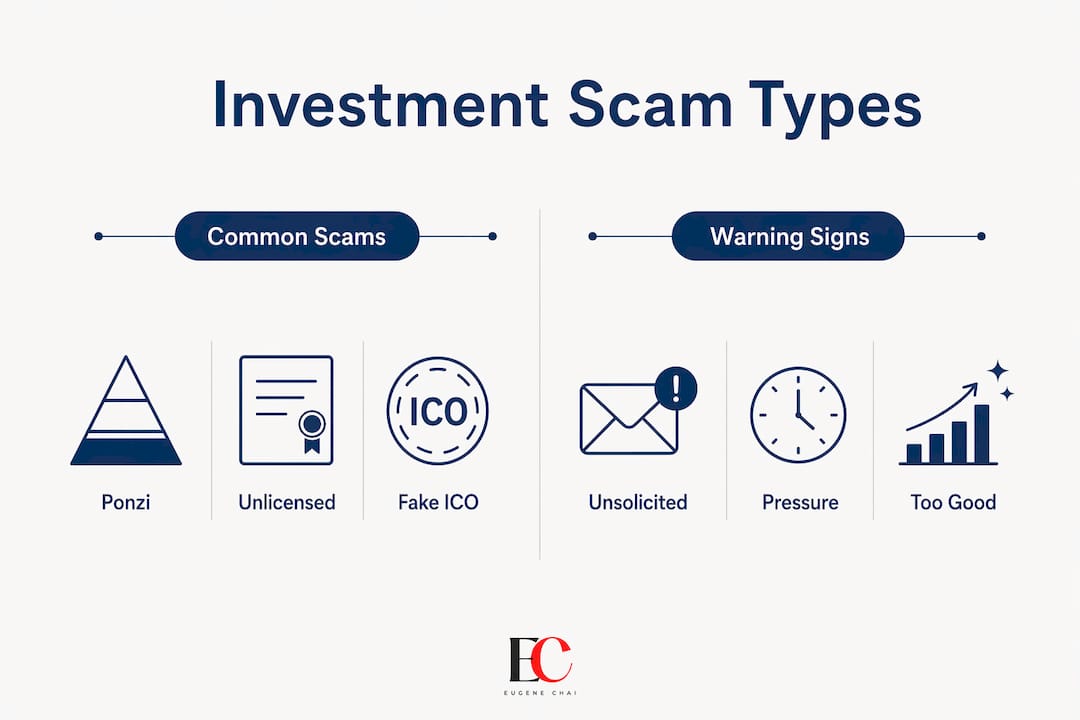
Investment scams in Singapore follow recognisable patterns once you know what to look for. The most prevalent formats include Ponzi schemes, fake trading platforms, and shell investment applications. Each is designed to appear credible long enough to extract your money before disappearing.

Ponzi schemes pay early investors using funds from newer participants, creating the illusion of genuine returns. They collapse once recruitment slows. Fake trading platforms mimic legitimate brokerages with professional-looking interfaces, fabricated profit dashboards, and customer service agents who are actually scammers. Shell investment apps are perhaps the most dangerous trend in 2026. These applications appear on official app stores with polished designs, but app store presence does not guarantee legitimacy. Always check user ratings and verify company licensing on MAS directories before downloading.
Common tactics used across all scam types include:
- Guaranteed high returns with no risk. No legitimate investment offers this. Any promise of 10%, 20%, or 30% monthly returns is a red flag without exception.
- Urgency and pressure. Scammers create artificial deadlines to prevent you from doing due diligence. Phrases like “limited slots” or “offer closes tonight” are deliberate pressure tactics.
- Social media recruitment. WhatsApp group chats filled with fake “successful investors” sharing fabricated testimonials are a primary recruitment channel in Singapore.
- Impersonation of banks or authorities. Scammers send messages mimicking MAS, IRAS, or DBS Bank, threatening account closures or penalties to coerce immediate payment.
- Fake tax demands. Investment scams often impersonate banks or authorities and pressure victims to pay fabricated taxes or fees via digital payment links before they can “withdraw” their profits.
Pro Tip: If someone contacts you unsolicited about an investment opportunity through Telegram, WhatsApp, or Instagram, treat it as suspicious by default. Legitimate investment firms do not recruit through personal messaging apps.
How to verify investment opportunities and spot warning signs
Verification is the single most effective defence against investment fraud. Cross-checking credentials with MAS and SPF-backed official sources is more reliable than trusting documents or company claims provided by the party seeking your money.
Follow these steps before committing any funds to an investment opportunity:
- Check the MAS Investor Alert List. The MAS maintains a publicly accessible list of unregulated entities and individuals suspected of conducting investment activities without a licence. Search the company name and any representative names at mas.gov.sg before proceeding.
- Verify using the MAS Financial Institutions Directory. Every licensed financial institution in Singapore is listed here. If the firm is not in this directory, it is not authorised to offer investment products to Singapore residents.
- Confirm the representative’s credentials. Ask for the representative’s MAS licence number and verify it directly on the MAS Register of Representatives. Do not accept screenshots or documents as proof.
- Scrutinise any tax-related demands. IRAS clarifies they never ask taxpayers to pay taxes via third-party accounts or digital payment links. Any demand to pay capital gains tax, stamp duty, or GST on investment profits before withdrawal is a classic scam signal. Cease all engagement immediately. Singapore does not impose capital gains tax on personal investment profits, so any such demand is fraudulent by definition.
- Install and use ScamShield. ScamShield combined with prompt action minimises scam impact by filtering suspicious calls and messages before they reach you. It is a free app developed by the Singapore Police Force and GovTech.
- Review app store ratings critically. A polished app with few reviews or a sudden spike in five-star ratings is a warning sign. Read one-star reviews carefully as they often reveal withdrawal problems or account freezes.
| Warning sign | What it means |
|---|---|
| Unlicensed firm or representative | Not authorised to offer investments in Singapore; engaging is high risk |
| Unsolicited contact via messaging apps | Legitimate firms do not cold-recruit through WhatsApp or Telegram |
| Requests to pay taxes before withdrawal | No such tax exists in Singapore; this is a deliberate scam workflow |
| Overseas bank account for fund transfer | Funds sent abroad are extremely difficult to recover |
| Pressure to invest quickly | Designed to prevent due diligence; always a red flag |
Pro Tip: Before investing in any opportunity, spend 15 minutes on the MAS Investor Alert List and the MAS Financial Institutions Directory. This single habit has prevented more losses than any other precaution I know of.
Understanding official IRAS tax rules is also worth your time. Knowing what taxes actually apply to your investments makes fake tax demands immediately obvious.
What steps should you take to protect yourself while investing safely?
Protecting yourself from investment fraud is an ongoing practice, not a one-time check. The following behaviours, adopted consistently, significantly reduce your exposure to scams.
- Guard your personal data. Never share your SingPass credentials, NRIC number, or bank account details with any investment platform or representative unless you have independently verified their legitimacy through MAS. Scammers use personal data to impersonate you or access your accounts.
- Avoid clicking unsolicited links. Links sent via SMS, WhatsApp, or email can redirect you to phishing sites that harvest your login credentials. Type URLs directly into your browser instead of clicking through messages.
- Do not download unverified apps. Even apps available on the Apple App Store or Google Play can be fraudulent. Verify the developer name, check the number of downloads, and confirm the company’s MAS licence before installing any investment application.
- Consult a licensed financial adviser before investing. MAS-licensed advisers are legally obligated to act in your interest and recommend suitable products. They provide a layer of accountability that unlicensed operators cannot. You can find licensed advisers through the MAS Financial Institutions Directory.
- Keep records of all communications. Save screenshots of conversations, payment receipts, and any documents provided by the investment firm. These records are critical if you need to report a scam or pursue recovery.
- Enable security features on your devices. Use two-factor authentication on banking apps such as DBS digibank, OCBC Digital, and UOB TMRW. Set your WhatsApp and Telegram to restrict unknown contacts from adding you to group chats.
- Stay informed through official channels. Follow SPF’s ScamAlert website and MAS announcements for the latest scam advisories. New scam formats emerge regularly, and awareness is your first line of defence.
Reviewing common investment mistakes alongside scam awareness gives you a fuller picture of the risks facing Singapore investors in 2026.
What to do if you suspect or fall victim to an investment scam
Speed of response when detecting a scam attempt is the single most important factor in limiting your losses and enabling recovery. Every hour of delay gives scammers more time to move funds beyond reach.
Follow these steps immediately:
- Stop all transactions with the suspected entity. Do not transfer any further funds, regardless of what the scammer tells you. Promises of recovering your money by paying more fees are a secondary scam tactic called “recovery fraud.”
- Preserve all evidence. Take screenshots of conversations, transaction records, app interfaces, and any documents received. Do not delete messages even if pressured to do so.
- Contact your bank immediately. Call the anti-scam hotline of your bank, whether DBS (1800 339 6963), OCBC (1800 363 3333), or UOB (1800 222 2121), and request a transaction freeze or recall. The MAS Shared Responsibility Framework makes financial institutions accountable to consumers in phishing and scam cases, so your bank has both the obligation and the tools to assist.
- Report to the Singapore Police Force. File a report at any Neighbourhood Police Centre or online at police.gov.sg/iwitness. Provide all evidence collected. A police report number is required for most fund recovery processes.
- Report to MAS. Submit a complaint through the MAS Consumer Portal. MAS uses these reports to update the Investor Alert List and pursue enforcement action against fraudulent operators.
- Use ScamShield and official helplines. Structured reporting and action help minimise losses and enable authorities to act. The National Anti-Scam Helpline is available at 1800 722 6688.
“If you have been scammed, the worst thing you can do is wait. Report to your bank and SPF within hours, not days. The faster authorities are notified, the greater the chance of fund recovery.”
Key takeaways
Avoiding investment fraud in Singapore requires combining official verification tools, consistent personal security habits, and rapid response when something feels wrong.
| Point | Details |
|---|---|
| Verify before you invest | Check every firm and representative on the MAS Investor Alert List and Financial Institutions Directory. |
| Reject fake tax demands | Singapore has no capital gains tax on personal profits; any such demand is a scam signal. |
| Use ScamShield proactively | Install ScamShield to filter suspicious calls and messages before they reach you. |
| Act immediately if targeted | Contact your bank and SPF within hours to maximise the chance of fund recovery. |
| Keep records of everything | Screenshots and transaction records are your primary evidence for police reports and recovery claims. |
What I have learned about scams after years of watching Singapore investors get burned
I have been writing about personal finance in Singapore for long enough to see the same patterns repeat, just with shinier packaging each time. The shell investment app trend in 2026 is particularly troubling because it exploits the trust people place in official app stores. Many readers assume that if something is on the App Store, it has been vetted. It has not been vetted for financial legitimacy, only for technical compliance.
What I find most concerning is how many victims delay reporting because they feel embarrassed. That delay is exactly what scammers count on. The upstream tools like ScamShield combined with downstream bank alerts represent the best available protection, but they only work if you use them before and during a scam, not after the money is gone.
My honest advice: treat every unsolicited investment offer as fraudulent until proven otherwise through MAS verification. Not suspicious. Fraudulent. That mental shift changes how quickly you act, and speed is everything. If you are just starting out and want to build a foundation of safe investing habits, the best investment options for beginners in Singapore are a good place to start before you encounter anyone trying to sell you something more exotic.
— Eugene
Start investing safely with the right guidance

Knowing how to spot a scam is only half the equation. The other half is building a sound investment strategy so you are not tempted by unrealistic promises in the first place. At Eugenechaitf, we cover everything from beginner-friendly investment options to tax-efficient strategies tailored for Singapore residents. Our investment tips and strategies section is built specifically for Singaporeans who want to grow their wealth without taking on unnecessary risk. Whether you are a young adult putting aside your first $500 or a working professional looking to diversify beyond your CPF, you will find practical, locally relevant guidance here. Explore the resources, ask questions, and invest with confidence.
FAQ
What is the MAS Investor Alert List?
The MAS Investor Alert List is a publicly accessible register of unregulated persons and entities suspected of conducting investment activities without a licence in Singapore. Checking it before investing is one of the most reliable ways to identify fraudulent operators.
Does Singapore have a capital gains tax on investments?
Singapore does not impose capital gains tax on personal investment profits. Any demand to pay such a tax before withdrawing investment returns is a scam tactic, as confirmed by IRAS.
How do I report an investment scam in Singapore?
Report to the Singapore Police Force via police.gov.sg/iwitness, contact your bank’s anti-scam hotline immediately, and submit a complaint to MAS through the MAS Consumer Portal. Call the National Anti-Scam Helpline at 1800 722 6688 for assistance.
Is an investment app on the App Store safe to use?
An app’s presence on the Apple App Store or Google Play does not confirm it is a legitimate investment platform. Always verify the company’s MAS licence and check user reviews for withdrawal complaints before using any investment application.
What should I do first if I suspect an investment scam?
Stop all transactions immediately and preserve all evidence, including screenshots and payment records. Then contact your bank and the Singapore Police Force as quickly as possible to maximise the chance of recovering your funds.
Disclaimer: Informational only. Consult an MAS-licensed advisor before investing.






Leave a Reply