



TL;DR:
- Setting clear, measurable financial goals improves money management and reduces stress.
- Automating savings and focusing on foundational goals build long-term financial stability.
Financial goals are defined as clear, measurable targets that direct your money management decisions towards improved well-being and long-term security. Research published in the Future Business Journal in april 2026 confirms that structured goal setting mediates financial well-being directly, with goal articulation and monitoring correlating strongly with reduced money-related strain (β = 0.245, p < .001). That finding matters because it shows goal setting is not just motivational advice. It is a self-regulatory process built on four pillars: clarity, commitment, time framing, and ongoing monitoring. Understanding the role of financial goals gives you a framework to make every dollar work with purpose, whether you are saving for an HDB flat, building an emergency fund, or planning for CPF LIFE top-ups in retirement.
What is the role of financial goals in personal finance?
Financial goal setting is a formal self-regulatory process, not simply a budgeting exercise. The same Future Business Journal study found that financial self-efficacy, your belief in your ability to manage money well, is directly associated with better financial outcomes (β = 0.372, p < .001). That is a stronger predictor than income alone. Goals give that self-efficacy something concrete to act on.

Without defined targets, spending decisions default to habit and impulse. With them, you have a filter. Every purchase, every transfer, every CPF voluntary contribution gets measured against a stated objective. That shift from reactive to intentional money management is the core benefit of setting financial objectives.
The four pillars of effective goal setting create a feedback loop. Clarity tells you what you are working towards. Commitment keeps you consistent. Time framing creates urgency. Ongoing monitoring shows you whether your actions are working. Together, they replace vague financial anxiety with a structured plan.
How does the SMART framework shape effective financial goals?
The SMART framework transforms vague intentions into actionable financial targets with set timelines. SMART stands for Specific, Measurable, Achievable, Relevant, and Time-bound. Each element removes ambiguity from the goal-setting process.
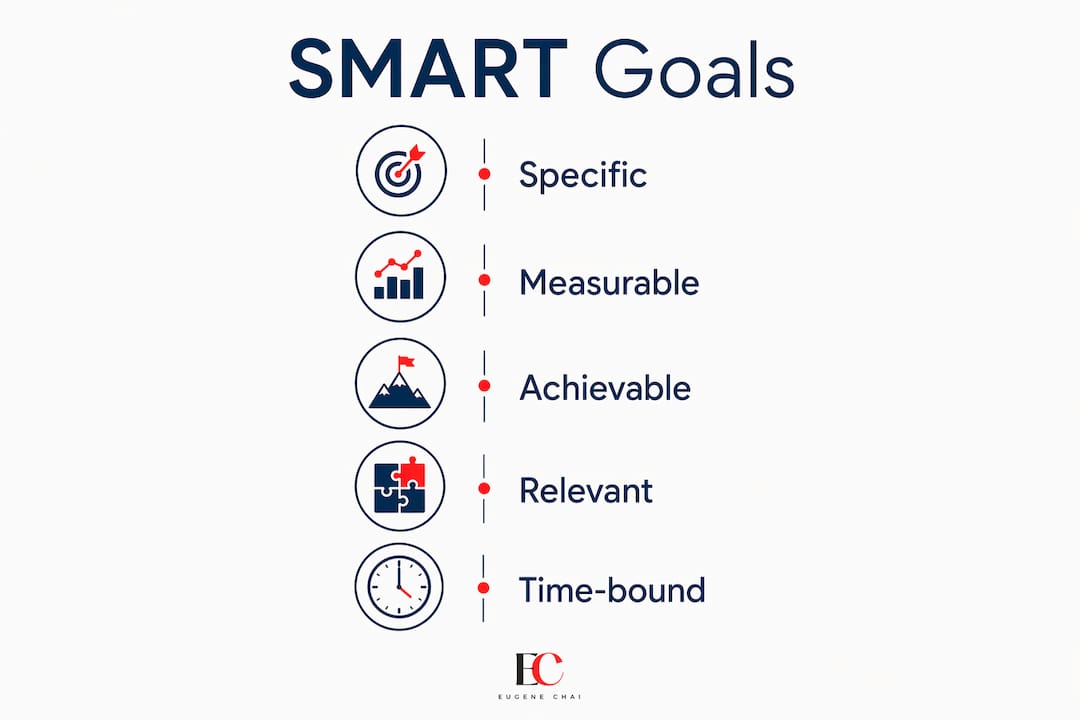
A goal like “save more money” fails all five criteria. A SMART version looks like this: “Save $6,000 in my OCBC 360 account within 12 months by setting aside $500 per month via GIRO.” That goal is specific (OCBC 360), measurable ($6,000), achievable (based on your income), relevant (emergency fund), and time-bound (12 months).
Goal categories by time horizon
Financial goals fall into three time categories, each requiring a different approach:
| Goal type | Time horizon | Singapore example |
|---|---|---|
| Short-term | Under 1 year | Build a $5,000 emergency fund |
| Medium-term | 3–10 years | Save for HDB BTO down payment |
| Long-term | 10+ years | Grow CPF SA for retirement via voluntary top-ups |
Categorising goals by horizon matters because it determines which financial products suit each target. Short-term goals need liquidity. Long-term goals can tolerate more volatility in exchange for higher growth potential.
- Short-term: High-yield savings accounts (e.g., UOB One, OCBC 360)
- Medium-term: Singapore Savings Bonds (SSBs), endowment plans
- Long-term: Diversified ETFs, CPF SA top-ups, SRS contributions
Pro Tip: Write your SMART goals down and review them monthly. Research consistently shows that written goals with review schedules outperform mental intentions alone.
Why do psychology and behaviour affect financial goal success?
The biggest barrier to achieving financial goals is rarely a lack of knowledge. It is behaviour. Financial avoidance, driven by emotional barriers like shame and anxiety, predicts poor financial outcomes more reliably than income or financial literacy in some studies. Avoidance means ignoring bank statements, delaying budget reviews, and putting off investment decisions indefinitely.
Present bias compounds the problem. The human brain consistently overvalues immediate rewards over future ones. Spending $80 at a hawker centre dinner with friends feels more real than the $80 that could have gone into your emergency fund. Recognising this bias is the first step to designing systems that work around it.
“Automation bypasses moment-to-moment willpower entirely. The Save More Tomorrow programme demonstrated that participants increased their savings rates significantly without relying on added willpower. The system did the work, not the individual’s resolve.”
The practical implication is straightforward. Set up GIRO transfers to a separate savings account on payday. Automate your CPF SA top-ups if your budget allows. Remove the decision from your daily routine and the behaviour follows automatically.
Pro Tip: If career uncertainty is making your financial goals feel unstable, reading about managing career transitions can help you reframe your financial plan around changing income scenarios rather than abandoning goals entirely.
The goal-setting paradox is also worth noting. Setting too many goals at once reduces follow-through on all of them. Cognitive load increases, motivation fragments, and progress stalls. Focus on one or two primary goals at a time and add others only when the first are on track.
How do financial goals guide smarter investment decisions?
Clear financial goals act as decision filters that reduce impulse spending and align your investments with your timeline and risk tolerance. Assigning specific financial targets increases motivation and improves decision quality across financial behaviour. That means fewer unplanned purchases and more consistent contributions to savings and investment accounts.
Matching investment type to goal timeline is critical. Short-term goals need low-risk, liquid assets. Long-term goals can bear volatility in exchange for higher expected returns. Mismatching the two is one of the most common and costly planning errors.
Matching assets to goal horizons
| Goal horizon | Risk tolerance | Suitable vehicles (Singapore context) |
|---|---|---|
| Short-term (under 1 year) | Low | High-yield savings, T-bills, SSBs |
| Medium-term (3–10 years) | Moderate | Endowment plans, balanced unit trusts |
| Long-term (10+ years) | Higher | Diversified ETFs, CPF SA, SRS investments |
As a goal approaches its deadline, the appropriate response is to reduce risk exposure. A portfolio built for a 10-year horizon should look different in year nine than it did in year one. Risk-averse investment options become more relevant as timelines shorten and capital preservation takes priority over growth.
Goals also reduce decision fatigue. When you know your next $500 is earmarked for your HDB down payment fund, the decision about where it goes is already made. That clarity prevents the mental drain of weighing competing uses for every dollar you earn.
How do you prioritise, monitor, and adjust financial goals?
Prioritising foundational goals before flexible ones is the most reliable path to financial stability. Experts recommend focusing first on an emergency fund and high-interest debt repayment before directing money towards investment or lifestyle goals. This sequencing creates capacity. Once your foundation is secure, funding additional goals becomes far easier.
A practical prioritisation order for most Singaporeans looks like this:
- Build a 3-to-6-month emergency fund in a liquid, high-yield account.
- Clear high-interest debt (credit card balances, personal loans).
- Maximise CPF contributions where relevant, particularly SA top-ups for tax relief.
- Fund medium-term goals such as an HDB down payment or education savings.
- Invest for long-term wealth via diversified ETFs or SRS contributions.
Monitoring progress is as important as setting the goal. A monthly review of your budgeting and spending against your targets creates the feedback loop that keeps goals alive. Without regular review, goals drift. With it, you catch shortfalls early and adjust before they become setbacks.
Phasing goals when income is limited is not a compromise. It is sound planning. If your take-home pay after CPF deductions leaves little room, focus entirely on the emergency fund first. Small, consistent wins build the habit and the confidence to tackle larger goals later.
Pro Tip: Use a simple spreadsheet or a free budgeting app to track your monthly progress against each goal. Seeing the number move, even by a small amount, reinforces the behaviour and sustains motivation over time.
Life changes require goal adjustments. A new job, a marriage, a child, or a health event all shift your financial picture. Treat your goals as living documents, not fixed commitments. Revising a goal in response to real circumstances is not failure. It is good financial management.
Key takeaways
Structured financial goal setting, built on clarity, commitment, time framing, and ongoing monitoring, is the most reliable driver of improved financial well-being and long-term money management.
| Point | Details |
|---|---|
| Goals reduce financial stress | Research links clear goal articulation and monitoring to measurably lower money-related strain. |
| SMART goals outperform vague intentions | Specific, time-bound targets with measurable milestones produce better follow-through than general aspirations. |
| Automation beats willpower | Setting up GIRO transfers removes daily decision-making and sustains saving behaviour over time. |
| Match assets to goal timelines | Short-term goals need liquid, low-risk accounts; long-term goals can use diversified ETFs or CPF SA top-ups. |
| Prioritise foundations first | Build your emergency fund and clear high-interest debt before funding flexible or investment goals. |
What I have learned from years of setting financial goals
Most people treat financial goals as a January ritual. They write a list, feel motivated for three weeks, and then quietly abandon it by february. I did exactly that for the first few years of my working life in Singapore. The problem was not discipline. It was design.
The turning point for me was accepting that willpower is a finite resource. Automating my savings on the first of every month, before I could spend the money, changed everything. I stopped relying on motivation and started relying on systems. That shift is the single most underrated piece of financial advice I can offer.
I have also seen the damage that emotional avoidance causes. Readers who contact Eugenechaitf often describe knowing they should review their finances but feeling paralysed by anxiety or shame. That avoidance is not a character flaw. It is a predictable psychological response. The fix is to make the first step so small it feels impossible to avoid. Open the app. Check one account. That is enough to break the cycle.
The SMART framework is genuinely useful, but only when paired with personal motivation. A goal that is technically SMART but emotionally meaningless will not survive the first difficult month. Connect your financial targets to something real: the flat you want to own, the security you want your family to feel, the freedom to stop worrying about your MediShield Life premiums. That connection is what sustains the goal when the numbers get hard.
Flexibility matters too. I have revised my own goals multiple times in response to life changes, and each revision made the plan stronger, not weaker. The goal is not to stick rigidly to a plan. The goal is to keep moving in the right direction.
— Eugene
Build your financial goals with Eugenechaitf
Eugenechaitf covers the full spectrum of personal finance for Singaporeans, from first budgets to long-term investment planning. Whether you are setting your first savings target or refining a multi-year wealth-building plan, the guides on this site give you the practical tools to move forward with confidence.
The financial goals guide for your 20s is a strong starting point if you are building your plan from scratch. For readers who want a broader view of personal finance resources tailored to the Singapore context, the Eugenechaitf home brings together budgeting, saving, and investing guides in one place. If you are working through budgeting challenges specifically, the budgeting strategies guide addresses the most common obstacles Singaporeans face when trying to stick to a spending plan.
FAQ
What is the role of financial goals in money management?
Financial goals provide clear targets that direct spending, saving, and investment decisions. Research shows they reduce financial stress and improve self-efficacy, which are stronger predictors of financial well-being than income alone.
How does the SMART framework help with financial planning?
The SMART framework makes goals Specific, Measurable, Achievable, Relevant, and Time-bound. This structure converts vague intentions into concrete steps with deadlines, which significantly improves follow-through.
Why do people fail to achieve their financial goals?
Financial avoidance driven by anxiety or shame is a primary cause of poor financial outcomes. Present bias, the tendency to overvalue immediate rewards, also undermines long-term goal commitment.
How should I match investments to my financial goals?
Short-term goals (under one year) require liquid, low-risk assets such as T-bills or high-yield savings accounts. Long-term goals (10+ years) can use diversified ETFs, CPF SA top-ups, or SRS investments to pursue higher growth.
How often should I review my financial goals?
A monthly review is the most effective frequency for most readers. Regular monitoring creates the feedback loop that keeps goals on track and allows early adjustments when income or circumstances change.
Disclaimer: Informational only. Consult an MAS-licensed advisor before investing.






Leave a Reply