



TL;DR:
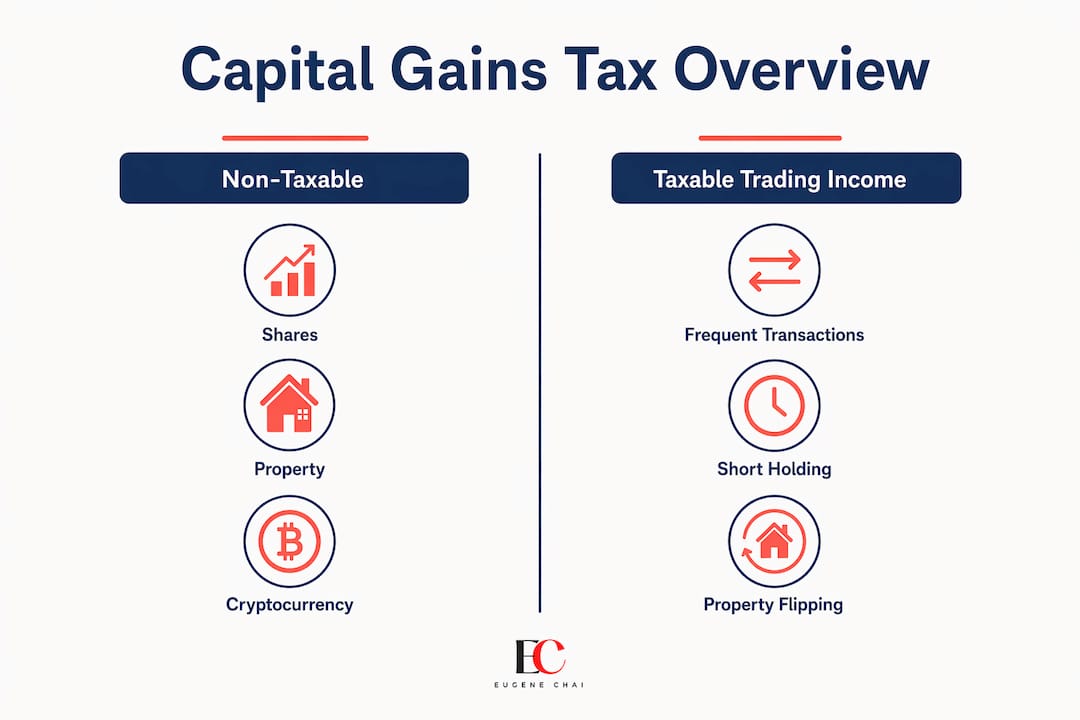
- Singapore does not charge a capital gains tax on individual profits from long-term investments in shares, property, or cryptocurrency. However, gains may be taxed as income if IRAS determines the activity resembles trading, based on intent, frequency, and financing. Foreign-sourced gains are generally exempt if they are genuinely capital in nature and taxed abroad.
Singapore does not impose a capital gains tax on individuals who profit from selling shares, property, or cryptocurrency under ordinary investment circumstances. This is one of the most investor-friendly features of Singapore’s tax system, and it is a fact that surprises many newcomers and even long-term residents. The Inland Revenue Authority of Singapore (IRAS) oversees all tax matters, and while capital gains are generally exempt, IRAS can reclassify gains as taxable trading income when certain conditions are met. Understanding where that line sits is the foundation of sound financial planning in Singapore. This guide covers the rules, the exceptions, and what they mean for your investments in 2026.
What counts as capital gains in Singapore?
Capital gains are profits made from selling a capital asset, such as shares, property, or cryptocurrency, at a price higher than you paid for it. The gain is “realised” when you complete the sale. An “unrealised” gain, where the asset has risen in value but you have not yet sold it, is never taxable anywhere in the world, including Singapore.

Singapore has no capital gains tax, no dividend tax, and no inheritance tax as of 2026. This means a long-term investor who buys shares in a Singapore Exchange (SGX) listed company, holds them for several years, and then sells at a profit pays zero tax on that gain. The same applies to private property sold after the minimum occupation period and to cryptocurrency held as a long-term investment.
The rationale sits within Singapore’s territorial tax system. Singapore taxes income earned in or derived from Singapore. Capital appreciation is not classified as income under the Income Tax Act. That distinction is the cornerstone of why Singapore attracts globally diversified investors and expatriates.
Common assets where capital gains typically arise include:
- Shares and equities, including SGX-listed stocks and overseas shares
- Residential and commercial property, including HDB resale flats and private condos
- Cryptocurrency, such as Bitcoin and Ethereum held as investments
- Unit trusts and ETFs held for long-term wealth building
- Bonds and fixed income instruments sold before maturity at a profit
When does IRAS treat gains as taxable trading income?
IRAS does not automatically accept that every asset sale produces a capital gain. When IRAS determines that a taxpayer is carrying out a trade or business in assets, the profits become taxable as income. Progressive income tax rates apply, running from 0% to 24% for residents in 2026. That is a significant difference from paying nothing at all.
IRAS uses a set of criteria to make this determination. No single factor is decisive. IRAS considers all factors collectively, including:
- Intent at the time of purchase. Did you buy the asset to resell it quickly for profit, or to hold it as a long-term investment?
- Transaction frequency. Buying and selling the same type of asset repeatedly signals trading behaviour.
- Holding period. Short holding periods, such as days or weeks, suggest trading rather than investing.
- Financing method. Using borrowed money to fund purchases is a marker of trading activity.
- Asset type and nature. Some assets, such as shares, are more commonly held for investment. Others, such as pre-sale property units bought and flipped, raise more scrutiny.
A practical example: an individual who buys 10 different SGX stocks over five years, holds each for two or more years, and sells gradually is almost certainly an investor. An individual who buys and sells the same penny stocks dozens of times in a single month, using a margin account, looks far more like a trader. IRAS would likely tax the second person’s profits as income.
Property flipping is another common trigger. Buying a private condo, renovating it quickly, and selling within a year, especially repeatedly, signals trading intent. IRAS has the authority to assess those profits as taxable income, separate from any Additional Buyer’s Stamp Duty (ABSD) or Seller’s Stamp Duty (SSD) already paid.
Pro Tip: Keep a written record of your investment rationale at the time of every purchase. A simple note stating your long-term intent and expected holding period can support your position if IRAS ever queries your gains.
One corporate exception worth knowing is the Safe Harbour Rule. Companies that hold at least 20% of another company’s shares for a minimum of 24 months can dispose of those shares tax-free. This rule applies to companies, not individuals, but it is relevant if you invest through a holding structure.
How are foreign-sourced gains treated under Singapore tax rules?
Singapore’s territorial tax system generally does not tax income or gains that arise outside Singapore. Foreign-sourced capital gains are not taxable in Singapore, even when remitted back into the country, provided they are genuinely capital in nature.
Foreign-sourced income exemptions are governed by Sections 13(7A) to 13(12) of the Income Tax Act. The key conditions for exemption include:
- The income must be subject to tax in the foreign jurisdiction where it originates
- The headline tax rate in that jurisdiction must be at least 15%
- The income must not be artificially routed through a low-tax territory
Foreign dividends remitted to Singapore by individuals are generally exempt. Foreign-sourced capital gains, being outside the scope of income tax entirely, face no remittance tax either. This makes Singapore particularly attractive for investors with globally diversified portfolios.
Expatriates and Permanent Residents with overseas investments benefit significantly from this structure. A Singapore PR who holds US equities through a brokerage account and sells at a profit does not pay Singapore tax on that gain, regardless of whether the proceeds are transferred to a Singapore bank account. The planning consideration is to ensure the gain is genuinely capital in nature and not reclassified as trading income by IRAS.
Foreign-sourced income exemptions require careful planning, especially for partnership income and complex remittance structures. If you operate through a foreign entity or partnership, the rules become more nuanced and professional advice is worth seeking.
Practical impact on your financial planning and investing
Singapore’s tax regime creates a genuine advantage for long-term investors. The combination of 0% capital gains tax and low progressive income tax means that patient, buy-and-hold investors keep far more of their returns than investors in most other developed economies. This is not a minor benefit. It compounds significantly over decades.
The table below compares the tax treatment of different investment activities in Singapore:
| Activity | Tax treatment | Key risk |
|---|---|---|
| Long-term share investing | No capital gains tax | Reclassification if trading-like |
| Frequent share trading | Taxable as income (0–24%) | Frequency and financing scrutiny |
| Property held long-term | No capital gains tax | ABSD and SSD still apply |
| Property flipping | Potentially taxable as income | Intent and frequency assessed |
| Foreign dividends (remitted) | Generally exempt | Must meet Income Tax Act conditions |
| CPF investment scheme gains | Not taxable | CPF withdrawal rules apply separately |
CPF adds another layer to consider. Gains made through the CPF Investment Scheme (CPFIS) are not subject to income tax. However, CPF funds remain subject to CPF withdrawal rules, so the tax efficiency of CPFIS gains is only realised when you access those funds at the appropriate age.
Accurate reporting to IRAS matters even when you believe your gains are capital in nature. If IRAS later determines that your activity constitutes trading, non-declaration of taxable gains can result in penalties, backdated interest, or prosecution under the Income Tax Act. Taxable trading gains must be reported under “Other Income” in your annual IRAS tax return.
Pro Tip: If you are unsure whether your investment activity crosses into trading territory, consult a tax professional before filing. The cost of advice is far lower than the cost of a penalty assessment.
For readers building their tax-efficient investing approach, the key principle is straightforward: invest with a genuine long-term intent, document that intent, and avoid patterns that mimic trading behaviour.
Common misconceptions about capital gains tax in Singapore
Several persistent myths cause unnecessary confusion, and some of them lead to real financial mistakes.
- “All gains in Singapore are tax-free.” This is false. Gains classified as trading income are taxable at progressive rates up to 24%. The absence of a formal capital gains tax does not mean all profits escape tax.
- “Frequent trading is fine as long as I declare nothing.” IRAS has the authority to audit investment activity and reclassify gains. Non-declaration of trading income is a compliance risk, not a strategy.
- “GST applies to my investment profits.” It does not. Singapore’s GST rate is 9% in 2026, applied to the consumption of goods and services. Most financial services and residential property transactions are exempt from GST. Capital gains and trading income fall entirely outside the GST framework.
- “Property gains are always tax-free after the MOP.” The Minimum Occupation Period (MOP) for HDB flats affects eligibility to sell, not tax treatment. IRAS can still assess property gains as trading income if the pattern of behaviour indicates it.
- “IRAS only looks at one factor.” IRAS takes a holistic view. No single factor, such as holding period alone, determines the outcome. The full picture of your behaviour, intent, and financing is assessed together.
Understanding these distinctions protects you from both over-paying and under-reporting. The Singapore stock market investing basics guide on Eugenechaitf covers these principles in practical detail for newer investors.
Key takeaways
Singapore’s absence of capital gains tax is a genuine, lasting advantage for long-term investors, but gains reclassified as trading income by IRAS are fully taxable at progressive rates up to 24%.
| Point | Details |
|---|---|
| No capital gains tax for investors | Singapore does not tax profits from asset sales under ordinary long-term investment activity. |
| Trading gains are taxable | IRAS taxes frequent, short-term trading profits as income at rates from 0% to 24%. |
| IRAS uses multiple criteria | Intent, frequency, holding period, and financing are all assessed together, not in isolation. |
| Foreign gains are generally exempt | Foreign-sourced capital gains are not taxable in Singapore, even when remitted, if genuinely capital in nature. |
| Non-declaration carries penalties | Failing to report taxable trading income can result in backdated assessments, interest, and prosecution. |
My honest view on navigating Singapore’s capital gains tax landscape
I have been investing in Singapore for years, and the single biggest mistake I see people make is assuming that the absence of a formal capital gains tax means they can trade freely without any tax consequence. That assumption is wrong, and IRAS has become increasingly attentive to patterns that look like trading dressed up as investing.
The practical reality is that the line between investor and trader is not always obvious. I have seen people with ten or fifteen stock transactions a year get nervous about classification. In most cases, if you are buying diversified assets with a genuine long-term view and not using margin financing aggressively, you are almost certainly on the right side of the line. The key is documentation. Write down why you bought each asset. Note your expected holding period. Keep records of your financing arrangements.
Where I think conventional wisdom falls short is on property. Many Singaporeans assume that selling a private condo or an EC after the MOP is automatically tax-free. It usually is. But if you have done it multiple times in a short span, IRAS may look more closely. The intent test applies to property just as it does to shares.
My advice is to invest with a long-term mindset, which aligns naturally with both good financial outcomes and clean tax treatment. If your situation is complex, such as operating through a trust, a foreign entity, or a high-frequency trading account, get professional advice from a tax practitioner registered with IRAS. The cost is modest relative to the risk.
— Eugene
Smart tax planning starts with the right financial foundation
Understanding Singapore’s capital gains tax rules is one piece of a larger financial picture. Tax efficiency matters most when it sits alongside a clear budget, a savings plan, and a disciplined investment approach.

Eugenechaitf covers all of these areas in plain language, built specifically for Singaporeans. Whether you are just starting out or refining an existing portfolio, the investment tips and strategies section gives you practical frameworks grounded in Singapore’s actual tax and financial environment. For readers who want to build the budgeting discipline that supports long-term investing, the budgeting tips guide is a strong starting point. Good tax planning and good money management work together, and Eugenechaitf is built to help you do both.
FAQ
Does Singapore have a capital gains tax?
Singapore does not impose a capital gains tax on individuals. Profits from selling shares, property, or cryptocurrency under ordinary investment activity are not taxable.
When does IRAS tax investment gains as income?
IRAS taxes gains as trading income when activity shows frequent transactions, short holding periods, borrowed financing, or clear intent to profit from resale rather than long-term holding.
What are Singapore’s income tax rates on trading gains in 2026?
Resident income tax rates run from 0% to 24% progressively in 2026. Trading gains classified as income are reported under “Other Income” in your IRAS tax return.
Are foreign investment gains taxable if I bring them into Singapore?
Foreign-sourced capital gains are generally not taxable in Singapore, even when remitted. The key condition is that the gains are genuinely capital in nature and not reclassified as trading income.
Is GST charged on investment profits in Singapore?
No. Singapore’s GST of 9% applies to the consumption of goods and services. Investment profits, whether capital gains or trading income, fall outside the GST framework entirely.
Disclaimer: Informational only. Consult an MAS-licensed advisor before investing.






Leave a Reply