



TL;DR:
- A credit score in Singapore measures creditworthiness and influences access to loans and credit cards. It is a fluid number, shaped by payment history, credit use, inquiries, and account age, impacting borrowing terms over time. Consistent responsible behaviour is essential for improving and maintaining a strong credit profile.
A credit score in Singapore is a numerical indicator of your creditworthiness, used by banks and financial institutions as part of their loan and credit approval process. The role of credit score in Singapore extends far beyond a simple number. It shapes whether you get approved for a credit card, a personal loan, or even an HDB flat purchase. Understanding how this system works gives you a real advantage when making financial decisions that matter.
What is the role of credit score in Singapore’s lending system?
Your credit score is calculated and maintained by Credit Bureau Singapore (CBS), the country’s primary credit information provider. CBS compiles your credit payment history across banks and major financial institutions, producing a Bureau Score that lenders use alongside other factors such as income and employment status. The score does not operate in isolation. It is one input in a broader assessment.

The Bureau Score ranges from 1,000 to 2,000 and is paired with a risk grade from AA (lowest risk) to HH (highest risk). This grading system gives lenders a quick read on where you stand relative to other borrowers. A score closer to 2,000 signals strong repayment behaviour and low default risk. A score near 1,000 raises red flags for most lenders.
CBS positions the Bureau Score as decision-support data, not a final verdict. Two applicants with identical bureau scores can receive different lending outcomes based on each lender’s internal risk profile and the applicant’s financial details. This is a point many borrowers miss entirely.
Key factors that shape your Bureau Score
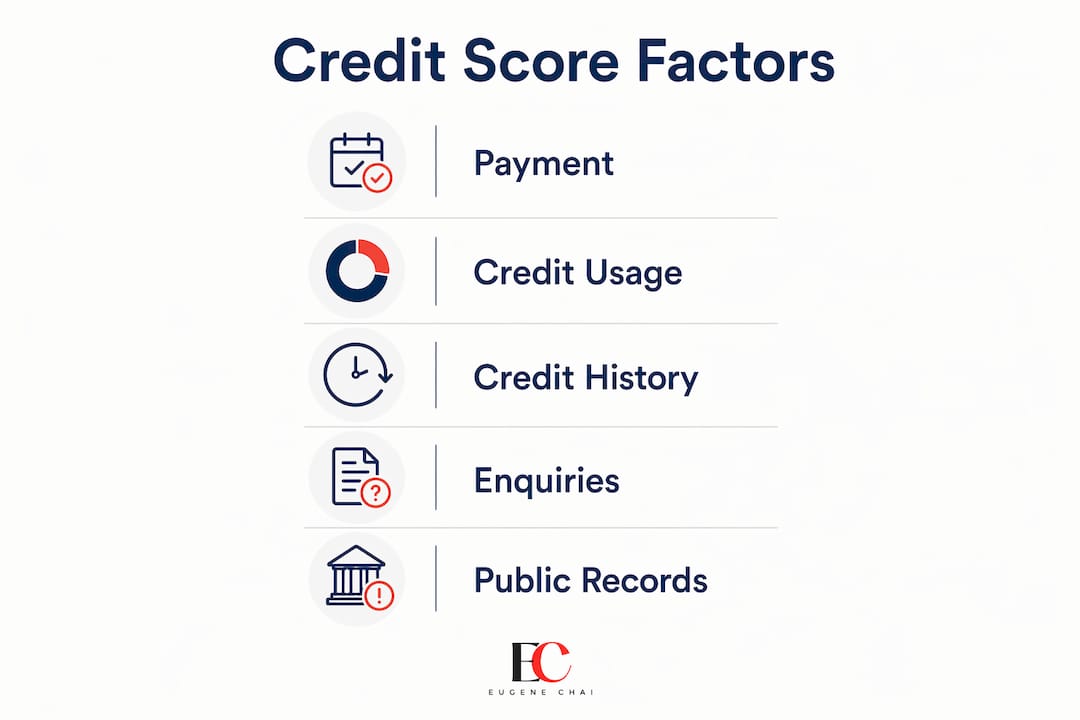
CBS calculates your score based on several credit behaviours:
- Repayment history: Whether you pay bills on time, consistently and in full
- Credit utilisation: How much of your available credit limit you are using at any given time
- Credit enquiries: How often lenders have pulled your credit report due to applications
- Public records: Any bankruptcies, court judgements, or debt restructuring on file
- Account age: The length of your credit history across all accounts
The Bureau Score is a fluid number. It adjusts progressively as your underlying credit data changes, rather than shifting suddenly after a single payment or missed bill. This means building a strong score takes time and consistent behaviour.
What impact does your credit score have on borrowing in Singapore?
A high credit score generally yields better loan terms. A poor score can lead to higher interest rates, reduced credit limits, or outright rejection. This is the most direct and practical consequence of your credit standing.
Here is how credit score impact plays out across different borrowing scenarios:
- Credit card applications: Banks assess your Bureau Score before approving a new card. A strong score improves your chances and may result in a higher credit limit from the outset.
- Personal loans: Lenders price interest rates partly based on perceived risk. A borrower with an AA grade typically receives a lower rate than one with a CC or DD grade.
- Car loans: Financing a vehicle through a bank involves a credit check. A weaker score may require a larger down payment or attract a higher interest rate.
- HDB financing: While HDB loans have their own eligibility criteria, private bank loans for HDB flats are subject to credit assessment. Your Bureau Score influences which banks will lend to you and on what terms.
A common misconception is that a single missed payment permanently ruins your score. The score is fluid and recovers over time with consistent good behaviour. Another misconception is that having no credit history is safe. Lenders actually view a thin credit file as a risk, because there is no track record to assess.
Pro Tip: If you are new to credit, a credit card used for small, regular purchases and paid in full each month is one of the fastest ways to build a positive credit history in Singapore.
How do credit enquiries affect your score in Singapore?
Understanding the difference between enquiry types is critical for anyone who applies for credit regularly. Not all enquiries carry the same weight.
- Self-enquiries: Checking your own credit report through CBS does not affect your score. You can review your report as often as you like without any negative consequence.
- Lender enquiries (hard enquiries): When you apply for a credit card or loan, the lender pulls your CBS report. This registers as a hard enquiry and signals to other lenders that you are seeking new credit.
- Multiple applications in a short period: Banks report to CBS monthly, not quarterly. Applying for several credit cards or loans within a few weeks can harm your score more than most people realise. Each application adds an enquiry, and the cumulative effect signals financial stress or desperation to lenders.
- The perceived risk signal: Increased application enquiries correlate with a higher perceived risk of debt accumulation. Lenders interpret a flurry of applications as a sign that you may be overextending yourself financially.
The practical takeaway is straightforward. Space out your credit applications. If you are comparing credit cards, do your research before applying, rather than submitting multiple applications to see which one approves you first. That approach costs you in score terms and signals poor financial planning to every lender who sees your report.
How can you improve your credit score in Singapore?
Improving your credit score is a long-term process built on consistent, responsible behaviour. There is no shortcut. Prompt repayments and responsible usage are the two most reliable drivers of a stronger score over time.
Here are the steps that produce real results:
- Pay on time, every time. A consistent repayment track record is the single biggest positive factor in your credit profile. Set up GIRO arrangements for minimum payments as a safety net, then pay the full balance manually each month.
- Keep credit utilisation moderate. Using more than 70–80% of your available credit limit signals financial strain. Aim to keep utilisation below 30% across all your credit accounts.
- Limit new applications. Each hard enquiry has a small but real negative effect. Only apply for credit when you genuinely need it and have done your research on the right product. For guidance on choosing wisely, the credit card selection guide at Eugenechaitf is a practical starting point.
- Consider a secured credit card. If you cannot qualify for an unsecured card due to a thin or damaged credit file, a secured card backed by a fixed deposit lets you build history with minimal risk.
- Review your credit report regularly. Errors and fraudulent accounts do appear on CBS reports. Catching them early prevents unnecessary score damage. You can purchase your CBS report directly through the CBS website or via SingPass.
For a broader view of how credit fits into your overall financial health, the financial literacy guide at Eugenechaitf covers the foundational concepts that underpin smart credit management. If you are working through debt alongside building your score, the Debt Management Guide offers structured strategies worth reviewing.
Pro Tip: Set a calendar reminder every six months to pull your CBS report. Reviewing it regularly keeps you aware of your standing and lets you spot any inaccuracies before they affect a loan application.
Key takeaways
Your credit score in Singapore is a fluid, multifactorial indicator that shapes your borrowing costs, credit access, and loan approval chances, and it responds to consistent, responsible financial behaviour over time.
| Point | Details |
|---|---|
| CBS Bureau Score range | Scores run from 1,000 to 2,000, with risk grades AA to HH used by lenders. |
| Score is decision-support, not a verdict | Lenders combine your Bureau Score with income, employment, and their own internal criteria. |
| Hard enquiries reduce your score | Multiple credit applications in a short period signal risk and lower your Bureau Score. |
| Repayment history is the top driver | Paying on time, consistently, is the most effective way to build and protect your score. |
| Score changes are gradual | The Bureau Score adjusts progressively; improvements take months of consistent behaviour. |
What I have learned about credit scores after years of watching Singaporeans borrow
Most people treat their credit score as something that only matters when they need a loan. That is the wrong way to think about it. Your credit profile is a living record of your financial habits, and lenders read it the way an employer reads a CV. The details tell a story before you say a word.
One thing I have noticed consistently is that borrowers are often surprised when they are rejected despite having a decent income. They assume income is the deciding factor. It is not. A strong salary with a history of late payments, maxed-out cards, and five recent credit applications tells a lender something very specific about your financial discipline. The Bureau Score captures that story accurately.
The other pattern I see is people trying to fix their score quickly before a major purchase, like a private condo or a car. That rarely works. The score responds to months of behaviour, not a single good month. The borrowers who get the best terms are the ones who have been quietly, consistently managing their credit well for years, often without thinking about it much at all.
My honest advice is to treat your credit profile the way you treat your CPF. Build it steadily, protect it carefully, and review it regularly. If you are in your 20s, the financial goals guide for young Singaporeans at Eugenechaitf is worth reading alongside this article. Starting early gives you the longest runway to build a strong credit history before you need it most.
— Eugene
Personal finance resources from Eugenechaitf
Managing your credit score well is one part of a larger financial picture. At Eugenechaitf, the focus has always been on giving Singaporeans practical, honest guidance that formal education rarely covers.

Whether you are building your first credit profile, recovering from a difficult financial period, or simply wanting to understand how lenders see you, the personal finance resources at Eugenechaitf cover credit management, budgeting, and loan decisions in plain language. The guides are written specifically for Singaporean readers, with local context and real examples. If you are ready to take your financial health seriously, that is the right place to start.
FAQ
What does Credit Bureau Singapore actually do?
Credit Bureau Singapore (CBS) collects and compiles credit payment data from banks and financial institutions, producing a Bureau Score and credit report used by lenders to assess borrower risk.
Does checking my own credit report lower my score?
No. Self-enquiries through CBS have no impact on your Bureau Score. Only lender-initiated hard enquiries, triggered by credit applications, affect your score.
What is a good credit score in Singapore?
A Bureau Score closer to 2,000 with a risk grade of AA or BB is considered strong. Lenders view these grades as low default risk and typically offer better loan terms.
How long does it take to improve a poor credit score?
Improving a poor score is a gradual process that typically takes several months to years of consistent on-time repayments and responsible credit usage, as the Bureau Score adjusts progressively with behavioural changes.
Can I get a loan in Singapore with a low credit score?
Yes, but the terms will likely be less favourable. Lenders may offer higher interest rates, lower credit limits, or require additional documentation. Some borrowers with low scores explore licensed moneylender options, though understanding the regulations is critical before proceeding.
Disclaimer: Informational only. Consult an MAS-licensed advisor before investing.






Leave a Reply