



TL;DR:
- Starting to invest $100 monthly in Singapore builds disciplined savings habits and access to diversified portfolios.
- Ensuring an emergency fund and understanding fee structures are essential for long-term success with small investments.
You can start investing $100 in Singapore right now, and that single decision is more powerful than most beginners realise. Small-scale investing, formally known as retail investing, has become genuinely accessible in Singapore thanks to digital platforms offering Regular Savings Plans (RSPs) and robo-advisors with monthly minimums as low as $100. The key is not the size of your first contribution. It is the habit you build around it. This guide covers what to prepare, which platforms suit small budgets, and how to grow your portfolio steadily over time.
What you need in place before investing your first $100

The single most important prerequisite for any new investor is an emergency fund. Financial guidance from CPF recommends securing three to six months of living expenses in cash before putting a single dollar into the markets. That buffer protects you from selling investments at a loss simply because an unexpected bill arrives.
Beyond the emergency fund, you need a clear picture of your monthly cash flow. The standard Singapore personal finance rule is to invest at least 10% of your monthly income for long-term goals. For someone earning $3,000 a month, that is $300. Starting with $100 is a perfectly reasonable entry point while you build towards that target.
Your CPF Ordinary Account (OA) already invests on your behalf through the CPF Investment Scheme (CPFIS), but it is not a substitute for personal investing. CPF covers retirement, not wealth building goals like a home upgrade, children’s education, or financial independence before 65. Personal investing fills that gap.
Before you open any account, ask yourself two questions:
- What is my investment horizon? Money you need within two years should not be in equities.
- How would I feel if my portfolio dropped 20%? If the answer is “I would sell everything,” you need lower-risk options like bond funds or Singapore Savings Bonds.
Pro Tip: Build your financial literacy foundation before picking a platform. Understanding basic concepts like diversification, expense ratios, and compounding will save you from costly beginner errors.
Common beginner mistakes to avoid:
- Investing money you cannot afford to lock away for at least three years
- Skipping the emergency fund and then panic-selling during a market dip
- Choosing a platform based on marketing rather than fee structure
- Ignoring CPF contributions while chasing higher returns elsewhere
How to choose the right platform for $100 investments in Singapore
Digital platforms in Singapore support $100 monthly investing through robo-advisors and RSPs, with annual fees typically ranging from 0.5% to 0.8%. That fee range matters enormously when your capital is small. A 0.5% annual fee on $1,200 invested over a year costs $6. A flat $5 brokerage fee per trade on a $100 purchase costs 5% immediately, wiping out any short-term gain before you have even started.
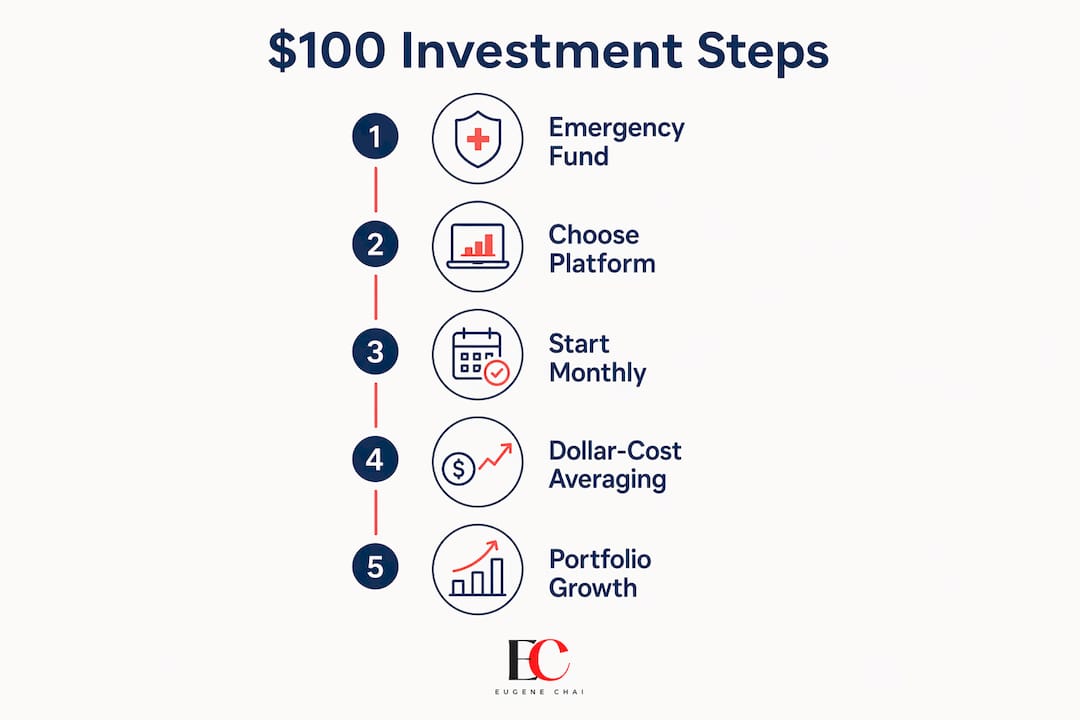
The three main options for beginner investors in Singapore are:
| Option | Minimum monthly | Fee structure | Best for |
|---|---|---|---|
| Robo-advisor | $1–$100 | 0.5%–0.8% p.a. | Hands-off, diversified portfolios |
| Regular Savings Plan (RSP) | $100 | Low flat or percentage fee | Automated ETF or unit trust investing |
| Fractional share investing | From $1 | Varies by platform | Buying partial shares of specific stocks or ETFs |
Robo-advisors build and rebalance a diversified portfolio for you automatically. They typically invest across global equities, bonds, and sometimes REITs using low-cost index funds. The expense ratio of the underlying funds is usually separate from the platform fee, so check both.
Regular Savings Plans offered by local banks and brokerages let you invest a fixed amount monthly into an ETF or unit trust. They use Dollar-Cost Averaging (DCA), which means you buy more units when prices are low and fewer when prices are high. DCA reduces the impact of market volatility on small, regular contributions. That smoothing effect is particularly valuable when you are starting out and cannot afford to absorb a badly timed lump-sum purchase.
Fractional investing allows you to buy partial shares of stocks or ETFs with as little as $100. This makes it possible to own a slice of a globally diversified ETF without needing the full unit price. It is a practical option for readers who want exposure to specific markets or sectors without committing large sums.
Pro Tip: Always check the robo-advisor options in Singapore before signing up. Compare the total cost of ownership, including platform fees and underlying fund expense ratios, not just the headline rate.
For most beginners, a robo-advisor or RSP invested in a low-cost global index fund is the most cost-effective starting point. The best beginner investment options in Singapore share two traits: low fees and broad diversification.
How to start investing your $100 monthly in Singapore: step by step
Getting started takes less time than most people expect. Platform registration typically takes 5–10 minutes using Singpass verification, and your first automated trade can execute within one to three business days of funding your account.
Follow these steps to set up your first investment:
- Choose your platform. Select a robo-advisor or RSP provider based on fee structure, minimum investment, and the asset classes available. Read the product disclosure sheet before committing.
- Open your account. Use Singpass to verify your identity. Most platforms complete this digitally with no paperwork.
- Fund your account. Transfer $100 via PayNow or bank transfer. Some platforms require a minimum initial deposit before your first trade executes.
- Set up a recurring transfer. Automate a monthly transfer timed for one to two days after your salary credit date. This removes the temptation to spend the money first.
- Select your portfolio or investment target. For beginners, a globally diversified portfolio of index funds or ETFs is the most straightforward choice. Avoid single-stock picks until you understand the risks.
- Execute your first trade. On a robo-advisor, the platform handles this automatically. On an RSP, the trade typically executes on a fixed date each month.
- Set a review schedule. Check your portfolio quarterly, not daily. Frequent monitoring encourages over-trading, which increases costs and reduces returns.
Key habits to build from day one:
- Treat your $100 investment like a fixed monthly bill, non-negotiable and paid first
- Increase your contribution by $50 every time you receive a pay rise
- Reinvest any dividends rather than withdrawing them
- Keep a simple spreadsheet tracking your total contributions versus current portfolio value
Dollar-Cost Averaging works best when you commit to it through market downturns. The months when your portfolio is down are the months when your $100 buys the most units. That is the mechanism working in your favour, not against you.
How to manage and grow your portfolio from a $100 starting point
Consistency beats timing every time. The greatest advantage young investors hold is time for compounding returns, not the size of their initial capital. A $100 monthly contribution started at 25 grows into a meaningfully larger sum by 45 than the same amount started at 35, purely because of the additional decade of compounding.
Pro Tip: Treat your investment contributions as a non-negotiable monthly obligation. Automating your transfers removes the decision entirely and eliminates the risk of skipping a month because something else came up.
As your portfolio grows, revisit these areas:
- Fee awareness. A flat $5 transaction fee on a $100 trade is a 5% immediate cost. As your monthly contribution grows to $500 or $1,000, flat fees become proportionally less damaging, but percentage-based fees remain the better structure for small investors.
- Diversification. A single global index fund provides broad diversification. As your portfolio grows beyond $5,000, consider adding a bond fund or a Singapore-focused ETF to balance geographic and asset-class risk.
- Rebalancing. Review your asset allocation annually. If equities have grown to represent 90% of your portfolio and your original target was 80%, sell a small portion and shift it to bonds or cash.
- Scaling contributions. The goal is not to invest $100 forever. Aim to increase contributions as your income grows. Even moving from $100 to $200 monthly doubles the compounding effect over time.
- Continuing education. Read about benefits of early investing and stay current on Singapore-specific changes to CPF rules, SRS contribution limits, and IRAS tax treatment of investment income.
Common challenges beginners face and how to overcome them
Fear of loss is the most common reason beginners delay or abandon investing. Markets do fall, and a $100 portfolio will occasionally show a negative return. That is normal. The mistake is treating a temporary paper loss as a permanent one by selling.
“Consistent investing beats market timing for beginners. Small initial investments are behavioural training as much as financial training. The habit you build with $100 a month is the same habit you will use when you invest $1,000 a month.”
The practical obstacles beginners face most often are:
- Analysis paralysis. Too many platform options leads to inaction. Pick one platform with low fees and start. You can always move later.
- Over-monitoring. Checking your portfolio daily creates anxiety and encourages reactive decisions. Consistent habits matter more than short-term fluctuations.
- Fee misunderstanding. Many beginners focus on returns and ignore fees. A 1% annual fee difference compounds into a significant sum over 20 years.
- Skipping contributions. One missed month becomes two, then three. Automation is the only reliable fix.
- Chasing performance. Last year’s top-performing fund is rarely next year’s winner. Stick to diversified, low-cost index funds rather than rotating into whatever is trending.
The solution to most of these challenges is the same: automate, simplify, and commit to a long time horizon. Investing $100 a month is not about getting rich quickly. It is about building a habit that scales.
Key takeaways
Starting with $100 a month in Singapore is a credible, cost-effective strategy when you choose low-fee platforms, automate contributions, and commit to a long investment horizon.
| Point | Details |
|---|---|
| Build your emergency fund first | Keep three to six months of expenses in cash before investing any amount. |
| Choose low-fee platforms | Prefer percentage-based or zero-commission structures; a $5 flat fee on $100 costs 5% immediately. |
| Use Dollar-Cost Averaging | Automate monthly contributions to smooth out market volatility over time. |
| Start with diversified index funds | A global index ETF or robo-advisor portfolio suits most beginners better than single stocks. |
| Scale contributions as income grows | Increasing from $100 to $200 monthly doubles your compounding effect over the long term. |
Why starting small is the most underrated financial move you can make
I have spoken with many young Singaporeans who wait until they have “enough” to invest. The number in their head is usually $10,000 or more. That wait costs them years of compounding, and no amount of future capital fully compensates for lost time.
When I started investing, I was not putting in large sums. The amount was almost embarrassingly small by the standards of what I read online. But the discipline I built in those early months, the habit of treating my investment transfer as non-negotiable, became the foundation for everything that followed.
The platforms available to Singaporeans today are genuinely good. Low fees, Singpass onboarding, and automated DCA mean there is no technical barrier to starting. The only real barrier is psychological, and the only way through it is to begin. A $100 monthly RSP or robo-advisor contribution is not a consolation prize for people who cannot afford more. It is a deliberate, disciplined strategy that compounds into real wealth over a decade or two.
My honest advice: stop comparing your starting point to others. Focus on why starting early matters, automate your contributions, and review your portfolio quarterly rather than daily. The readers who build wealth are not the ones who found the perfect investment. They are the ones who kept going.
— Eugene
Personal finance resources for new investors in Singapore
Building a solid investment habit starts with understanding your full financial picture, not just picking a platform.
Eugenechaitf covers the practical side of personal finance for Singaporeans at every stage, from building your first budget to choosing your first investment. The investment tips and strategies section walks through beginner-friendly options, fee comparisons, and portfolio-building approaches tailored to Singapore. If you are still working on the savings side before you invest, the personal finance home page covers budgeting, saving, and the foundational steps that make investing sustainable. Start where you are, use what you have, and build from there.
FAQ
Can I really start investing with just $100 in Singapore?
Yes. Regular Savings Plans and robo-advisors in Singapore accept monthly contributions from $100, with annual platform fees typically between 0.5% and 0.8%.
What is the safest investment option for a $100 monthly budget?
A globally diversified index fund or robo-advisor portfolio is the most practical low-risk option for beginners, as it spreads risk across hundreds of companies and asset classes automatically.
How does Dollar-Cost Averaging help small investors?
Dollar-Cost Averaging means investing a fixed amount monthly regardless of market conditions. This approach buys more units when prices fall and fewer when prices rise, reducing the average cost per unit over time.
Do I need an emergency fund before I start investing?
Yes. CPF’s financial guidance recommends holding three to six months of living expenses in accessible cash before committing money to investments.
What fees should I watch out for as a beginner investor?
Avoid platforms that charge flat transaction fees on small trades. A $5 fee on a $100 investment is a 5% immediate cost. Prefer platforms with percentage-based or zero-commission structures.
Disclaimer: Informational only. Consult an MAS-licensed advisor before investing.






Leave a Reply