



TL;DR:
- Singapore’s MAS regulates financial activities through the SFA, FAA, and PSA, requiring precise activity classification and ongoing compliance. Firms must implement strict AML, technology risk, and customer fund safeguards, while maintaining board-level authority and documenting policies. Recent updates expand scope and enforce stricter oversight, emphasizing governance and proactive regulation awareness for all financial participants.
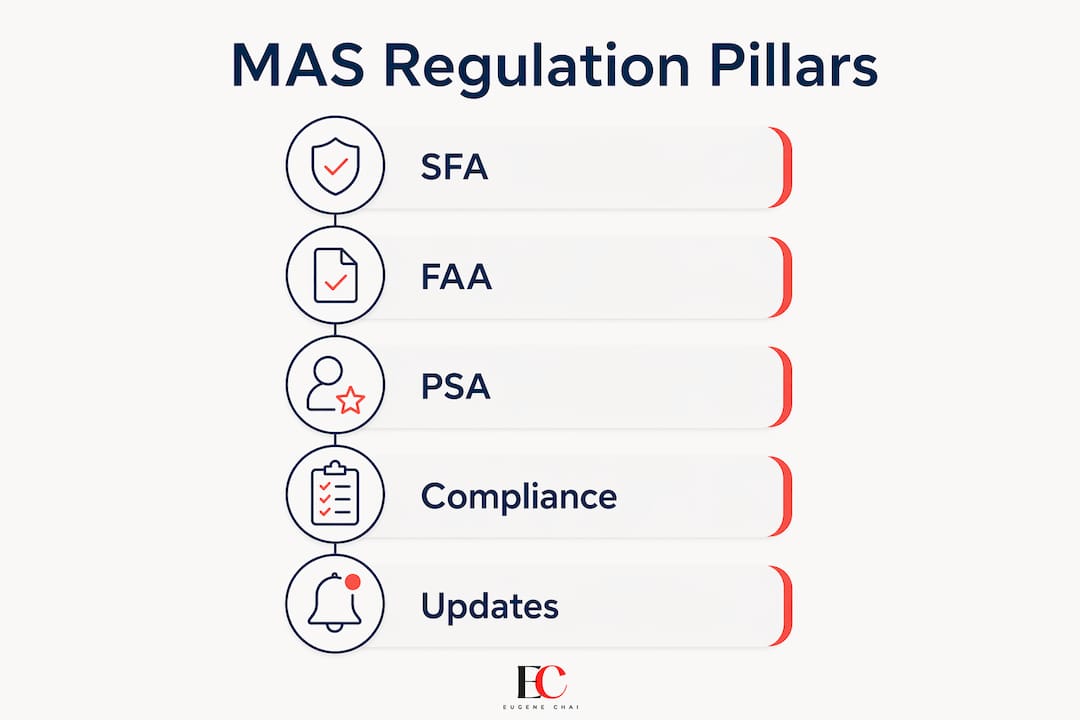
The Monetary Authority of Singapore (MAS) is defined as Singapore’s central bank and integrated financial regulator, responsible for supervising all financial institutions operating in the country. MAS regulations in Singapore govern everything from capital markets and financial advice to payment services and digital assets. Three cornerstone Acts form the backbone of this regulatory framework: the Securities and Futures Act (SFA), the Financial Advisers Act (FAA), and the Payment Services Act (PSA). Understanding these laws is not optional. Whether you are an investor, a business owner, or someone planning your financial future, the MAS regulatory framework shapes the rules of the game you are already playing.
What are the key legislative pillars of MAS regulations?
MAS regulation rests on three core Acts: the SFA, the FAA, and the PSA, each with specific mandatory MAS Notices enforcing AML/CFT and governance standards. Each Act covers a distinct segment of financial activity, and the boundaries between them matter enormously.
- Securities and Futures Act (SFA): Governs capital markets activities, including dealing in securities, fund management, and trading in futures contracts. If you run a fund or advise on listed products, the SFA applies to you.
- Financial Advisers Act (FAA): Covers the provision of financial advice on investment products such as unit trusts, life policies, and structured deposits. Licensed financial advisers in Singapore operate under this Act.
- Payment Services Act (PSA): Regulates payment institutions and digital payment token (DPT) services. The PSA covers account issuance, money transfers, merchant acquisition, e-money issuance, and money-changing activities.
- MAS Notices: These are mandatory instruments issued under each Act. They translate broad legislative requirements into specific operational standards, covering areas such as anti-money laundering (AML), counter-financing of terrorism (CFT), and technology risk management.
One critical point that catches many businesses off guard: MAS assesses activities using statutory definitions, not commercial product names. A firm that markets a product as a “savings plan” or a “digital wallet” must still determine which statutory category applies. Getting this classification wrong leads directly to unlicensed activity findings.
Pro Tip: Before launching any financial product or service in Singapore, map your activity against the exact definitions in the SFA, FAA, or PSA. Do not rely on how competitors or marketing teams describe the product.
If you want a broader grounding in Singapore’s financial laws, the Singapore moneylender rules guide on Eugenechaitf covers related legislative frameworks in accessible detail.
What are the core compliance obligations under MAS regulations?
MAS compliance requirements are not a checklist you complete once. They are ongoing obligations embedded into how a regulated entity operates every single day.
-
AML/CFT programmes: MAS enforces AML/CFT requirements through MAS Notices PSN01, PSN02, and Notice 626. These require customer due diligence (CDD), ongoing transaction monitoring, and suspicious transaction reporting to the Suspicious Transaction Reporting Office (STRO). Failure to comply can result in fines up to $1 million per offence, licence revocation, or prohibition orders for individuals.
-
Technology risk management: Payment service licensees must maintain pre-tested incident response plans. Major payment institutions must notify MAS within one hour of any service outage affecting customers. Failure to meet this deadline can result in fines up to $100,000 and imprisonment.
-
Customer fund safeguarding: PSA licensees must conduct daily reconciliation of customer funds and hold those funds in trust accounts. The DPT Travel Rule applies to digital payment token transfers of $1,500 or more, aligning Singapore with Financial Action Task Force (FATF) standards.
-
Fit and proper criteria: Key personnel at MAS-regulated entities must meet MAS’s fit and proper standards. This covers honesty, integrity, financial soundness, and competence. MAS can bar individuals from managing regulated entities for misconduct.
-
Documented internal policies: Regulated entities must maintain documented policies covering conflicts of interest, data protection, and operational risk management. These documents must be current, accessible, and actually followed.
-
Board-level accountability: MAS expects compliance to sit at the board level, not in a back-office function.
“MAS expects the compliance function to have real authority within governance structures, including the capacity to challenge business decisions. Firms treating compliance solely as an administrative role face regulatory scrutiny.”
— MAS compliance framework guidance
Pro Tip: Build your compliance function so it can say “no” to a business unit and be heard. MAS looks for evidence that compliance has genuine authority, not just a reporting line on an org chart.
What recent MAS regulatory updates should you know about?
MAS does not stand still. The regulatory framework Singapore relies on evolves regularly, and 2026 has brought significant changes.

Revised Single Family Office framework
The revised regulatory framework for Single Family Offices (SFOs) takes effect on 15 june 2026. This update streamlines licensing exemptions and tightens AML controls for family wealth structures. Under the new rules, SFOs must notify MAS, maintain an account at a MAS-licensed bank, and file annual returns including total assets under management. For high-net-worth families managing wealth through SFO structures, this is a material change requiring immediate attention.
Expanded Payment Services Act scope
The PSA’s scope has expanded to capture a wider range of digital payment token services. Businesses that previously operated in a grey area now fall clearly within the licensing perimeter.
| Regulatory area | Key change | Implication |
|---|---|---|
| Single Family Offices | New framework effective 15 june 2026 | SFOs must notify MAS and file annual AUM returns |
| Digital payment tokens | Expanded PSA scope | More DPT businesses require a PSA licence |
| AML/CFT enforcement | Stricter monitoring requirements | Higher documentation and reporting burden |
| Technology risk | One-hour outage notification rule | Pre-tested incident response plans are mandatory |
Enforcement trends
MAS penalties for regulatory breaches include fines, licence suspensions, revocation, and public reprimands. OCBC was fined $10.8 million for AML/CFT control failures, a clear signal that even large, established institutions are not immune. MAS can also bar individuals from managing regulated entities for misconduct, making personal accountability a real risk for directors and senior managers.
- MAS enforcement actions are published publicly, creating reputational consequences beyond the financial penalty.
- Individuals, not just firms, face prohibition orders for serious breaches.
- Repeat or systemic failures attract the most severe responses, including licence revocation.
How can you effectively navigate MAS regulations in practice?
Navigating Singapore’s financial regulations effectively comes down to treating compliance as a governance function, not a paperwork exercise.
- Classify your activities precisely. Use the exact statutory definitions in the SFA, FAA, or PSA to determine which licence you need. Aligning your business model with MAS statutory definitions is the single most effective way to avoid inadvertent non-compliance.
- Document everything. MAS expects written policies on AML/CFT, conflicts of interest, data protection, and operational risk. Undocumented practices do not count.
- Report proactively and on time. Suspicious transactions must be reported to STRO promptly. Technology outages must be notified to MAS within one hour. Late reporting is treated as a breach in its own right.
- Invest in your compliance function. Compliance must have the authority to challenge business decisions. A compliance officer without real power is a liability, not an asset.
- Stay current with MAS Notices and circulars. MAS issues guidance regularly. Subscribing to MAS updates and reviewing them systematically prevents surprises.
- Seek qualified support. For complex licensing questions or AML programme design, work with professionals who specialise in MAS-regulated environments.
Pro Tip: Set a quarterly calendar reminder to review the MAS website for new Notices, circulars, and consultation papers. Regulatory changes rarely arrive with much warning, and being ahead of them is far cheaper than catching up after a breach.
For individuals looking to build the financial literacy that supports sound compliance and planning decisions, the financial literacy guide for Singaporeans on Eugenechaitf is a practical starting point. If you are investing in capital markets under the SFA framework, the Singapore stock market basics guide provides useful context on how regulated markets operate.
Key takeaways
MAS regulations in Singapore form a structured, enforceable framework built on the SFA, FAA, and PSA, and compliance requires board-level accountability, precise activity classification, and proactive reporting.
| Point | Details |
|---|---|
| Three legislative pillars | The SFA, FAA, and PSA each govern distinct financial activities with mandatory MAS Notices. |
| AML/CFT is non-negotiable | Fines reach $1 million per offence; suspicious transactions must be reported to STRO. |
| Technology risk rules are strict | Payment institutions must notify MAS within one hour of customer-affecting outages. |
| SFO framework updated in 2026 | New rules effective 15 june 2026 require MAS notification and annual AUM filings. |
| Compliance needs real authority | MAS expects the compliance function to challenge business decisions, not just record them. |
Why I think most people misread MAS compliance
I have spoken with many Singaporeans who assume MAS regulations only matter if you run a bank or a large financial institution. That assumption is wrong, and it is getting more wrong every year.
The PSA expansion means that anyone running a payment app, a crypto exchange, or even a peer-to-peer transfer service now sits squarely within MAS’s perimeter. The SFO framework update affects wealthy families who thought their private structures were outside the regulatory net. MAS is not shrinking its scope. It is expanding it deliberately.
What I find most telling is the board-level accountability expectation. MAS does not just want a compliance officer. It wants a governance culture where compliance can stop a bad business decision before it becomes a regulatory breach. That is a fundamentally different ask from most regulators globally, and it reflects how seriously Singapore takes its reputation as a clean, well-regulated financial centre.
The practical lesson I draw from this: whether you are an individual investor or a business owner, understanding the MAS framework is not just about avoiding fines. It is about making better decisions with your money. Knowing which products are regulated, which advisers are licensed, and which activities require MAS oversight helps you protect yourself as a consumer. That is the part that formal education in Singapore rarely covers, and it is exactly why I write about it.
— Eugene
Personal finance resources for MAS-aware Singaporeans
Understanding MAS regulations gives you a clearer picture of the financial environment you operate in. The next step is putting that knowledge to work in your own financial planning.
Eugenechaitf covers the practical side of personal finance in Singapore, from budgeting and saving to investing within a regulated framework. Whether you are building your first monthly budget or thinking about where to put your savings, the guides on the site are written specifically for Singaporeans navigating real financial decisions. Start with the investment tips and strategies section for a grounded view of how to grow your money within Singapore’s regulatory environment. For day-to-day money management, the budgeting tips guide offers practical steps you can act on immediately.
FAQ
What is MAS and what does it regulate?
MAS is Singapore’s central bank and integrated financial regulator. It supervises banks, insurers, capital market intermediaries, and payment service providers under Acts including the SFA, FAA, and PSA.
What are the main MAS compliance requirements for businesses?
MAS-regulated businesses must maintain AML/CFT programmes, conduct customer due diligence, file suspicious transaction reports, document internal policies, and meet technology risk management standards including the one-hour outage notification rule.
What happens if a firm breaches MAS regulations?
MAS can impose fines up to $1 million per AML/CFT offence, suspend or revoke licences, issue public reprimands, and bar individuals from managing regulated entities. OCBC was fined $10.8 million for AML/CFT control failures as a recent example.
What changed for Single Family Offices in 2026?
The revised SFO framework took effect on 15 june 2026, requiring SFOs to notify MAS, maintain an account at a MAS-licensed bank, and file annual returns disclosing total assets under management.
Do MAS regulations affect individual investors?
MAS regulations affect individual investors indirectly by setting the standards that licensed advisers, fund managers, and brokers must meet. Knowing whether your adviser holds an FAA licence or your broker is SFA-licensed helps you assess the protection you have as a consumer.
Disclaimer: Informational only. Consult an MAS-licensed advisor before investing.






Leave a Reply