



TL;DR:
- A retirement budget is a monthly plan that aligns income from CPF LIFE, savings, and part-time work with essential and discretionary expenses. It helps prevent overspending and ensures your guaranteed income covers fixed costs while variable income funds flexible spending. Regularly reviewing and adjusting your budget maintains financial stability throughout your retirement years.
A retirement budget is a monthly spending plan that matches your expected retirement income with your essential and discretionary expenses to maintain financial stability. In Singapore, this means aligning payouts from CPF LIFE, personal savings, the Supplementary Retirement Scheme (SRS), and any part-time income against your actual cost of living. Unlike a working-age budget, a retirement budget must account for a diversified mix of guaranteed and variable income streams. Getting this right from the start gives you a clear picture of what you can spend, what you need to save, and where you have room to flex.
What is a retirement budget and why does it matter?
A retirement budget is defined as a structured monthly plan that maps income to expenses, separating costs into essential and discretionary categories. The distinction matters because your income sources in retirement behave very differently from a regular paycheck. CPF LIFE provides a guaranteed monthly payout for life, but personal savings withdrawals and SRS drawdowns are variable. A well-built budget tells you exactly which income covers which expense, so you never draw down savings unnecessarily.
Budgeting for retirement also protects you from one of the most common financial mistakes retirees make: spending as though the money will always be there. Without a plan, discretionary spending on travel or dining out can quietly erode the savings you need for healthcare or housing maintenance. A retirement budget gives you permission to spend on what matters, because you have already confirmed the numbers work.
Which income sources should you include when planning a retirement budget in Singapore?
Retirement income includes CPF payouts, personal savings, annuities, and possible part-time work income, all of which vary in stability. Knowing which sources are guaranteed and which are variable is the foundation of any reliable retirement savings plan.
Guaranteed income sources provide a fixed, predictable payout every month:
- CPF LIFE payouts from your Retirement Account (RA), which begin at your payout eligibility age (currently 65)
- Annuities purchased from insurers such as NTUC Income or Prudential Singapore
- CPF OA and SA interest if you have not yet transferred funds to your RA
Variable income sources depend on market conditions, your health, or personal decisions:
- SRS withdrawals, which are tax-advantaged but not guaranteed
- Investment dividends from Singapore Exchange (SGX) listed stocks, REITs, or unit trusts
- Part-time or freelance income, which many Singaporeans continue into their 60s and 70s
- Rental income from an HDB flat or private property, subject to HDB rules and market conditions
Pro Tip: Use the CPF Retirement Estimator on the CPF Board website to project your CPF LIFE monthly payout before you finalise your budget. This single number anchors everything else.
The practical rule is to cover essential expenses with guaranteed income first, then allocate variable income to discretionary spending. This sequence protects your non-negotiable costs even in months when markets fall or part-time work dries up.
How do you estimate and categorise your retirement expenses?
Tabulating average monthly expenses using bank statements and credit card records is the most reliable starting point for calculating retirement costs. Pull three to six months of statements and sort every transaction into essential or discretionary.

Essential expenses
These are the costs you cannot reasonably cut without affecting your basic quality of life:
- Housing: HDB conservancy fees, property tax, mortgage payments if any remain, or rental costs
- Utilities: electricity, water, gas, and broadband
- Food: groceries and regular hawker centre meals
- Healthcare: MediShield Life premiums, Integrated Shield Plan (IP) premiums, regular medication, and GP visits
- Transport: MRT and bus fares, or COE renewal and petrol if you own a car
- Insurance: life insurance premiums and any critical illness cover still in force
Discretionary expenses
These are meaningful but flexible costs that you can adjust month to month:
- Overseas travel and local staycations
- Dining at restaurants and cafés
- Hobbies, club memberships, and entertainment
- Gifts to children or grandchildren
- Home improvement and renovation
Spending patterns shift after retirement. Commuting costs typically fall, but healthcare and leisure spending often rise. Maintaining an active social life is a meaningful expenditure that directly influences health and wellbeing, so do not cut it entirely from your plan.
One-time and irregular expenses deserve their own line item. A new air-conditioning unit, a family holiday, or a dental procedure can cost several thousand dollars. Set aside a monthly amount specifically for these irregular costs so they do not derail your regular budget.
Pro Tip: Review your statements from the last 12 months, not just three. Annual expenses like insurance renewals and festive spending only show up once a year but are very real costs.
Which retirement budgeting frameworks work best?
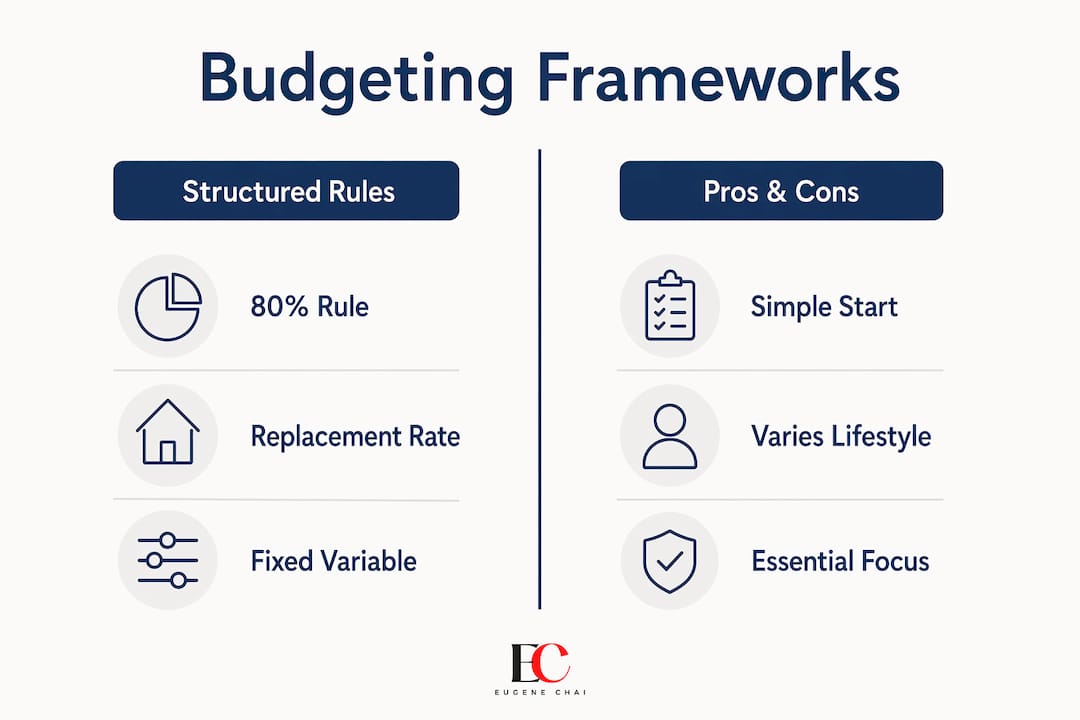
Several frameworks exist for structuring a retirement budget. Each has strengths and limitations, and the right choice depends on your income mix and lifestyle.
| Framework | How it works | Best suited for | Key limitation |
|---|---|---|---|
| 80% income replacement rule | Budget for 80% of your pre-retirement income | Those with straightforward expenses | Replacement rates vary from 55% to 80%, so 80% may be too high or too low |
| Fixed vs variable expense split | Match fixed expenses to guaranteed income; variable expenses to non-guaranteed income | Those with CPF LIFE plus investment income | Requires accurate income projections |
| 50/30/20 adaptation | 50% of income to needs, 30% to wants, 20% to savings or debt repayment | Those who want a simple structure | The 20% savings portion may not apply once fully retired |
| Range-based discretionary budgeting | Set a minimum and maximum for discretionary spending each month | Those with variable income or lifestyle | Requires discipline to stay within the upper range |
The 80% rule is a useful starting estimate, but replacement rates vary significantly based on income level and expected lifestyle. A retiree with a paid-off HDB flat and simple tastes may need only 60% of their pre-retirement income. Someone planning frequent overseas travel may need 90%.
The most practical approach for most Singaporeans is the fixed versus variable split. Cover your essential expenses entirely with CPF LIFE and any annuity payouts. Then use SRS withdrawals, dividends, or part-time income for discretionary spending. This structure means your non-negotiable costs are always funded, regardless of what happens to markets or your ability to work.
Inflation and major one-time purchases should be treated as integral budget line items, not afterthoughts. Edelman Financial Engines recommends planning with a 3% inflation assumption and explicitly budgeting one-time expenses such as home repairs or family costs. Over a 20-year retirement, a 3% annual inflation rate meaningfully erodes purchasing power, so your budget needs a built-in annual review.
Pro Tip: Express discretionary spending as a range rather than a fixed figure. For example, budget $400–$700 per month for dining and entertainment. This builds resilience by allowing you to flex spending up or down without feeling like you have failed your budget.
What are the common challenges in retirement budgeting?
Retirees often mistakenly apply pre-retirement paycheck habits to retirement income, which consists of mixed guaranteed and variable sources requiring a different approach. This is the single most common budgeting error, and it leads to overspending in early retirement and anxiety later.
The key challenges to plan for include:
- The paycheck mindset trap. When you were working, one salary covered everything. In retirement, income arrives from multiple sources at different times and in different amounts. Treat your total monthly income as a pool, not a single figure.
- Healthcare cost variability. Healthcare expenses are a major variable cost requiring cautious planning. MediShield Life and an Integrated Shield Plan reduce exposure, but out-of-pocket costs for specialist visits, dental care, and long-term conditions can still be substantial. Maintain an emergency fund of at least three to six months of essential expenses specifically for medical costs.
- Lifestyle creep in early retirement. The first few years of retirement often see higher spending on travel and leisure. This is normal and healthy, but it must be planned for. Build a higher discretionary allowance into your early retirement budget and reduce it gradually as you settle into a routine.
- Underestimating longevity. Singaporeans have one of the highest life expectancies in the world. A budget that works at 65 must still work at 85. Plan for at least 25–30 years of retirement income.
- Irregular reviews. A retirement budget is not a one-time exercise. Realistic retirement budgeting requires tracking and projecting all income and expenses on an ongoing basis. Review your budget at least once a year, and after any major life event such as a health change, a child’s wedding, or a property decision.
Key takeaways
A sustainable retirement budget matches guaranteed income to essential expenses first, then allocates variable income to discretionary spending, with an annual review to account for inflation and life changes.
| Point | Details |
|---|---|
| Define your income sources | Separate guaranteed income (CPF LIFE, annuities) from variable income (SRS, dividends, part-time work). |
| Cover essentials with guaranteed income | Match fixed costs like housing, healthcare, and utilities to reliable monthly payouts. |
| Use a range for discretionary spending | Set a minimum and maximum for flexible costs to build resilience without rigid restrictions. |
| Plan for inflation and one-off costs | Apply a 3% annual inflation assumption and budget separately for irregular large expenses. |
| Review your budget annually | Adjust your plan after major life events and at least once a year to stay on track. |
My honest view on building a retirement budget in Singapore
The biggest mistake I see people make is waiting until the year before retirement to think about their budget. By then, the decisions that matter most, such as how much to top up your CPF SA before age 55, whether to purchase an annuity, and how to structure your SRS withdrawals, have already been made or missed. The earlier you build a draft retirement budget, the more time you have to adjust your savings and investment strategy to match it.
The mental shift from a monthly paycheck to a diversified income mix is genuinely difficult. I have spoken to professionals in their 60s who still feel uneasy about drawing down savings, even when the numbers clearly support it. A written budget removes that anxiety. When you can see that your CPF LIFE payout covers your HDB conservancy fees, utilities, food, and MediShield Life premiums, you can spend on a holiday without guilt.
One thing I would add that most guides overlook: do not strip out all discretionary spending in the name of frugality. Spending on meaningful experiences, whether that is a family trip to Japan, a weekly dinner with friends, or a hobby you have always wanted to pursue, is not waste. It is the point of retiring. Build it into your budget deliberately, and you will be far more likely to stick to the plan.
If you are not sure where to start, the CPF Board’s retirement planning tools and MoneySense Singapore offer free, locally relevant resources. For personalised planning, consult an MAS-licensed financial adviser who can model your specific CPF projections, SRS strategy, and investment income together.
— Eugene
Retirement budgeting resources from Eugenechaitf
Eugenechaitf covers the full range of personal finance topics that matter to Singaporeans approaching retirement, from CPF strategies to practical budgeting frameworks built for local costs and income structures.
If you want to go deeper on the budgeting fundamentals behind a solid retirement plan, the budgeting tips and strategies section covers practical methods for managing monthly cash flow at every life stage. For those still building their retirement savings base, the personal finance resources hub brings together guides on CPF shielding, SRS contributions, and investment options tailored to the Singapore context. You will also find a dedicated guide on maximising CPF for retirement that pairs directly with the income planning steps covered here.
FAQ
What is a retirement budget in simple terms?
A retirement budget is a monthly spending plan that aligns your retirement income (from sources like CPF LIFE, savings, and SRS) with your essential and discretionary expenses. It tells you exactly how much you can spend each month without running out of money.
How much income do I need to replace in retirement?
Replacement rates vary from roughly 55% to 80% of pre-retirement income, depending on your lifestyle and expenses. Singaporeans with a paid-off HDB flat and modest spending habits often need less than those planning active travel or private healthcare.
What are the most important expenses to include in a retirement budget?
Essential retirement expenses include housing costs, utilities, food, MediShield Life and Integrated Shield Plan premiums, transport, and regular healthcare. Discretionary expenses such as travel, dining out, and hobbies should also be included but expressed as a flexible range.
How does CPF LIFE fit into a retirement budget?
CPF LIFE provides a guaranteed monthly payout for life, making it the most reliable income source in your retirement budget. The standard approach is to cover all essential expenses with your CPF LIFE payout before allocating any variable income to discretionary spending.
How often should I review my retirement budget?
Review your retirement budget at least once a year and after any major life event such as a health change, a property decision, or a significant family expense. Realistic retirement budgeting requires ongoing tracking and adjustment, not a single set-and-forget plan.
Disclaimer: Informational only. Consult an MAS-licensed advisor before investing.






Leave a Reply