



TL;DR:
- Singapore residents face progressive income tax rates up to 24% on income over S$1 million, while non-residents pay flat rates of 15% or 24%, with no personal reliefs. Personal reliefs are capped at S$80,000 annually, and the top corporate rate is 17% with available rebates for companies meeting employment criteria. Accurate residency classification, timely filing, and strategic relief claims are essential for optimal tax management.
Singapore’s income tax rate for residents is progressive, ranging from 0% on the first S$20,000 of chargeable income to a top marginal rate of 24% on income exceeding S$1,000,000. Non-residents face flat rates instead, generally 15% on employment income or 24% on other income types. Whether you are a salaried employee, a freelancer, or a small business owner, understanding how IRAS applies these rates to your specific situation is the foundation of smart financial planning. This guide covers resident and non-resident tax brackets, personal reliefs, corporate tax obligations, and practical compliance tips for 2026.
What are the current income tax rates in Singapore for residents?
Singapore’s progressive resident tax rates apply to chargeable income, which is your gross income minus allowable deductions and personal reliefs. The distinction between gross income and chargeable income matters enormously. A resident earning S$120,000 gross may have a chargeable income closer to S$80,000 after reliefs, which places them in a significantly lower effective tax band.

The table below shows the full resident tax bracket structure for Year of Assessment (YA) 2026:
| Chargeable income (S$) | Tax rate | Tax payable on band |
|---|---|---|
| First 20,000 | 0% | S$0 |
| Next 10,000 (20,001 to 30,000) | 2% | S$200 |
| Next 10,000 (30,001 to 40,000) | 3.5% | S$350 |
| Next 40,000 (40,001 to 80,000) | 7% | S$2,800 |
| Next 40,000 (80,001 to 120,000) | 11.5% | S$4,600 |
| Next 40,000 (120,001 to 160,000) | 15% | S$6,000 |
| Next 40,000 (160,001 to 200,000) | 18% | S$7,200 |
| Next 40,000 (200,001 to 240,000) | 19% | S$7,600 |
| Next 40,000 (240,001 to 280,000) | 19.5% | S$7,800 |
| Next 40,000 (280,001 to 320,000) | 20% | S$8,000 |
| Next 180,000 (320,001 to 500,000) | 22% | S$39,600 |
| Next 500,000 (500,001 to 1,000,000) | 23% | S$115,000 |
| Above 1,000,000 | 24% | On excess |
The top marginal rate of 24% applies only to the portion of income above S$1 million. This means the vast majority of salaried professionals in Singapore never approach that band. Your effective tax rate, which is total tax divided by total income, will always be lower than your marginal rate.
Pro Tip: Use the IRAS Tax Calculator on the IRAS website to estimate your chargeable income and effective rate before filing. Knowing your effective rate, not just your marginal rate, gives you a more accurate picture of your actual tax burden.
How do non-resident tax rates differ in Singapore?
Non-resident individuals are taxed at a flat 24% on most income, including director’s fees, rental income, and consultancy fees. Employment income is taxed at the higher of 15% flat or the resident progressive rates, whichever produces a greater tax liability. This means IRAS effectively ensures non-residents cannot benefit from the zero-rate band on the first S$20,000 that residents enjoy.
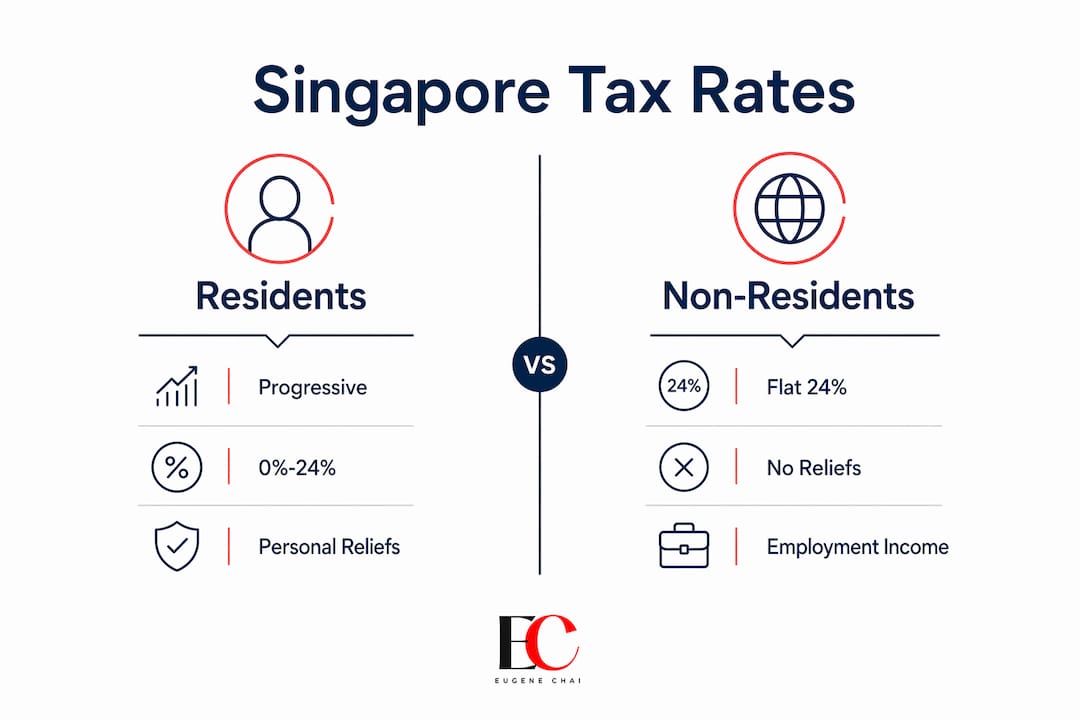
Tax residency in Singapore requires physical presence of at least 183 days in the preceding calendar year for foreigners, or Singapore Citizen or Permanent Resident status with normal residence here. This 183-day rule is the single most important threshold for expats and foreign professionals to track. Falling below it means losing access to progressive rates and all personal reliefs.
Here is a summary of non-resident income types and their applicable rates:
- Employment income: Higher of 15% flat rate or resident progressive rates (no zero-rate band applies)
- Director’s fees: 24% flat rate
- Rental income: 24% flat rate
- Consultancy and professional fees: 24% flat rate
- Short-term employment (60 days or fewer): Generally exempt from tax, with exceptions for directors, public entertainers, and certain approved professionals
Non-residents are not entitled to personal reliefs such as Earned Income Relief, Spouse Relief, or CPF-related deductions. This absence of reliefs, combined with flat rates, makes residency status a critical financial planning variable for anyone spending significant time in Singapore.
What personal reliefs and rebates can Singapore tax residents claim?
Personal reliefs directly reduce your chargeable income, which is why understanding them is one of the most practical ways to manage your Singapore personal tax rates. IRAS offers a range of reliefs targeting different life stages and financial behaviours. The total relief cap is S$80,000 per Year of Assessment, meaning even if your combined reliefs exceed this amount, only S$80,000 will be deducted from your chargeable income.
The S$80,000 cap is an often-overlooked planning constraint for higher earners who stack multiple reliefs. A taxpayer claiming CPF top-up relief, SRS contributions, parent relief, and child relief simultaneously may hit the cap without realising it, leaving some reliefs effectively unused.
| Relief type | Maximum amount | Who qualifies |
|---|---|---|
| Earned Income Relief | Up to S$8,000 (age-dependent) | All working residents; higher for those aged 55 and above |
| Spouse Relief | S$2,000 | Residents supporting a non-working or low-income spouse |
| Parent Relief | Up to S$9,000 per parent | Residents supporting parents or grandparents in Singapore |
| Child Relief (WMCR) | Up to 25% of mother’s earned income per child | Working mothers with Singapore Citizen children |
| CPF Cash Top-Up Relief | Up to S$8,000 (own account) + S$8,000 (family) | Residents making voluntary CPF SA/RA top-ups |
| SRS Relief | Up to S$15,300 (citizens/PRs); S$35,700 (foreigners) | Residents contributing to Supplementary Retirement Scheme |
Pro Tip: Keep all supporting documents for relief claims, including receipts for parent medical expenses, CPF top-up acknowledgements, and SRS contribution statements. IRAS may request verification, and missing documents can result in disallowed claims.
The SRS relief limit is particularly worth noting. Contributing the maximum S$15,300 to your SRS account each year not only reduces your chargeable income but also grows your retirement savings in a tax-deferred environment. Pair this with voluntary CPF top-ups and you can reduce your income tax legally and meaningfully.
How do corporate tax rates and rebates affect small business owners?
Singapore’s corporate income tax rate is a flat 17% for both local and foreign-incorporated companies. This flat rate applies to chargeable income after deductions, and it is one of the most competitive corporate rates in Asia. For small business owners, the more immediately relevant figure for YA2026 is the 50% Corporate Income Tax (CIT) Rebate, capped at S$40,000.
To qualify for the CIT Rebate Cash Grant of at least S$1,500, a company must employ at least one local employee with CPF contributions made for 2025. This is where many small business owners make a costly error. Shareholder-directors do not count as local employees for this purpose. If the only person working in your company is you as a director-shareholder, your company does not meet the eligibility threshold for the cash grant component.
Key filing obligations and rebate conditions for small business owners:
- Estimated Chargeable Income (ECI): Must be filed within 3 months of financial year-end. Late or inaccurate ECI filing creates compliance complications even if the final tax assessment is later adjusted.
- Form C-S: For companies with annual revenue of S$5 million or below and straightforward tax matters.
- Form C: For larger or more complex companies with additional disclosure requirements.
- CIT Rebate eligibility: Company must have at least one non-director local employee with CPF contributions for 2025.
- Tax exemption for new start-ups: Companies in their first three YAs may qualify for partial tax exemption on the first S$200,000 of chargeable income, subject to conditions.
Singapore’s territorial tax system also means there is no capital gains tax, dividend tax, or inheritance tax. For small business owners structuring their wealth, this creates meaningful advantages compared to jurisdictions with global taxation. Dividends paid from a Singapore company to shareholders are tax-exempt in the hands of the recipient under the one-tier tax system.
What practical tips should individuals and business owners know about Singapore tax?
Checking your residency status before filing is the single most impactful step you can take. A foreigner who spent fewer than 183 days in Singapore in the preceding year must file as a non-resident, losing access to progressive rates and all personal reliefs. This is not a minor administrative detail. It can mean the difference between a 2% effective rate and a 15% flat rate on employment income.
For individuals, the IRAS myTax Portal is the primary filing platform. The Singapore tax filing deadline for residents is 18 April each year for e-filing. Paper filing closes on 15 April. Missing this deadline can result in late filing penalties, so setting a calendar reminder in early March to gather your documents is a practical habit worth building.
Different income sources receive different tax treatment, and understanding this helps with planning. Employment income is straightforward, but rental income from an HDB flat or private property is taxable and must be declared. Dividends from Singapore-listed companies are tax-exempt. Interest from Singapore Savings Bonds (SSBs) and bank deposits is also not taxable for individuals. This means tax-efficient investing in Singapore-listed equities and SSBs can complement your overall tax position.
Pro Tip: Use the IRAS Tax Calculator and the IRAS Personal Reliefs Checker before your filing date each year. These free tools take less than 15 minutes to use and can surface reliefs you may have overlooked, such as the Grandparent Caregiver Relief or the Course Fees Relief for skills upgrading.
For context on how your income compares to peers, understanding Singapore’s median income distribution helps you gauge which tax bracket is most relevant to your situation and where relief optimisation will have the greatest impact.
Key takeaways
Singapore’s income tax system rewards residents who understand their residency status, claim all eligible reliefs, and file accurately and on time.
| Point | Details |
|---|---|
| Progressive resident rates | Resident tax runs from 0% to 24%, with the top rate applying only above S$1 million chargeable income. |
| Non-resident flat rates | Non-residents pay 15% or 24% depending on income type, with no access to personal reliefs. |
| S$80,000 relief cap | Total personal reliefs are capped at S$80,000 per YA, making strategic relief selection important for higher earners. |
| Corporate tax and rebate | The flat 17% corporate rate is offset by a 50% CIT Rebate capped at S$40,000 for YA2026, subject to local employee CPF conditions. |
| File on time | The IRAS e-filing deadline is 18 April annually. Late filing attracts penalties regardless of whether tax is ultimately owed. |
Why I think most Singaporeans underestimate their tax position
I have spoken to many working professionals and small business owners over the years, and the most common mistake I see is treating income tax as something to deal with once a year in April. The reality is that your tax position is shaped by decisions you make throughout the year, from CPF top-ups in December to SRS contributions before 31 December, to how you structure your business payroll.
One insight that surprises people is the S$80,000 relief cap. High earners who diligently contribute to SRS, top up their CPF SA, and claim parent relief often assume their tax bill will drop proportionally with each additional relief. It does not, once you hit the cap. I have seen taxpayers contribute an extra S$8,000 to their CPF SA in December expecting a full deduction, only to discover they had already reached the cap through other reliefs. Knowing your running relief total before year-end is a habit that pays off.
For small business owners, the shareholder-director exclusion from the local employee count for the CIT Rebate Cash Grant is genuinely counterintuitive. Many sole-director companies assume they qualify simply because the director works full-time in the business. They do not. Hiring even one local employee on CPF contributions changes that eligibility entirely.
Singapore’s tax environment is genuinely competitive. The absence of capital gains tax and dividend tax means that building wealth through equities and business ownership here is structurally more efficient than in most developed economies. That is not an accident. It is a deliberate policy choice, and it rewards those who understand how to work within it. My honest advice is to spend two hours a year reviewing your reliefs and filing position rather than rushing through it on 17 April.
— Eugene
Take control of your tax and financial planning
Understanding your income tax position is only one part of a healthy financial plan. At Eugenechaitf, we cover the full picture, from budgeting and saving to investing and insurance, all tailored for Singaporeans navigating real financial decisions.
If you want to put your tax savings to work, our budgeting tips and strategies page gives you a practical framework for managing your money after tax. We also cover smart saving ideas for building your financial buffer and growing your wealth over time. Whether you are just starting out or optimising an established financial plan, Eugenechaitf has the localized, practical content you need to move forward with confidence.
FAQ
What is the top income tax rate in Singapore for residents?
The top marginal income tax rate for Singapore tax residents is 24%, applying only to chargeable income above S$1,000,000. Most residents pay an effective rate well below this figure due to progressive brackets and personal reliefs.
When is the Singapore income tax filing deadline?
The IRAS e-filing deadline for personal income tax is 18 April each year. Paper filing closes on 15 April. Missing the deadline can result in penalties even if no tax is ultimately owed.
How are non-residents taxed on employment income in Singapore?
Non-resident employment income is taxed at the higher of 15% flat or the resident progressive rates, with no access to personal reliefs or the zero-rate band on the first S$20,000. Short-term employment of 60 days or fewer is generally exempt, with exceptions for directors and public entertainers.
What is the corporate income tax rate in Singapore?
Singapore’s corporate income tax rate is a flat 17% on chargeable income. For YA2026, eligible companies can claim a 50% CIT Rebate capped at S$40,000, provided they employ at least one local non-director employee with CPF contributions for 2025.
Can I reduce my personal income tax through CPF and SRS contributions?
Yes. Voluntary CPF SA top-ups qualify for up to S$8,000 in relief for your own account, and SRS contributions qualify for up to S$15,300 for Singapore Citizens and PRs. Both reduce your chargeable income, subject to the overall S$80,000 personal relief cap per Year of Assessment.
Disclaimer: Informational only. Consult an MAS-licensed advisor before investing.






Leave a Reply