



TL;DR:
- Saving $20,000 in one year requires setting aside about $1,667 monthly through disciplined expense management, income growth, and strategic investing. Prioritizing savings as a fixed expense, optimizing housing, food, and transport costs, automating transfers, and increasing income are essential strategies for Singaporean earners. Combining these habits with investing in diversified assets helps preserve purchasing power and achieve long-term financial goals.
Saving $20,000 in one year is defined as accumulating a fixed annual target through a combination of disciplined expense management, income growth, and strategic investment. In Singapore’s high-cost environment, this goal requires roughly $1,667 per month, which translates to a 20% to 30% savings rate depending on your income level. The honest truth is that cutting expenses alone will not get most people there. You also need to grow your income and put your money to work through investing. This article covers exactly how to do all three, with practical numbers and Singapore-specific examples throughout.
How much do you need to save each month to reach $20,000?
The maths behind saving 20k in a year is straightforward once you break it down into daily and weekly targets. Saving $1,667 per month means setting aside roughly $385 per week or $55 per day. These numbers feel abstract until you map them against your actual take-home pay.
| Income level | Monthly take-home (est.) | Monthly savings needed | Savings rate required |
|---|---|---|---|
| Median earner (~$67k p.a.) | ~$4,600 | $1,667 | ~36% |
| Above-median (~$80k p.a.) | ~$5,500 | $1,667 | ~30% |
| Higher earner (~$100k p.a.) | ~$6,800 | $1,667 | ~25% |
For median earners, a 36% savings rate is genuinely demanding. This is why the goal of saving $20,000 in one year cannot rest on frugality alone. It requires a two-track approach: controlling your top spending categories while actively raising your income ceiling.
Pro Tip: Treat your $1,667 monthly savings target as a fixed bill, not an aspiration. Transfer it to a separate account on the same day your salary arrives, before you spend a single dollar on anything else.
The most effective reframe here is to stop thinking of savings as what remains after spending. Savings as a fixed expense is the single most important mindset shift you can make. When savings compete with discretionary spending, spending wins almost every time.
Where can you cut the most in Singapore?
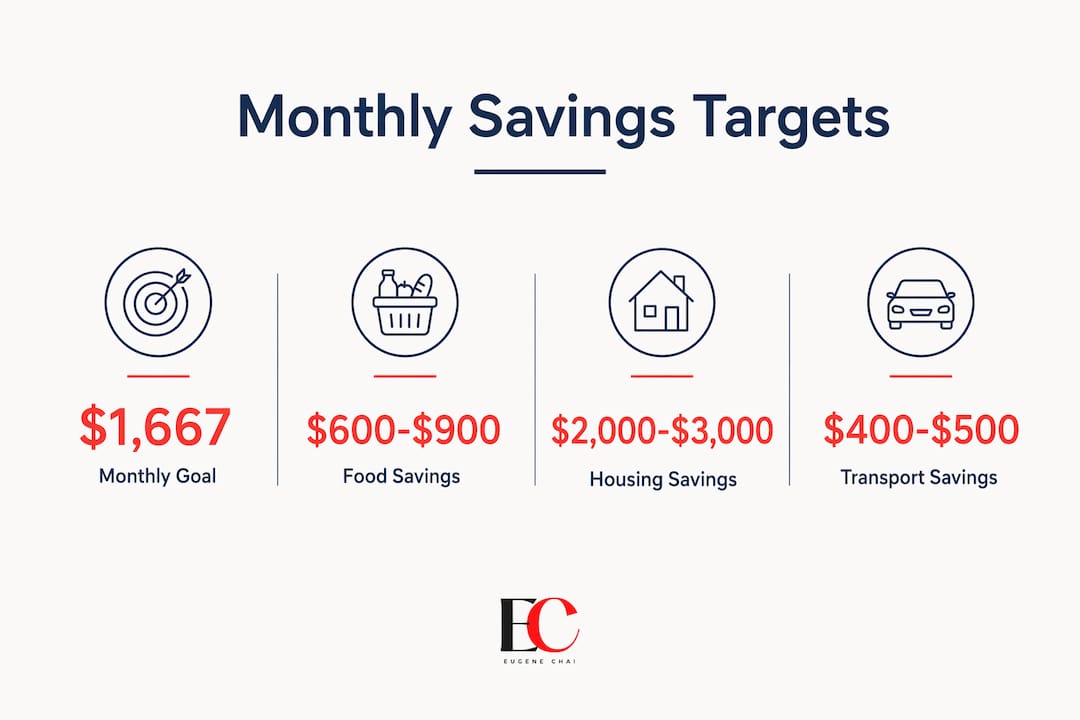
Optimising housing, food, and transport can free up $3,400 to $5,200 per month in Singapore. These three categories are where most of your money goes, and they are also where the biggest gains are available without requiring extreme lifestyle sacrifice.

Housing: the single largest lever
Choosing a suburban HDB flat over a central condominium can save $2,000 to $3,000 per month in rent alone. A two-bedroom unit in Tampines or Woodlands typically rents for $1,800 to $2,400, while a comparable unit in Tanjong Pagar or Orchard can exceed $4,500. If you are already a homeowner, consider whether your current mortgage is optimised. Refinancing your HDB loan or switching from a bank loan at a higher rate can reduce monthly outgoings meaningfully.
Food: hawker centres versus restaurants
Eating primarily at hawker centres rather than restaurants or cafes saves $600 to $900 per month for a single person. A full hawker meal costs $4 to $6. The equivalent at a mid-range restaurant costs $20 to $35. Over 30 days, that difference compounds quickly. The convenience tax from GrabFood and food delivery platforms adds platform fees, delivery charges, and inflated menu prices on top of restaurant pricing. Ordering delivery three times a week instead of walking to a hawker centre can cost an extra $200 to $300 per month without you noticing.
Transport: MRT versus private car
Using the MRT and buses instead of owning a car saves $400 to $700 per month when you account for COE, road tax, insurance, petrol, and parking. Singapore’s public transport network is one of the most reliable in the world, and a monthly adult concession card costs under $130. Ride-hailing services like Grab are fine for occasional use, but relying on them daily can easily add $300 or more to your monthly transport bill.
- Housing: Choose suburban HDB over central condo to save $2,000 to $3,000 per month.
- Food: Eat at hawker centres and reduce GrabFood orders to save $600 to $900 per month.
- Transport: Use the MRT and buses instead of a private car to save $400 to $700 per month.
- Convenience traps: Avoid frequent ride-hailing, premium supermarkets, and daily café coffee, which collectively drain $200 to $400 per month.
Pro Tip: Audit your last three months of bank and credit card statements. Categorise every transaction. Most people are genuinely surprised by how much they spend on food delivery and transport. Seeing the number clearly is what motivates real change.
How to build saving habits that actually stick
Most people fail to save consistently because they treat savings as leftover money, not as a committed monthly obligation. Changing this behaviour requires both structural and psychological shifts.
Here is a practical system that works for Singaporean earners:
- Automate your savings transfer. Set up a GIRO instruction with your bank to move $1,667 to a separate savings account on the day your salary is credited. Automation removes the decision entirely. You cannot spend what you never see.
- Use multiple bank accounts. Maintain at least three accounts: one for salary crediting and bills, one for daily spending, and one dedicated savings account. This separation makes it much harder to accidentally dip into your savings.
- Set a weekly spending budget. Divide your remaining take-home pay after savings and fixed bills by four. That is your weekly discretionary budget. Track it using a simple notes app or a budgeting app like Seedly.
- Eliminate the convenience tax. Reduce GrabFood orders to once or twice a week maximum. Walk or take public transport for journeys under 3 km. These small decisions, repeated daily, add up to hundreds of dollars per month.
- Review your progress monthly. A 15-minute monthly check-in to compare your actual savings against your $1,667 target keeps you accountable and allows you to course-correct before a bad month becomes a bad quarter.
Automated saving pipelines are the most reliable predictor of long-term savings success. The goal is to make saving the default behaviour, not a conscious act of willpower each month.
Why increasing your income matters as much as cutting costs
Expense cutting alone is insufficient for many Singaporeans trying to save $20,000 in a year. If your take-home pay is $3,000 per month, saving $1,667 means living on $1,333. That is genuinely very difficult in Singapore. If your take-home is $6,000, the same target leaves you $4,333 to cover all living expenses. The difference is vast.
This is something I experienced personally. When I first started saving seriously in my early twenties, my income was modest and every month felt like a struggle. No matter how carefully I tracked my spending, the numbers were tight. What changed everything was not finding a new budgeting trick. It was growing my income. Once my salary increased and I started directing every raise and bonus straight into savings, the $20,000 target became achievable and then comfortable.
Here are the most practical ways to raise your income in Singapore:
- Negotiate your salary at every review cycle. Research market rates on MOM’s salary benchmarks or platforms like NodeFlair and Glassdoor. Singaporean employers expect negotiation. A 10% raise on a $4,500 salary adds $5,400 per year to your savings potential.
- Take on a side hustle aligned with your skills. Freelance writing, tutoring, digital marketing, and e-commerce on Carousell or Shopee are all viable options. Even $300 to $500 per month from a side hustle meaningfully closes the savings gap.
- Allocate windfalls automatically. Direct your annual bonus, AWS (Annual Wage Supplement), or tax refund from IRAS straight into your savings account before it touches your spending account.
- Invest in career advancement. SkillsFuture credits can fund courses that lead to promotions or career switches into higher-paying fields. The return on a $500 course that leads to a $500 monthly raise is extraordinary.
The two-track method of controlling your top three expense categories while proactively raising income is the most reliable path to saving $20,000 in one year for middle-income earners in Singapore.
Should you invest while trying to save $20,000?
Saving $20,000 in a year and investing are not mutually exclusive. In fact, keeping all your savings in a standard bank account is a mistake because traditional fixed deposits in Singapore offer returns below the inflation rate, meaning your money loses purchasing power in real terms.
Here is how to think about the split between saving and investing:
| Purpose | Recommended product | Approximate return | Liquidity |
|---|---|---|---|
| Emergency fund (3 to 6 months expenses) | Cash management account (e.g., Syfe Cash+, Endowus Cash Smart) | 2.1% to 2.5% p.a. | High (T+1 to T+2) |
| Short-term savings goal | Standard Chartered Bonus$aver | Up to 4.55% p.a. | Medium (monthly) |
| Long-term wealth building | ETFs, REITs, robo-advisors (e.g., Syfe, Endowus) | Variable, historically 6% to 9% p.a. | Low to medium |
Build your emergency fund first. Three to six months of living expenses held in a liquid cash management account gives you the financial buffer to invest the rest without panic-selling during market downturns. Once that buffer is in place, direct surplus savings into diversified investments. For beginners, the best investment options in Singapore include low-cost ETFs tracking the S&P 500 or STI, and robo-advisors that handle portfolio construction automatically.
Pro Tip: Do not wait until you have “enough” to invest. Starting with $200 per month in a robo-advisor while building your savings habit is far better than waiting two years to invest a lump sum. Time in the market matters.
If you want a clear framework for deciding how much to save versus invest at each stage of your financial journey, the saving vs investing guide on Eugenechaitf covers this in detail.
Key takeaways
Saving $20,000 in one year in Singapore requires a monthly target of $1,667, disciplined expense control across housing, food, and transport, automated savings habits, active income growth, and strategic investment to prevent inflation from eroding your progress.
| Point | Details |
|---|---|
| Monthly savings target | Set aside $1,667 per month as a fixed, non-negotiable transfer on payday. |
| Top three expense cuts | Optimise housing, food, and transport to free up $3,400 to $5,200 monthly. |
| Automate savings | Use GIRO transfers and separate bank accounts to remove spending temptation. |
| Grow your income | Salary negotiation, side hustles, and directing bonuses to savings are critical levers. |
| Invest alongside saving | Use cash management accounts for your emergency fund and ETFs or robo-advisors for long-term growth. |
What I learnt saving my first $100,000
When I started my career, saving felt genuinely hard. My income was modest, my fixed costs were real, and $1,667 per month felt like an impossible number. I made the classic mistake of saving whatever was left at the end of the month, which was often nothing. The turning point was treating savings as a bill I paid myself first, automating the transfer, and then working hard to grow my income through salary progression and a small side hustle.
By the time I was 28, I had hit $100,000 in savings and investments. The savings rate mattered, but income growth was the real accelerant. Every raise I received went straight into savings and investments rather than lifestyle inflation. I also learnt early that leaving money in a savings account earning 0.05% was not a strategy. Putting surplus savings into diversified ETFs and a cash management account made my money work alongside me.
If you are reading this on a $3,000 monthly income and feeling discouraged, I want to be direct: the goal is not to punish yourself with extreme frugality. The goal is to build the habits now, grow your income deliberately, and invest consistently. The compounding effect of all three together is what gets you to $20,000 in a year and well beyond. For a broader view of financial goals in your 20s, the Eugenechaitf blog has a dedicated guide worth reading alongside this one.
— Eugene
Start your $20,000 savings plan with Eugenechaitf
If this article has given you a clear picture of what saving $20,000 in one year actually requires, the next step is putting a personalised plan together.
Eugenechaitf has a full library of Singapore-specific resources to help you move from intention to action. The smart saving tips page covers high-yield savings products, automated saving strategies, and practical budgeting frameworks tailored for Singaporean earners. If you are ready to go beyond saving and start growing your money through investments, the beginner investment guide walks you through the most accessible options available in Singapore today. You can also explore the budgeting tools and tips section to build the spending discipline that makes saving $20,000 realistic rather than aspirational.
FAQ
How much do I need to save each month to reach $20,000 in a year?
You need to save approximately $1,667 per month to reach $20,000 in one year. This represents a savings rate of 20% to 36% depending on your income level.
Is it realistic to save $20,000 in a year on a median Singapore salary?
It is challenging but achievable on a median salary of around $4,600 per month, requiring a savings rate of roughly 36%. Combining expense reduction in housing, food, and transport with income growth through salary negotiation or a side hustle makes the target more realistic.
Should I invest while saving towards $20,000?
Yes. Keeping all savings in a standard bank account means inflation erodes your purchasing power. Build a 3 to 6 month emergency fund in a liquid cash management account first, then direct surplus savings into diversified investments such as ETFs or robo-advisors.
What is the fastest way to increase my savings rate in Singapore?
The fastest lever is reducing your three largest expenses: housing, food, and transport. Choosing a suburban HDB over a central rental, eating at hawker centres, and using public transport can collectively free up $3,400 to $5,200 per month.
What savings accounts offer the best returns in Singapore?
Standard Chartered Bonus$aver offers up to 4.55% per annum for qualifying customers. Cash management accounts from providers like Syfe and Endowus offer 2.1% to 2.5% per annum with high liquidity, making them suitable for emergency funds and short-term savings goals.
Disclaimer: Informational only. Consult an MAS-licensed advisor before investing.






Leave a Reply