



A Singapore endowment plan is a regulated life insurance contract that combines disciplined savings with life protection, paying a lump sum at a fixed maturity date or as a death benefit during the policy term. Unlike a standard savings account, the payout structure is defined from the outset, making it one of the more predictable medium-term financial tools available to Singapore residents. Insurers such as Singlife offer products like the Steadypay Saver under oversight from the Monetary Authority of Singapore (MAS), giving policyholders a regulated framework to build towards goals like education funding or retirement. In this guide, we will walk through how endowment plans work, the main types available, how they compare with whole life insurance, and what to consider before committing to one.
How does a Singapore endowment plan work?

An endowment plan functions as a savings and insurance hybrid, where you pay premiums over a fixed term and receive a lump sum payout at maturity or a death benefit if you pass away during the term. The mechanics are straightforward, but understanding the components in detail helps you evaluate whether the product suits your financial goals.
Here is how the key elements fit together:
-
Premium payment structure. You choose either a single-premium plan, where you pay one lump sum upfront, or a regular-premium plan, where you pay monthly or annually over the policy term. Regular-premium plans are more common for salaried individuals who prefer spreading the commitment over time.
-
Guaranteed maturity value. At the end of the policy term, you receive a guaranteed lump sum. This is the baseline payout regardless of market conditions, and it forms the foundation of the plan’s value proposition.
-
Non-guaranteed bonuses. Many participating endowment plans layer reversionary or terminal bonuses on top of the guaranteed amount. The Singlife Steadypay Saver, for example, offers potential returns of up to 2.83% per annum, but these bonuses depend on the insurer’s participating fund performance and are not contractually guaranteed.
-
Death benefit. If the policyholder passes away before maturity, the insurer pays a death benefit to the named beneficiary. This is the life insurance component that distinguishes an endowment plan from a pure savings product.
-
Policy term length. Endowment plans typically run from 5 to 20 years, aligning the payout with a specific financial milestone such as a child’s university fees or a property down payment.
-
Early surrender. Exiting the plan before maturity almost always results in receiving less than the total premiums paid. The surrender value is particularly low in the early years of the policy.
Pro Tip: If you think you may need to exit a plan early, consider a resale endowment policy instead. These are existing policies sold by the original holder, offering shorter remaining tenures and clearer visibility of accumulated value, which reduces the risk of a painful early surrender.
What are the main types of endowment plans in Singapore?
Singapore insurers offer several variants of endowment plans, and knowing the differences helps you match the right product to your financial situation.
-
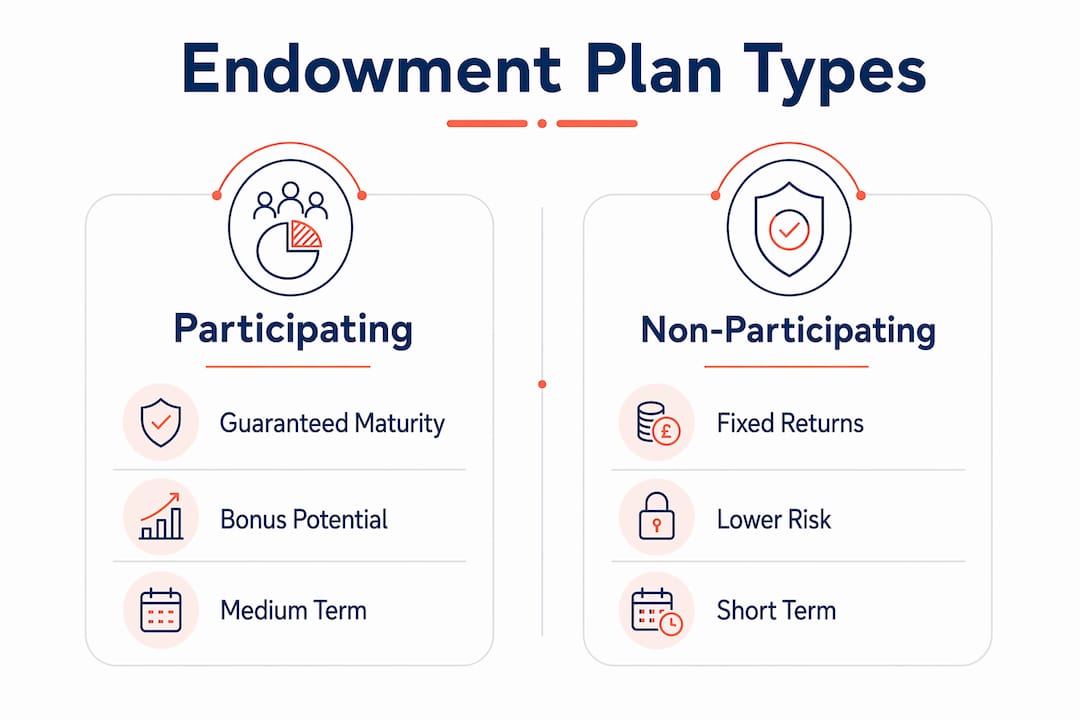
Participating endowment plans. These plans invest premiums in the insurer’s participating fund, which holds a mix of equities and bonds. Policyholders receive guaranteed maturity benefits plus potential bonuses. The upside is higher possible returns; the trade-off is that non-guaranteed bonuses vary with fund performance.
-
Non-participating endowment plans. These offer fully guaranteed payouts with no bonus element. Returns are lower but entirely predictable, making them suitable for risk-averse savers who prioritise certainty over upside.
-
Single-premium endowment plans. You invest a lump sum once and receive a guaranteed return at maturity. These are popular with individuals who have received a windfall, such as a bonus or inheritance, and want a structured, low-risk home for the funds.
-
Anticipated endowment plans. These pay out a portion of the sum assured at regular intervals during the policy term, rather than a single lump sum at the end. They suit policyholders who want periodic cash flow alongside long-term savings.
| Plan type | Payout structure | Bonus element | Best suited for |
|---|---|---|---|
| Participating | Guaranteed + bonuses | Yes (non-guaranteed) | Medium-term savers seeking upside |
| Non-participating | Fully guaranteed | No | Risk-averse savers |
| Single-premium | Lump sum at maturity | Varies | Lump-sum investors |
| Anticipated | Periodic + final payout | Varies | Those needing interim cash flow |
Pro Tip: When comparing plans from providers such as Singlife, Prudential, or AIA, always separate the guaranteed maturity value from the illustrated bonus projections. The guaranteed figure is what you can count on; treat the bonus as a potential upside, not a certainty.
How does an endowment plan compare with whole life insurance?
The endowment versus whole life question is one of the most common points of confusion for Singapore residents evaluating insurance savings products. Both combine insurance with a savings element, but they serve fundamentally different purposes.
Whole life insurance provides lifelong coverage with cash value that accumulates slowly over decades. An endowment plan, by contrast, has a fixed maturity date and is designed to return a meaningful lump sum within a defined timeframe. Whole life prioritises longevity and legacy planning; an endowment plan prioritises medium-term, predictable returns.
| Feature | Endowment plan | Whole life insurance |
|---|---|---|
| Coverage duration | Fixed term (5 to 20 years) | Lifelong |
| Primary purpose | Savings with protection | Protection with savings |
| Cash value growth | Faster, within defined term | Slower, accumulates over decades |
| Payout trigger | Maturity or death | Death or surrender |
| Flexibility | Lower (fixed term) | Higher (can adjust coverage) |
| Suitable for | Specific financial milestones | Long-term legacy and protection |
The structural difference between the two is that an endowment plan’s outcome depends on guaranteed components and bonus declarations, not daily market performance. This makes it more predictable than a unit-linked product but less flexible than a whole life policy with adjustable coverage.
“Endowment plans are not designed to replace whole life insurance. They are designed to work alongside it, addressing a specific savings goal within a defined window of time.”
If your priority is ensuring your family is protected regardless of when you pass away, whole life insurance is the more appropriate tool. If your priority is accumulating a specific sum by a target date, an endowment plan delivers that with greater clarity and structure.
What should you consider before buying a Singapore endowment plan?
Buying an endowment plan is a medium-term financial commitment, and getting the decision right requires honest self-assessment across several dimensions.
-
Match the term to your goal. Aligning the policy term to a specific financial milestone is the single most important factor in making an endowment plan work for you. A 10-year plan taken out when your child is eight years old, for instance, matures just as university fees become due.
-
Assess premium affordability. Regular-premium plans require consistent payments over the full term. Missing premiums can reduce benefits or trigger policy lapse. Only commit to a premium amount you can sustain comfortably through income changes or unexpected expenses.
-
Separate guaranteed from non-guaranteed returns. Participating bonuses are variable and should be treated as potential upside rather than confirmed income. Base your financial planning on the guaranteed maturity value alone.
-
Verify insurer credibility. All endowment plans sold in Singapore must be offered by MAS-regulated insurers. Check that your provider holds the appropriate licence and has a strong track record of bonus declarations.
-
Understand your exit options. If circumstances change and you need to exit early, surrendering the policy typically returns less than premiums paid. The resale market for traded endowment policies offers a better alternative, allowing you to transfer policy rights and future benefits to a buyer rather than surrendering at a loss.
Pro Tip: Before signing any policy, use the MAS Financial Industry Disputes Resolution Centre (FIDReC) as a reference point for understanding your rights as a policyholder. Knowing your recourse options before you commit adds a meaningful layer of confidence to the decision.
Key takeaways
A Singapore endowment plan delivers predictable, medium-term savings growth with built-in life protection, making it most effective when the policy term is matched precisely to a defined financial goal.
| Point | Details |
|---|---|
| Core structure | Endowment plans combine guaranteed savings with life insurance in a fixed-term contract. |
| Bonus treatment | Non-guaranteed bonuses should be treated as upside only; base planning on guaranteed values. |
| Term alignment | Matching the policy term to a financial milestone avoids costly early surrender. |
| Endowment vs whole life | Endowment plans suit specific savings goals; whole life suits long-term protection and legacy. |
| Exit strategy | The resale market offers better value than early surrender if you need to exit before maturity. |
Why I think endowment plans deserve more credit than they get
I have spoken to many readers through Eugenechaitf who dismiss endowment plans as old-fashioned or low-return products. I understand the scepticism. When you compare illustrated returns with the potential gains from equities or even a well-chosen ETF, the numbers can look modest. But that comparison misses the point entirely.
What endowment plans do exceptionally well is enforce discipline. I have seen too many people with the best intentions to save consistently, only to dip into their savings when something more urgent comes along. An endowment plan removes that temptation. The premium commitment is a feature, not a flaw. It creates a savings habit that many people simply cannot replicate with a bank account.
The area where I do urge caution is around bonus expectations. I have reviewed policy illustrations where the projected bonuses nearly double the guaranteed payout. Investors who plan around those figures are setting themselves up for disappointment. Always stress-test your plan using the guaranteed maturity value alone. If that figure still meets your goal, you have a solid plan. If it only works with maximum bonuses, reconsider the product or the goal.
One underused option I recommend exploring is the resale endowment market. Buying a traded policy with a shorter remaining tenure gives you clearer visibility of accumulated value and reduces the risk of being locked in for longer than you need. It is a genuinely smart way to access the benefits of endowment plans with less of the long-term commitment risk.
— Eugene
Take your financial planning further with Eugenechaitf
If this guide has helped clarify how endowment plans fit into your financial picture, the next step is building the broader financial foundation that makes any savings product work harder for you.
At Eugenechaitf, you will find practical, Singapore-specific guidance on budgeting and saving strategies that help you manage premium commitments without straining your monthly cash flow. For a wider view of how endowment plans sit alongside other savings and investment options, the saving vs investing guide is a strong next read. You can also explore the full insurance planning section for deeper guidance on selecting the right mix of protection and savings products for your stage of life.
FAQ
What is an endowment plan in Singapore?
An endowment plan is a life insurance policy that combines savings with life protection, paying a guaranteed lump sum at maturity or a death benefit during the policy term. It is regulated by the Monetary Authority of Singapore and offered by licensed insurers such as Singlife, Prudential, and AIA.
How long does a Singapore endowment plan typically last?
Most endowment plans run for 5 to 20 years, with the term chosen at inception to align with a specific financial goal such as education funding or a property purchase.
Are endowment plan returns guaranteed?
The guaranteed maturity value is contractually fixed, but bonuses in participating plans are non-guaranteed and depend on the insurer’s participating fund performance. Always base financial planning on the guaranteed figure alone.
What happens if I surrender my endowment plan early?
Early surrender typically returns less than the total premiums paid, particularly in the first few years of the policy. The resale market for traded endowment policies is a better alternative, as it allows you to transfer policy rights and recover more value than a direct surrender.
Is an endowment plan better than whole life insurance?
The two products serve different purposes. An endowment plan is better suited for accumulating a specific sum by a target date, while whole life insurance is better for lifelong protection and legacy planning. Many financial plans in Singapore use both products to address different goals simultaneously.






Leave a Reply