



TL;DR:
- Singapore’s wealth inequality exceeds its income gap due to asset accumulation at the top, mainly driven by property. While institutions moderate the wealth floor, rising property prices and limited top-end taxes widen the top wealth gap further. Understanding this disparity and strategic investments can help individuals build financial flexibility despite systemic gaps.
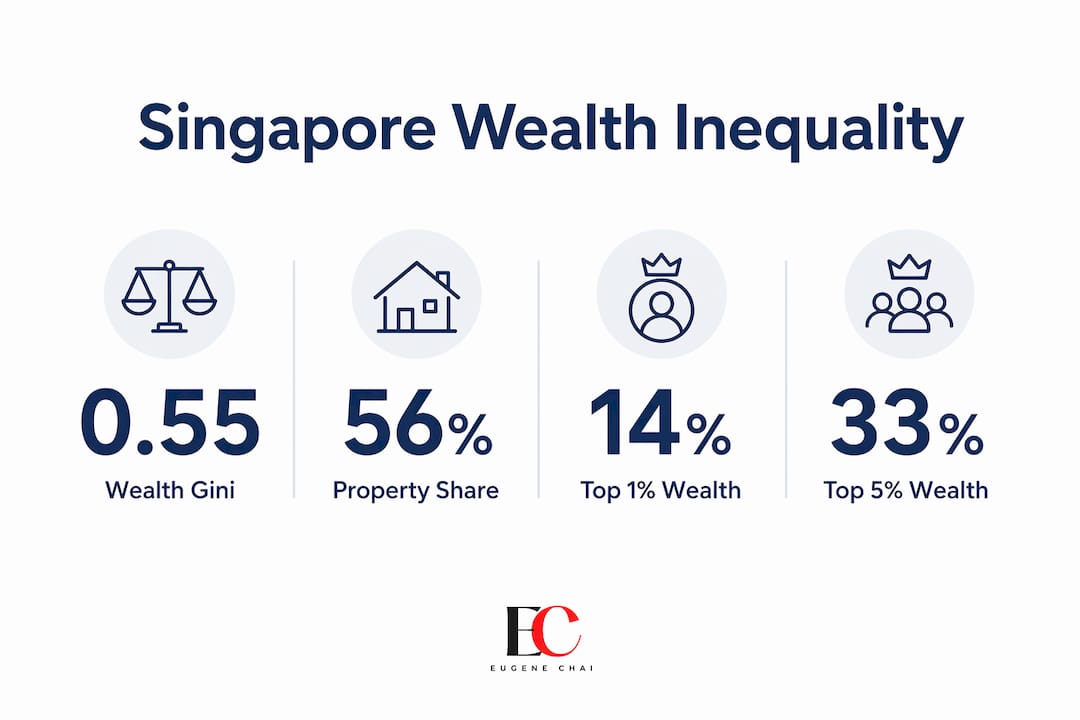
Wealth inequality in Singapore is defined by a Gini coefficient of 0.55, a figure that sits meaningfully above the country’s income Gini of 0.38. That gap matters because it tells you something income data alone cannot: assets accumulate faster at the top than wages do. The Ministry of Finance published this analysis in february 2026, making it the most authoritative snapshot of Singapore’s wealth distribution to date. Understanding both numbers is the first step toward making sense of the rich and poor divide in Singapore and what, if anything, can be done about it.
What are the main contributors to wealth inequality in Singapore?
Property is the single largest driver of economic disparity in Singapore. Property accounts for 56% of total household wealth, with CPF balances and financial assets each making up roughly 22%. That concentration in a single illiquid asset class means wealth accumulation is tightly linked to when and whether a household entered the property market.
The gap between the bottom and top wealth quintiles is stark. Households in the bottom 20% hold most of their net worth in HDB home equity and CPF savings. Households in the top 20% hold a far broader mix: private property, equities, business interests, and offshore assets. That diversity of asset types compounds over time, widening the gap with each passing decade.
Generational wealth transfer accelerates this process. Wealthier families pass on property, CPF top-ups, and investment portfolios to their children. This gives the next generation a head start that lower-income families, whose wealth sits locked in HDB flats and CPF accounts, simply cannot replicate. If you want to understand property’s role in wealth building, the entry point and timing matter enormously.
Key asset breakdown by wealth group:
- Bottom 20%: Positive net wealth, but almost entirely in HDB equity and CPF. Very little liquid savings.
- Middle 40%: Mix of HDB and some financial assets. CPF remains the dominant savings vehicle.
- Top 20%: Private property, diversified financial assets, and business equity. High liquidity relative to net worth.
- Top 1%: Hold 14% of total household wealth, with the top 5% controlling 33%.
Pro Tip: If you are in the early stages of building wealth, starting to invest early compounds your returns over decades. Read Eugenechaitf’s guide on early investing in Singapore to see how time in the market changes the outcome.
How does Singapore’s wealth inequality compare internationally?
Singapore’s wealth Gini of 0.55 is broadly comparable with other advanced economies, including the United Kingdom, Japan, and Germany. That framing matters because it prevents a misleading conclusion: Singapore is not uniquely unequal by global standards. The concentration of wealth at the top is a feature of most developed market economies, not a Singaporean anomaly.
The meaningful difference lies in redistribution. Scandinavian countries achieve lower inequality through significantly higher taxes and more aggressive social spending. Singapore’s low-tax model produces a different outcome by design. Economist Walter Theseira has noted that this reflects a deliberate social compact, not a policy failure.
“Singapore’s inequality profile is shaped by its social compact on taxation. Singaporeans have historically preferred lower taxes and targeted transfers over Scandinavian-style redistribution. The data reflects that choice, not neglect.”
There is also a measurement problem. Survey-based wealth data under-reports top wealth concentration because richer households are less likely to participate in surveys and more likely to hold assets offshore. The actual Gini could be higher than 0.55. That uncertainty should inform how policymakers and community activists interpret the numbers.
What are the social implications of the wealth gap in Singapore?
Social mobility is slowing in Singapore, and the wealth gap is a key reason. When the bottom 20% hold mostly illiquid assets, they cannot easily fund a business, pay for private tuition, or weather a financial shock without taking on debt. Positive net worth on paper does not translate to financial flexibility in practice.
The social implications extend beyond individual households. A widening gap between the wealthy and the rest erodes the sense of shared progress that has historically defined Singapore’s social contract. Community activists increasingly point to this as a source of tension, particularly among younger Singaporeans who feel the property ladder is out of reach.
That said, Singapore’s institutional framework does meaningful work to moderate the worst outcomes:
- HDB housing policy ensures most Singaporean households own their home, giving even lower-income families a positive net worth that would not exist in a pure rental market.
- CPF enforced savings prevent households from arriving at retirement with nothing. The mandatory contribution structure creates a wealth floor that most comparable economies lack.
- MediShield Life and Integrated Shield Plans (IPs) reduce the risk of a medical catastrophe wiping out a household’s savings entirely.
- CDC vouchers and targeted transfers provide direct support to lower-income households without requiring a broad tax increase.
The Ministry of Finance has acknowledged that HDB and CPF act as moderating institutions, preventing deeper negative net worth among lower-wealth households. That is a genuine achievement. The challenge is that these institutions protect the floor but do little to close the gap at the top.
Pro Tip: Understanding where you sit in Singapore’s income distribution is the first step to building a plan. Eugenechaitf’s breakdown of median income in Singapore gives you a clear benchmark.
SkillsFuture is another institutional lever worth knowing. Lower-income families can use SkillsFuture credits to access training and upskilling, which directly improves earning potential and, over time, wealth accumulation.
What policies address wealth inequality in Singapore?
The government’s primary tools for managing Singapore income distribution issues are CPF, HDB, and targeted fiscal transfers. These are well-established and have proven effective at preventing extreme poverty. The policy debate in 2026 has shifted toward whether these tools are sufficient for the next phase of inequality, where the gap is driven less by income and more by asset appreciation.
MP Shawn Loh has argued that global winner-takes-all economic trends are concentrating wealth faster than existing policy tools can offset. That is a significant observation. When technology and capital returns outpace wage growth, the gap between asset owners and non-owners widens regardless of employment levels.
Current and proposed policy directions include:
- Wealth taxation debates: IRAS currently does not levy a capital gains tax or inheritance tax. Calls for introducing these have grown louder, though the government has been cautious about changes that could affect Singapore’s attractiveness as a financial centre.
- CPF top-up schemes: Workfare and CPF top-ups for lower-income workers directly address the wealth floor but do not significantly alter the distribution at the top.
- Property cooling measures: Stamp duties and loan restrictions slow speculative property accumulation, though they also affect genuine first-time buyers.
- Transparency initiatives: The MOF’s 2026 paper itself represents a shift toward greater data transparency, which is a precondition for informed public debate.
| Policy area | Current approach | Gap or limitation |
|---|---|---|
| Housing | HDB subsidies, BTO pricing | Private property appreciation widens the gap |
| Retirement savings | CPF mandatory contributions | Lower earners accumulate less in absolute terms |
| Taxation | No capital gains or inheritance tax | Top wealth grows largely untaxed |
| Skills and mobility | SkillsFuture, Workfare | Addresses income but not asset accumulation |
The social compact on taxation is the underlying constraint. Singaporeans have historically favoured low taxes and targeted support over broad redistribution. Any policy evolution must work within that preference, or it must first change it through public dialogue.
Key takeaways
Wealth inequality in Singapore is primarily an asset story: property ownership and CPF balances determine most of the gap, and institutional policies moderate the floor without closing the top-end divide.
| Point | Details |
|---|---|
| Wealth Gini exceeds income Gini | Singapore’s wealth Gini of 0.55 is significantly higher than its income Gini of 0.38. |
| Property drives the gap | Property accounts for 56% of household wealth, making market entry timing a key wealth determinant. |
| Institutions moderate the floor | HDB and CPF prevent negative net worth for most lower-income households, but do not close the top-end gap. |
| Data likely understates concentration | Survey-based figures under-report top wealth; actual inequality may be higher than official figures show. |
| Policy toolkit needs updating | Global asset appreciation trends are outpacing Singapore’s existing redistribution tools. |
My honest view on Singapore’s wealth data
Reading the MOF’s 2026 paper carefully, I think the most important number is not the Gini coefficient. It is the liquidity gap. The bottom 20% of Singaporean households have positive net worth on paper, which sounds reassuring. But almost all of that wealth sits in HDB equity and CPF accounts that cannot be easily accessed. You cannot pay school fees, start a business, or handle a sudden job loss with your CPF balance. That is a real constraint that the headline Gini figure does not capture.
What concerns me more, as someone who writes about financial literacy for Singaporeans, is that most people in the bottom half do not know they are asset-rich and cash-poor. They feel the squeeze every month but cannot articulate why. The answer is structural: Singapore’s wealth-building system is excellent at creating paper wealth and poor at creating financial flexibility.
For community activists, I would argue the most productive focus is not on redistribution debates, which move slowly, but on helping individuals understand and use the tools they already have. CPF top-ups, SRS contributions, and SkillsFuture credits are underused by the people who need them most. That gap is closable without waiting for a policy change.
The international comparison is also worth keeping in mind. Singapore is not uniquely unequal. The choice to maintain a low-tax model is a genuine social compact, not a conspiracy. The honest question is whether that compact still reflects what most Singaporeans want, given how much property prices have moved in the past decade.
— Eugene
How Eugenechaitf can help you build wealth in an unequal world
Understanding the wealth gap is one thing. Knowing what to do about your own financial position is another.

Eugenechaitf covers the practical side of personal finance for Singaporeans at every stage: from budgeting basics that free up cash each month, to investment strategies that help you build assets beyond your CPF and HDB. The blog draws on Eugene’s own financial journey, including the mistakes and the wins, to give you advice that is grounded in the Singapore context. Whether you are a young adult trying to get on the property ladder or a working professional looking to diversify beyond your flat, the resources at Eugenechaitf are built for your situation.
FAQ
What is Singapore’s wealth Gini coefficient?
Singapore’s wealth Gini coefficient is 0.55, as reported in a Ministry of Finance paper published in february 2026. This is higher than the income Gini of 0.38, reflecting greater disparity in asset ownership than in earnings.
How much wealth do Singapore’s richest households hold?
The top 1% of Singapore households hold 14% of total household wealth, and the top 5% hold 33%. These figures were reported by the Senior Minister of State for Finance in 2026.
Why does property matter so much for wealth inequality in Singapore?
Property accounts for 56% of total household wealth in Singapore. Because private property appreciates faster than HDB flats, households that own private property accumulate wealth at a significantly higher rate than those who do not.
Does Singapore’s wealth inequality compare badly with other countries?
Singapore’s wealth Gini of 0.55 is broadly comparable with other advanced economies such as the United Kingdom, Japan, and Germany. Scandinavian countries show lower inequality primarily because of higher taxes and more aggressive redistribution, which reflects a different social compact.
What can individuals do about the impact of wealth inequality in Singapore?
Individuals can maximise CPF contributions, use SRS accounts for tax-efficient savings, and invest beyond their CPF to build liquid assets. Understanding your position relative to Singapore’s income distribution is the starting point for any personal wealth-building plan.
Disclaimer: Informational only. Consult an MAS-licensed advisor before investing.






Leave a Reply