



Credit card companies earn revenue through three main channels: interest charges on unpaid balances, interchange fees paid by merchants, and cardholder fees such as annual charges, late payment penalties, and cash advance fees. Understanding how this works puts you in a stronger position to use credit cards to your advantage rather than theirs.
Here is a quick summary of the key revenue streams:
- Interest income: Charged when you carry a balance past your statement due date, typically averaging around 20% across all accounts.
- Interchange fees: Paid by merchants every time a card is used, typically ranging from 1% to 3% of the transaction value.
- Cardholder fees: Annual fees, late payment charges, cash advance fees, and foreign transaction fees.
- Rewards programmes: Funded by interchange income and interest revenue, not a separate profit centre.
- Network assessment fees: Charged by payment networks such as Visa and Mastercard on top of interchange.
Knowing which of these applies to you, and when, is the first step to keeping more money in your own pocket.
How credit card issuers and payment networks share revenue
The credit card industry involves two distinct types of players, and they earn money in different ways.

Issuers are the banks and financial institutions that actually provide the credit and put the card in your wallet. In Singapore, this includes banks such as DBS, OCBC, and UOB. Issuers earn the bulk of their revenue from interest charges and cardholder fees. They also receive the largest portion of interchange fees when you use your card at a merchant.
Payment networks such as Visa and Mastercard sit in the middle, managing the infrastructure that processes every transaction. They do not lend you money directly. Instead, they earn what are called assessment fees, charged as a small percentage of each transaction. Visa charges approximately 0.14% per transaction, while Mastercard charges approximately 0.1375%.
When you tap your card at a hawker centre or pay online, money flows electronically from the issuer, through the network, to the merchant’s bank. The network verifies the transaction and ensures it is attributed to your account. Each party takes a slice of the fee the merchant pays. The issuer takes the largest cut, the network takes a smaller assessment fee, and the merchant’s bank (the acquiring bank) retains a processing margin.
- Issuers earn: interest income, cardholder fees, and the majority of interchange.
- Networks earn: assessment fees on transaction volume.
- Merchants pay: the combined processing fee, which covers all of the above.
This structure explains why credit card companies still profit even when you pay your balance in full every month. The interchange revenue keeps flowing regardless of whether you carry a balance.
How interest income drives the biggest share of credit card profits
Interest is the single largest profit driver for card issuers. When you carry a balance beyond your statement due date, the issuer charges interest on that outstanding amount, and those charges accumulate quickly at an average rate of approximately 20% across all accounts. At those rates, even a modest revolving balance generates meaningful income for the issuer month after month. The Federal Reserve data shows that the 20% of accounts that revolve a balance consistently account for about two thirds of all revolving balances. Heavy revolvers pay more than $60 per month in interest charges on average, and they account for over 70% of all interest paid across the portfolio.
- Interest rates vary by transaction type: Purchases, cash advances, and balance transfers each carry different rates, with cash advances typically attracting the highest charges.
- Grace periods matter: Most cards offer an interest-free grace period if you pay in full by the due date. Miss that date, and interest accrues from the transaction date.
- Revolvers fund the rewards ecosystem: The interest paid by cardholders who carry balances effectively subsidises the cashback and miles earned by those who pay in full.
What merchants pay: interchange fees and how they work
Every time you use a credit card, the merchant on the other end pays a fee. That fee, known as the interchange fee or “swipe fee,” is the mechanism through which issuers and networks earn revenue from the payment function of credit cards.

Interchange fees vary as a percentage of the transaction value, influenced by factors including card type, merchant industry, and transaction volume. Premium rewards cards generally attract higher interchange rates than basic cards, which is precisely how issuers fund the generous cashback and miles programmes attached to those products. Interchange fees generally average close to around two percent of the purchase price across the market.
Merchants typically absorb these costs as a cost of doing business, though in practice the fees are often factored into the prices consumers pay. In Singapore, you may have noticed some smaller merchants adding a surcharge for card payments or setting a minimum spend threshold. That is a direct response to interchange costs eating into already thin margins.
- Who sets interchange rates? Payment networks such as Visa and Mastercard set the rates, not individual banks.
- Who receives the fee? The issuing bank receives the largest portion. The network takes its assessment fee. The acquiring bank retains a processing margin.
- How do rewards cards affect this? Premium cards carry higher interchange rates, which fund the rewards. Merchants pay more when customers use a miles card than when they use a basic card.
- What about 0% interest offers? Issuers still earn interchange on every transaction during a 0% promotional period, which is how they remain profitable even without charging interest.
For a deeper look at how credit cards can work in a business context, the guide on using credit cards for business covers the merchant and entrepreneur perspective well.
Cardholder fees: what you pay beyond interest
Beyond interest, issuers collect a range of fees directly from cardholders. These fees are a meaningful revenue line, and most of them are entirely avoidable with a bit of planning.
Annual fees are the most visible. Premium and rewards cards in Singapore, such as those offering air miles or high cashback rates, typically charge annual fees ranging from a few dozen dollars to several hundred dollars. The fee provides the issuer with a predictable revenue stream regardless of how much you spend or whether you carry a balance.
Late payment fees are penalties for missing your minimum payment by the due date. In the UK, the Financial Conduct Authority has flagged that late payment fees can be unacceptable when disproportionate to the actual cost incurred. In Singapore, late fees are typically a fixed charge per missed payment, and they add up quickly if you are juggling multiple cards.
Cash advance fees apply when you withdraw cash using your credit card at an ATM. These fees are steep. Cash advance fees are typically around 5% of the amount withdrawn, or a fixed minimum charge, whichever is greater. On top of that, interest on cash advances usually starts accruing immediately with no grace period, making this one of the most expensive ways to access cash.
Balance transfer fees are charged when you move debt from one card to another, typically 3%–5% of the amount transferred. Some cards waive this fee during promotional periods.
Foreign transaction fees apply when you make purchases in a foreign currency. These are usually 1.5%–3% of the transaction and are worth watching if you travel frequently or shop on overseas websites.
- Annual fees: common on rewards and premium cards; worth paying only if the benefits outweigh the cost.
- Late payment fees: fixed penalty per missed payment; avoidable with automatic payment set-up.
- Cash advance fees: approximately 5% plus immediate interest; best avoided entirely.
- Balance transfer fees: 3%–5% of the transferred amount; some promotional offers waive this.
- Foreign transaction fees: 1.5%–3% per overseas transaction; fee-free cards exist for frequent travellers.
How to minimise credit card fees and interest charges
The good news is that most credit card costs are avoidable. The issuers count on a portion of cardholders not paying attention, but you can opt out of most of these charges with a few straightforward habits.
Pay your statement balance in full every month. This single action eliminates interest charges entirely. If you consistently pay in full, the issuer earns nothing from you in interest, only the interchange fees generated by your spending. That is a perfectly acceptable arrangement for both sides. You can compare credit cards to find one where the rewards genuinely exceed any annual fee you pay.
Set up automatic payments or calendar reminders. Late fees are pure waste. A missed payment by even one day triggers a penalty and can affect your credit record. Most Singapore banks allow you to set a GIRO arrangement to pay at least the minimum due automatically, though paying the full balance is always better.
Avoid cash advances. Using your credit card at an ATM is one of the most expensive financial decisions you can make on a routine basis. The combination of an upfront fee and immediate interest accrual at a high rate makes it far cheaper to use your debit card or draw from your savings account instead.
Choose the right card for your spending pattern. If you rarely spend enough to justify a high annual fee, a no-fee card with modest rewards is almost always the better choice. Understanding the risks of not using a credit card is useful context, but so is recognising when a card’s costs outweigh its benefits.
Watch for foreign transaction fees. If you travel or shop on overseas platforms, a card with no foreign transaction fees saves money on every purchase. Several Singapore banks offer travel-focused cards with this feature built in.
Pro Tip: Rewards programmes are funded by interchange fees and interest paid by revolving users. If you pay in full every month and choose a card with no annual fee, you are effectively receiving a subsidy from the cardholders who carry balances. Use that to your advantage by picking a card with strong cashback or miles on your regular spending categories.
How revenue is split between issuers, networks, and merchants
The credit card revenue pie is not divided equally, and understanding who gets what helps explain why the industry is structured the way it is.
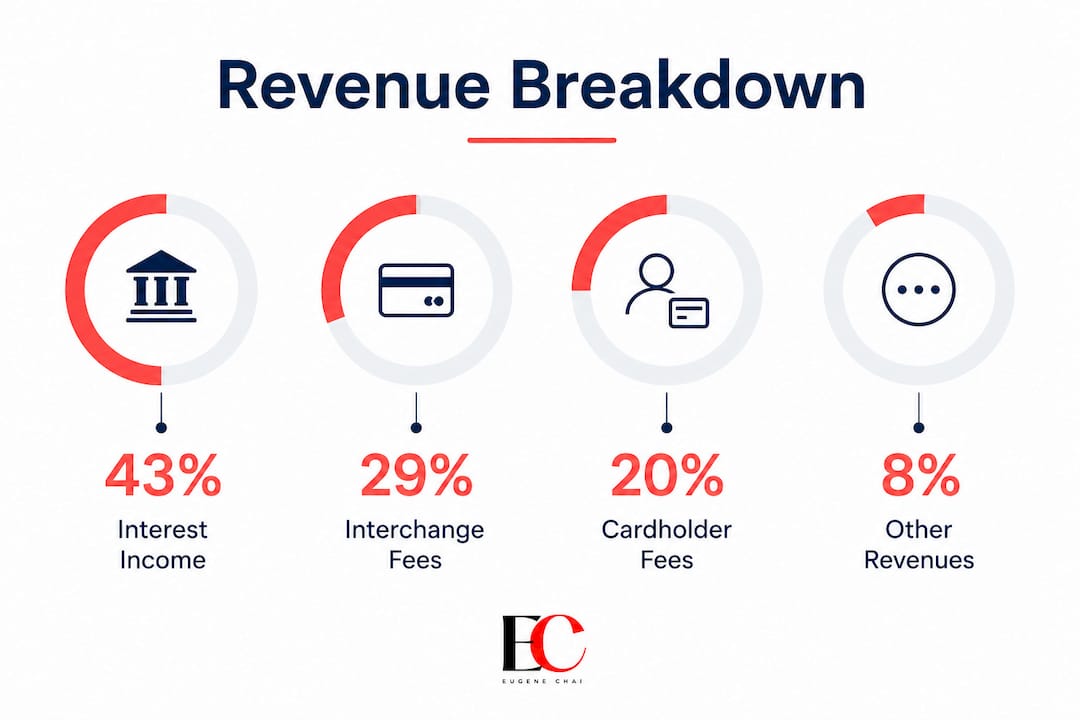
Interest income makes up a significant portion of credit card industry revenue, with interchange fees and cardholder fees constituting most of the remainder. No single fee category exceeds a major share on its own. That breakdown reflects the fundamental reality that revolving credit is the core profit engine, while payment processing is a secondary and sometimes net-negative function once rewards costs are factored in.
The Federal Reserve’s profitability analysis breaks this down further. The credit function (interest from revolving balances) accounts for approximately 80% of aggregate profitability. Late and other usage fees contribute approximately 16%. The transaction function, meaning interchange income net of rewards expenses, is slightly negative on average, because rewards costs now exceed interchange revenue for many issuers.
| Revenue source | Approximate share of industry income |
|---|---|
| Interest income | ~43% |
| Interchange fees | ~29% |
| Late and other usage fees | <10% |
| Annual fees (part of transaction margin) | Included in interchange/transaction |
| Other (balance transfers, miscellaneous) | — |
Merchants bear the cost of interchange but have limited ability to avoid it, since accepting card payments is effectively a commercial necessity. Networks such as Visa and Mastercard sit in a powerful position: they set the interchange rates, earn assessment fees on every transaction, and bear almost none of the credit risk. The issuing bank takes on the credit risk and earns the largest share of interchange in return. This is why building financial literacy around credit products matters so much for everyday cardholders navigating these systems.
Take control of your credit card costs
Understanding how credit card companies profit is genuinely useful knowledge. When you know that interest from revolving balances drives roughly 80% of issuer profitability, the case for paying your balance in full every month becomes obvious. When you understand that rewards are funded by interchange and interest revenue, you can make a clear-eyed decision about whether a premium card’s annual fee is worth paying for your spending pattern.
At Eugenechaitf, we believe that financial clarity leads to better decisions. If you want to build a stronger foundation around managing your money, the budgeting tips and strategies on this site are a practical starting point for keeping credit card costs firmly under control.

Key takeaways
Credit card companies earn their revenue primarily through interest on revolving balances (approximately 43% of industry income), interchange fees (about 29%), and cardholder fees (less than 10%).
| Point | Details |
|---|---|
| Interest dominates revenue | Interest income accounts for approximately 43% of credit card industry revenue, driven by revolving balances. |
| Interchange funds rewards | Interchange fees of around 29% of industry income fund rewards programmes and issuer operations, with typical transaction fees ranging from 1%–3%. |
| Fees are largely avoidable | Cardholder fees account for less than 10% of total revenue and can be avoided with good habits. |
| Networks earn separately | Visa and Mastercard charge assessment fees of approximately 0.14% and 0.1375% per transaction respectively. |
| Pay in full to opt out | Paying your statement balance in full every month eliminates interest charges entirely. |
FAQ
Do credit card companies make money if you pay in full each month?
Yes. Issuers still earn interchange fees from merchants every time you use your card, even when you pay your balance in full and incur no interest charges. Convenience users who pay monthly are profitable through interchange, though issuers earn significantly more from cardholders who carry balances.
How do credit card companies make money on 0% interest offers?
During a 0% promotional period, issuers forgo interest revenue but continue earning interchange fees on every purchase you make. They also collect any applicable balance transfer fees, typically 3%–5% of the amount moved, and count on a portion of cardholders carrying a balance once the promotional rate expires.
Why is there typically a 3% fee for credit card transactions?
The merchant processing fee, which often totals around 1%–3% of the transaction, covers interchange paid to the issuing bank, the network assessment fee paid to Visa or Mastercard, and a margin for the acquiring bank. Premium rewards cards attract higher rates within this range because the issuer needs more interchange revenue to fund the rewards it pays out.
What is the most expensive credit card fee for cardholders?
Cash advances are typically the most costly. The fee is approximately 5% of the amount withdrawn (or a fixed minimum, whichever is greater), and interest begins accruing immediately at a rate that is often higher than the standard purchase rate, with no grace period.
Can I avoid all credit card fees?
Most fees are avoidable. Paying your balance in full each month eliminates interest. Setting up automatic payments prevents late fees. Avoiding ATM cash withdrawals on your credit card sidesteps cash advance charges. Choosing a no-annual-fee card removes that cost entirely, though you should weigh that against the rewards you might forgo.
Disclaimer: Informational only. Consult an MAS-licensed advisor before investing.






Leave a Reply