



An endowment savings plan is a life insurance policy that bundles protection with a long-term savings component, paying out a lump sum either at the end of a fixed term or upon the policyholder’s death, whichever comes first. Unlike a standard bank deposit or a pure investment account, part of every premium you pay goes towards life cover, while the remainder is invested by the insurer. Terms typically run from 10 to 30 years, and the maturity value comprises both guaranteed and non-guaranteed elements.
Here is what that means in practice:
- Guaranteed sum assured: the minimum payout the insurer commits to, regardless of market performance.
- Non-guaranteed bonuses or dividends: additional amounts declared annually by the insurer, dependent on the performance of the participating fund.
- Death benefit: if you pass away before maturity, your beneficiaries receive the sum assured plus any declared bonuses.
- Maturity benefit: if you survive the full term, you receive the lump sum, which you can direct towards education fees, housing, or retirement.
In Singapore, endowment plans are widely used for goals such as children’s education or supplementing CPF savings. MoneySense notes that endowment products are sometimes incorrectly marketed as fixed deposits, which is a critical distinction every buyer should understand before signing.
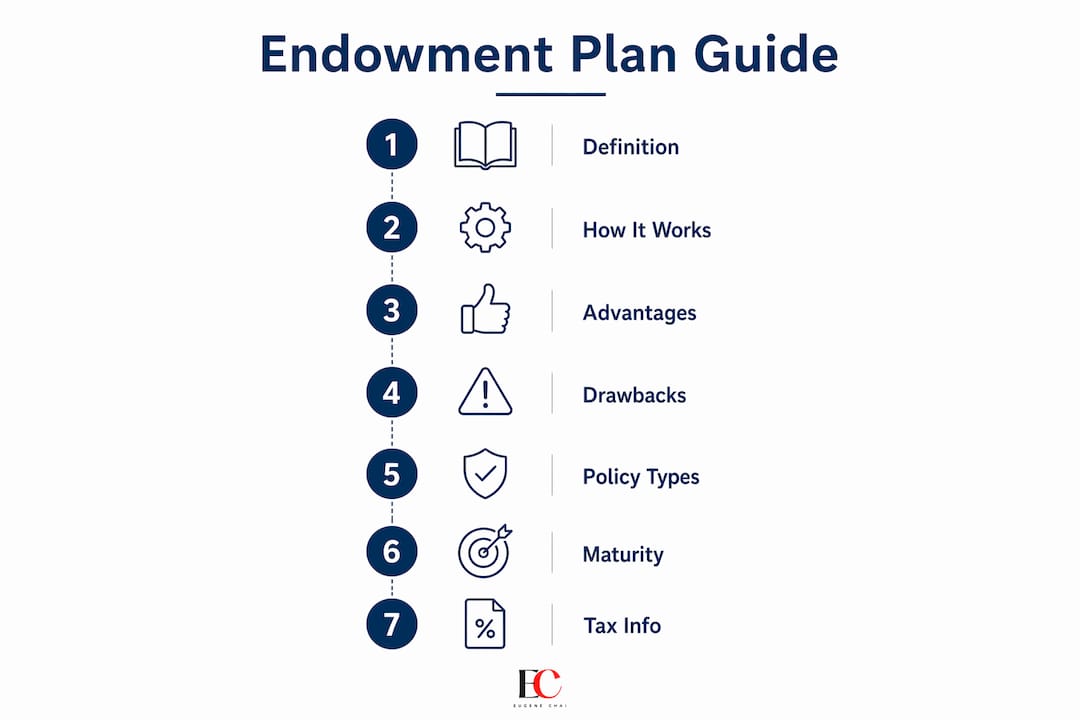
How endowment savings plans work
Every premium payment you make is split across two purposes: funding your life insurance cover and contributing to the savings or investment portion of the policy. The insurer pools the savings component into a participating fund (for with-profit policies) or manages it as a fixed reserve (for non-participating policies).
- Participating policies share the insurer’s profits through annual bonus declarations. Once a bonus is declared and added to your policy, it is guaranteed and cannot be reduced.
- Non-participating policies offer fixed, guaranteed maturity and cash values with no bonus upside.
- Premium payment terms are fixed at the point of purchase and generally do not increase over the policy’s life.
- Surrender value builds up after a minimum period, but early surrender typically yields less than total premiums paid, especially in the early years when front-loaded costs dominate.
Pro Tip: If you struggle with saving consistently, the fixed premium structure of an endowment plan can act as a forced savings mechanism. Just be certain you can commit to the full term before you start, because exiting early almost always costs you.

Advantages and drawbacks of endowment plans
Endowment plans support disciplined savings and downside protection rather than market-beating returns, which makes them suited to people with a conservative risk appetite or those who find it hard to save without a structured commitment.
Key benefits:
- Built-in life cover means your family is protected if you die before the plan matures.
- The guaranteed component provides a floor on your payout, unlike pure equity investments.
- Participating policies offer the potential for additional bonuses when the fund performs well.
- The fixed premium structure creates a savings habit, which is genuinely useful for young adults or families managing tight monthly budgets.
- In Singapore, SRS contributions used to fund certain endowment premiums may attract tax relief under IRAS rules; check the tax-efficient investing checklist for details.
Key drawbacks:
- Bundling insurance and investment into one premium is typically costlier than buying term insurance separately and investing the difference.
- Non-guaranteed bonuses can be reduced in poor market conditions; only declared bonuses are locked in.
- Liquidity is poor. You cannot access your money freely the way you can with a savings account or a unit trust.
- Endowment plans are not substitutes for bank savings, and net returns after fees and insurance costs are often lower than pure investment alternatives.
MoneySense advises verifying the guaranteed vs non-guaranteed breakdown in any benefit illustration before you commit. That single step prevents the most common source of disappointment at maturity.
Types of endowment policies you should know
Not all endowment policies are built the same way, and choosing the right type depends on your goals and tolerance for uncertainty.
- Participating (with-profit) policies share the insurer’s participating fund profits via annual bonuses. Returns are higher in good years but variable across the policy’s life.
- Non-participating policies carry guaranteed maturity and cash values with no bonus entitlement. What you see in the illustration is what you get.
- Anticipated endowment policies pay out a portion of the sum assured at pre-set intervals during the term, with the remaining balance and accrued bonuses paid at maturity. These suit people who want periodic liquidity without fully surrendering the policy.
- Unit-linked endowment plans invest the savings portion into unit trusts or funds, exposing you to market risk in exchange for potentially higher growth. Returns are not guaranteed.
- Whole-of-life endowment variants combine lifelong cover with a savings element, though these carry higher premiums and are less common for straightforward savings goals.
For a deeper look at how these products are structured for Singapore residents, the Singapore endowment plan guide on Eugenechaitf covers the regulatory and practical details specific to the local market.

What do endowment plans actually cost?
Premiums for endowment plans are typically higher than term insurance for the same sum assured, because you are paying for both protection and a savings accumulation function within a single product.
- Costs are front-loaded: a significant portion of your early premiums covers agent commissions and insurance charges before meaningful savings accumulate.
- Premiums are fixed at inception and do not rise over time, which aids budgeting but removes flexibility.
- Surrendering early can result in receiving back less than you paid in, particularly within the first few years of the policy.
- Benefit illustrations will show both guaranteed and non-guaranteed projections. The guaranteed figure is the one you should plan around.
A common mistake is treating an endowment plan like a fixed deposit where you can withdraw at any time without penalty. The front-loaded cost structure means the plan only becomes financially worthwhile if you hold it to, or close to, maturity.
What happens when your endowment plan matures?
At maturity, the insurer pays you a lump sum comprising the guaranteed sum assured plus any bonuses that have been declared and accumulated over the policy term, which you can use for your child’s education by exploring how to pay for college without student loans. The policy then ends. There is no automatic renewal; if you want continued cover or savings, you would need to purchase a new policy.
- If you die before maturity, your beneficiaries receive the death benefit, which typically equals the sum assured plus declared bonuses at the time of the claim.
- Maturity proceeds are commonly used for children’s university fees, an HDB upgrade, or topping up retirement savings alongside CPF LIFE.
- Once paid out, the lump sum is yours to deploy freely, whether into a fixed deposit, a unit trust, or an SRS account.
Planning what to do with the maturity payout before the policy ends is worth doing early. Readers looking to put that lump sum to work can explore saving vs investing strategies to decide the best next step.
How to handle complaints about your endowment plan
Disputes most often arise around surrender values, bonus declarations, or a mismatch between what was illustrated at sale and what the policy actually delivers.
- Start with your insurer’s internal complaints process. Document every communication in writing and keep copies of your original benefit illustration and policy documents.
- If the insurer does not resolve the matter satisfactorily, escalate to the Financial Industry Disputes Resolution Centre (FIDReC) in Singapore, which handles disputes between consumers and financial institutions regulated by MAS.
- An MAS-licensed financial adviser can help you interpret policy terms and assess whether the insurer has acted within the agreed contract.
- Reading the policy contract carefully before purchase, particularly the sections on surrender values and non-guaranteed bonuses, prevents most misunderstandings before they become disputes.
Tax implications of endowment savings plans in the UK
In the United Kingdom, endowment policies are classified as qualifying or non-qualifying life insurance contracts under HMRC rules, and the tax treatment differs between the two. Qualifying policies, which meet specific premium and term conditions set by HMRC, generally pay out free of income tax in the hands of the policyholder. Non-qualifying policies may be subject to income tax on gains when they are surrendered, mature, or are assigned.
For UK policyholders, gains on non-qualifying policies are taxed as income rather than as capital gains, and the insurer typically pays tax within the fund at a rate equivalent to basic-rate income tax. Higher or additional-rate taxpayers may face a further liability on top of that. HMRC’s Insurance Policyholder Taxation Manual sets out the detailed qualifying conditions that determine which category your policy falls into.
Singapore residents holding UK-issued endowment policies should note that IRAS treats overseas insurance proceeds differently from locally issued plans. Consulting an MAS-licensed adviser who also understands cross-border tax treatment is advisable before purchasing or surrendering such a policy.
Key takeaways
An endowment savings plan combines life insurance with a structured savings component, paying a guaranteed lump sum at maturity or on death, making it best suited to disciplined savers with a long time horizon and low risk tolerance.
| Point | Details |
|---|---|
| Bundled product structure | Premiums fund both life cover and a savings component; neither element is optional. |
| Terms span a fixed multi-year period | Committing to the full term is critical; early surrender typically returns less than premiums paid. |
| Guaranteed vs non-guaranteed | Only the guaranteed sum assured is certain; bonuses depend on participating fund performance. |
| Higher cost than unbundled | Buying term insurance separately and investing the remainder is usually cheaper, but less structured. |
| Complaints route via FIDReC | Unresolved disputes with Singapore insurers can be escalated to FIDReC under MAS oversight. |
FAQ
What is an endowment savings plan?
An endowment savings plan is a life insurance policy that combines protection with a long-term savings element, paying a lump sum at the end of a fixed term or to your beneficiaries upon death, whichever occurs first.
Are endowment policies still a good investment?
They suit disciplined savers who want guaranteed protection alongside structured savings, but the bundled cost structure means net returns are often lower than investing separately. They are not ideal for those prioritising high growth or needing liquidity.
Do endowment policies pay out on death?
Yes. If the policyholder dies before the plan matures, the insurer pays the sum assured plus any declared bonuses to the named beneficiaries, fulfilling the life insurance element of the contract.
Is an endowment plan good or bad?
It depends on your goals. For someone who struggles to save consistently and wants a guaranteed payout with life cover, it can be a practical tool. For someone comfortable investing independently, the higher costs and low liquidity make it less attractive than alternative savings products.
If you are working out where an endowment plan fits within your broader financial picture, start with the basics. Eugenechaitf’s budgeting tips and money management guide is a practical first step before committing to any long-term savings product.
Disclaimer: Informational only. Consult an MAS-licensed adviser before investing.






Leave a Reply