



TL;DR:
- Credit counselling in Singapore helps individuals manage unsecured debts through negotiated repayment plans and professional guidance. The process involves attending an educational webinar, disclosing full financial details, and undergoing personalized counselling before formalizing a Debt Management Programme for three to five years. It offers benefits like interest reductions and creditor trust but requires strict adherence, account closures, and early engagement to prevent worsening debt situations.
Credit counselling in Singapore is defined as a structured service that helps individuals manage and repay unsecured debts through negotiated repayment plans and professional financial guidance. The recognised body for this service is Credit Counselling Singapore (CCS), a non-profit agency with formal credibility among local banks. Singapore credit counselling Singapore explained covers everything from the initial assessment to enrolment in the Debt Management Programme (DMP), a formal repayment arrangement that typically runs for 3 to 5 years with reduced or halted interest charges. Understanding how this process works gives you a clear path forward when credit card debt or personal loans become unmanageable.
How does credit counselling work in Singapore?
The credit counselling process in Singapore follows a clear sequence of steps. CCS does not simply hand you a repayment plan on day one. You must first demonstrate a genuine effort to understand your financial situation before formal support begins.

Step 1: Attend an educational talk or webinar
The initial counselling process starts with a mandatory educational talk or webinar. CCS requires this before any one-on-one session. The webinar covers how unsecured debts accumulate, what options exist, and what to expect from the DMP.
Step 2: Disclose your full financial picture
You must submit a complete picture of your income, assets, and liabilities. This is not optional. CCS uses this information to assess whether you qualify for the DMP and to build a realistic repayment proposal for your creditors.
Step 3: One-on-one counselling session
A counsellor reviews your case and provides personalised advice. This session addresses the root causes of your debt, not just the numbers. You will discuss spending habits, income stability, and any changes needed to sustain a repayment plan.
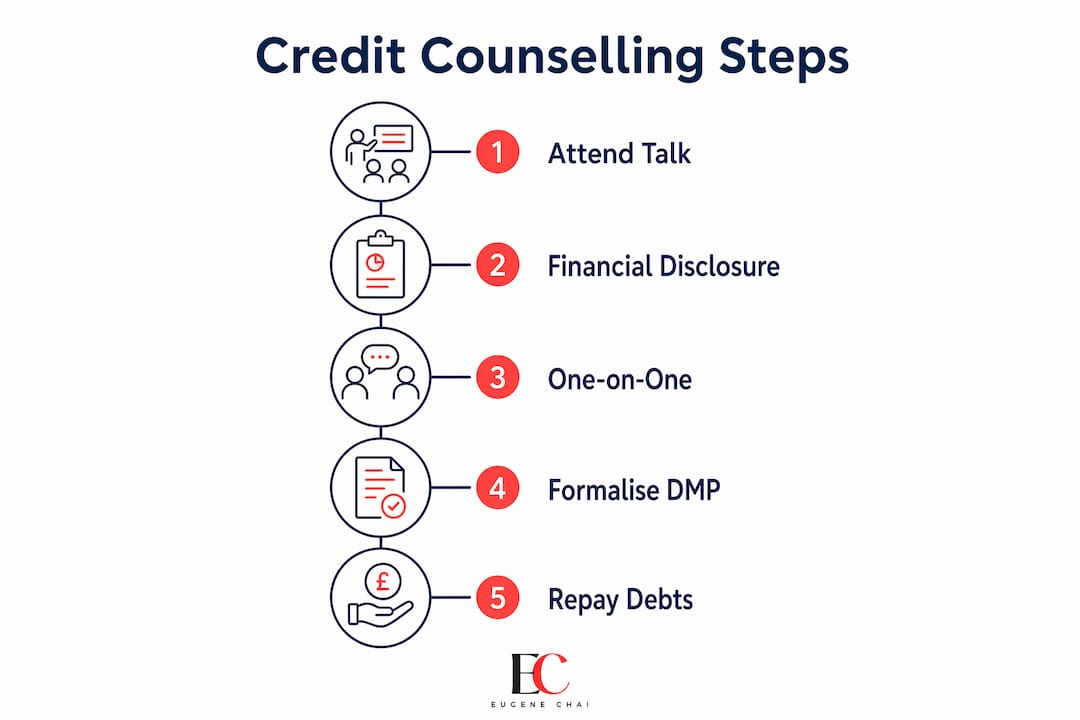
Step 4: Formalise the Debt Management Programme
If you qualify, CCS negotiates with your creditors on your behalf. Banks respond better to proposals submitted through CCS than to individual debtor requests. Once creditors agree, you sign a formal DMP contract and begin monthly payments through CCS.
Step 5: Repay over 3 to 5 years
The DMP repayment window is typically 3 to 5 years. During this period, interest on your unsecured debts is reduced or stopped entirely. You make a single consolidated payment to CCS each month, and CCS distributes it to your creditors.
Pro Tip: Attend the CCS webinar as soon as you notice repayment difficulties. The earlier you engage, the more options remain available to you.
What is the difference between credit counselling and debt consolidation?
Many readers confuse credit counselling with debt consolidation loans. They solve similar problems but work in fundamentally different ways. Choosing the wrong option can worsen your financial position.
Debt consolidation involves taking out a new loan to pay off existing debts. This requires a good credit score and the ability to service a new loan. Credit counselling through the DMP, by contrast, negotiates your existing debts without any new borrowing or credit checks.
| Feature | Debt consolidation loan | Credit counselling DMP |
|---|---|---|
| New borrowing required | Yes | No |
| Credit score requirement | Good credit needed | No minimum score |
| Interest treatment | New loan interest applies | Reduced or halted by creditors |
| Credit accounts | Remain open (risk of more debt) | Mandatory closure |
| Creditor negotiation | None | Handled by CCS |
| Typical duration | Loan tenure (varies) | 3–5 years |
| Suitable for | Those with good credit and discipline | Those with poor credit or high debt load |
The key distinction is this: debt consolidation replaces your debts with a new loan, while the DMP restructures your existing debts through negotiation. If your credit score is already damaged by missed payments, a consolidation loan may not even be available to you. The DMP is specifically designed for that situation.
Pro Tip: Check your credit report via the Credit Bureau Singapore before deciding. If your score is below the bank’s threshold for a consolidation loan, the DMP is likely your most practical option.
What benefits and limitations should you expect from credit counselling?
Credit counselling delivers real, measurable benefits. It also comes with firm restrictions that you must accept before enrolling. Knowing both sides helps you commit with realistic expectations.
Benefits of the Debt Management Programme
- Reduced or halted interest. Once your DMP is active, creditors agree to reduce or stop charging interest on your unsecured debts. This alone can save thousands of dollars over the repayment period.
- Single monthly payment. You pay one amount to CCS each month. CCS handles distribution to all creditors. This removes the stress of managing multiple payment deadlines.
- Protection from legal action. Creditors who agree to the DMP typically pause collection calls and legal proceedings. This gives you breathing room to focus on repayment.
- Financial education. Credit counselling addresses the root causes of debt, not just the repayment mechanics. You gain practical knowledge on budgeting and spending habits that reduces the risk of falling into debt again.
- Credible mediation. CCS is the sole recognised non-profit for structured debt management in Singapore. Banks trust CCS proposals in a way they do not trust individual debtor requests.
Limitations to be aware of
- Mandatory account closure. The DMP requires closure of all credit cards and unsecured credit accounts. You cannot borrow more during the programme. This is non-negotiable.
- Strict payment adherence. Missing a payment can void the DMP agreement, reinstating full interest charges and restarting creditor actions. The commitment is binding.
- Impact on credit score. Enrolling in a DMP is recorded on your credit report. Your ability to obtain new credit during and shortly after the programme will be limited.
- Time commitment. Three to five years is a significant period. You must maintain financial discipline throughout, with no access to credit facilities.
The most common pitfall is waiting too long. Delayed assistance worsens debt outcomes. Individuals who seek help early retain more options and face less creditor pressure.
How to prepare for credit counselling in Singapore
Preparation makes the credit counselling process faster and more effective. Walking into your first CCS interaction with the right documents and the right mindset shortens the time to a formal agreement.
- Gather your financial documents. Bring your NRIC, recent payslips or CPF contribution statements, bank statements for the past three months, and a full list of all outstanding debts including credit card statements and personal loan agreements.
- List every creditor. Write down the name of each bank or lender, the outstanding balance, the monthly minimum payment, and the current interest rate. CCS needs this to build your repayment proposal.
- Attend the mandatory webinar first. CCS will not proceed to a one-on-one session without this step. Register early, as slots fill up.
- Set a realistic monthly budget. Before your counselling session, calculate your take-home income and fixed expenses such as HDB mortgage or rental, utilities, and food. The amount left over will inform what monthly DMP payment is sustainable.
- Commit to behaviour change. The DMP closes your credit accounts. Use this period to build an emergency savings habit so that unexpected expenses do not push you back into debt after the programme ends.
- Maintain communication with your counsellor. If your income changes or you face a financial shock during the programme, contact CCS immediately. Proactive communication protects your DMP agreement.
Understanding Singapore’s financial hardship options alongside credit counselling gives you a fuller picture of the support available. Credit counselling is one tool in a broader set of resources.
Key takeaways
Credit counselling through CCS is the most accessible and creditor-recognised route to structured debt repayment for Singaporeans with unsecured debts and damaged credit.
| Point | Details |
|---|---|
| CCS is the recognised agency | CCS holds unique status with Singapore banks, making its DMP proposals far more effective than individual negotiations. |
| DMP runs for 3–5 years | Interest is reduced or halted during this period, making repayment significantly more manageable. |
| Credit accounts must close | All unsecured credit facilities are closed upon DMP enrolment to prevent further borrowing. |
| Seek help early | Delayed action worsens debt outcomes; engaging CCS at the first sign of difficulty preserves more options. |
| Counselling changes behaviour | The process addresses spending habits and financial literacy, not just the debt balance itself. |
My honest view on credit counselling in Singapore
I have spoken with many Singaporeans who waited far too long before seeking help. By the time they contacted CCS, creditors had already initiated legal proceedings, and the stress had compounded for months unnecessarily. The single most important thing I can tell you is this: seek help at the first sign of difficulty, not the last.
There is a persistent misconception that credit counselling is a sign of failure. It is not. It is a structured, professionally mediated process that banks themselves respect. The fact that banks respond better to CCS proposals than to individual requests tells you everything about how the system is designed. You are not begging. You are engaging a recognised intermediary.
The DMP’s strict rules, particularly the closure of credit accounts, feel harsh at first. I think they are actually the programme’s greatest strength. Removing access to credit forces a genuine reset of spending behaviour. The financial discipline built during three to five years of structured repayment is worth more than the temporary inconvenience of not having a credit card.
My caution is against unregulated alternatives. There are services that promise quick debt relief without the formal structure of a DMP. These are not recognised by banks and offer no protection from creditor action. Stick with CCS. The process is slower, but the outcome is real and lasting. Pair it with genuine financial literacy and you will not need to return.
— Eugene
Personal finance resources to support your debt management
Managing debt is only one part of the picture. Building strong financial habits alongside credit counselling is what prevents a return to the same situation.

At Eugenechaitf, you will find practical, Singapore-specific guides on budgeting strategies that work alongside a DMP repayment schedule. The personal finance resources cover everything from creating your first monthly budget to building an emergency fund on a tight income. These guides are written for Singaporeans navigating real financial pressure, not theoretical scenarios. If you are working through a DMP or preparing to engage CCS, the budgeting content on Eugenechaitf gives you the practical tools to make every dollar count during the repayment period and beyond.
FAQ
What is Credit Counselling Singapore (CCS)?
Credit Counselling Singapore is the sole recognised non-profit agency for structured debt management in Singapore. It is formally accepted by local banks as a neutral mediator for Debt Management Programme negotiations.
Who qualifies for the Debt Management Programme?
The DMP is designed for individuals with unsecured debts such as credit card balances and personal loans who are unable to meet repayment obligations. There is no minimum credit score requirement, unlike debt consolidation loans.
How long does a Debt Management Programme last?
A DMP typically runs for 3 to 5 years, during which interest on unsecured debts is reduced or halted and a single monthly payment is made through CCS.
What happens if I miss a DMP payment?
Missing a payment can void the DMP agreement, reinstating full interest charges and restarting creditor collection actions. Contact CCS immediately if you anticipate a payment difficulty.
Does credit counselling affect my credit score?
Enrolment in a DMP is recorded on your credit report and will limit your ability to obtain new credit during the programme. The long-term benefit of clearing your debts outweighs the short-term credit impact for most individuals.
Disclaimer: Informational only. Consult an MAS-licensed advisor before making financial decisions.






Leave a Reply