



TL;DR:
- The statutory retirement age in Singapore will increase to 64 on July 1, 2026, with plans to raise it to 65 by 2030. Employers are required to offer re-employment until age 69 if eligible, but this is not automatic. Singaporeans must plan carefully for the income gap between age 55 and 65, using CPF, SRS, and private savings strategies.
The statutory retirement age in Singapore is 64 years, effective 1 july 2026, following the Ministry of Manpower’s phased roadmap under the Retirement and Re-employment Act (RRA). This increase from 63 marks a deliberate policy shift to keep senior workers employed longer and to align retirement timelines with Singapore’s ageing population. The government has confirmed a further increase to 65 by 2030, with the re-employment age rising to 70 in the same period. If you are approaching your early sixties, these changes directly affect your career, your CPF timeline, and your financial planning strategy.
What does the retirement age in Singapore mean for workers and employers?
The statutory retirement age is the earliest age at which an employer can lawfully ask an employee to retire. As of 1 july 2026, that age is 64. The re-employment age, now set at 69, is the upper limit to which eligible employees must be offered continued work.
These two figures are distinct and carry different legal weight. Retirement age governs when a contract can be ended on age grounds. Re-employment age governs how long an employer must offer continued employment after that point.
Who qualifies for re-employment?
Re-employment eligibility is not automatic. An employee must meet all three of the following criteria:
- Minimum service: At least two years with the current employer before reaching retirement age.
- Satisfactory performance: The employer must assess the employee’s work record as acceptable.
- Medical fitness: The employee must be physically and mentally fit to continue in the role.
Employers who cannot offer a suitable re-employment position must provide an Employment Assistance Payment (EAP) instead. Contracts under re-employment are offered annually, up to the age of 69.
Pro Tip: If you are 62 or older and planning to stay with your current employer past 64, document your performance reviews carefully. A strong track record is your best protection when re-employment eligibility is assessed.
The Senior Employment Credit has been extended until december 2027, providing wage offsets for employers who hire workers aged 69 and above. This reduces the financial disincentive for employers to retain older staff, which is good news for workers who wish to continue beyond the re-employment age.
How does CPF interact with the new retirement age?
The CPF system operates on its own age milestones, and these do not align neatly with the statutory retirement age. Understanding this gap is one of the most important aspects of retirement planning in Singapore.

The CPF age milestones you need to know
| Age | CPF Event |
|---|---|
| 55 | Retirement Account (RA) created; excess savings above the Full Retirement Sum can be withdrawn |
| 65 | CPF LIFE monthly payouts begin |
| 64 | New statutory retirement age (from 1 july 2026) |
| 69 | Re-employment age ceiling |
The CPF structure comprises four accounts: the Ordinary Account (OA), Special Account (SA), MediSave Account (MA), and Retirement Account (RA). At 55, your OA and SA balances are used to form the RA, up to the applicable Retirement Sum tier. The three tiers are the Basic Retirement Sum, Full Retirement Sum, and Enhanced Retirement Sum, each producing a different monthly CPF LIFE payout from age 65.
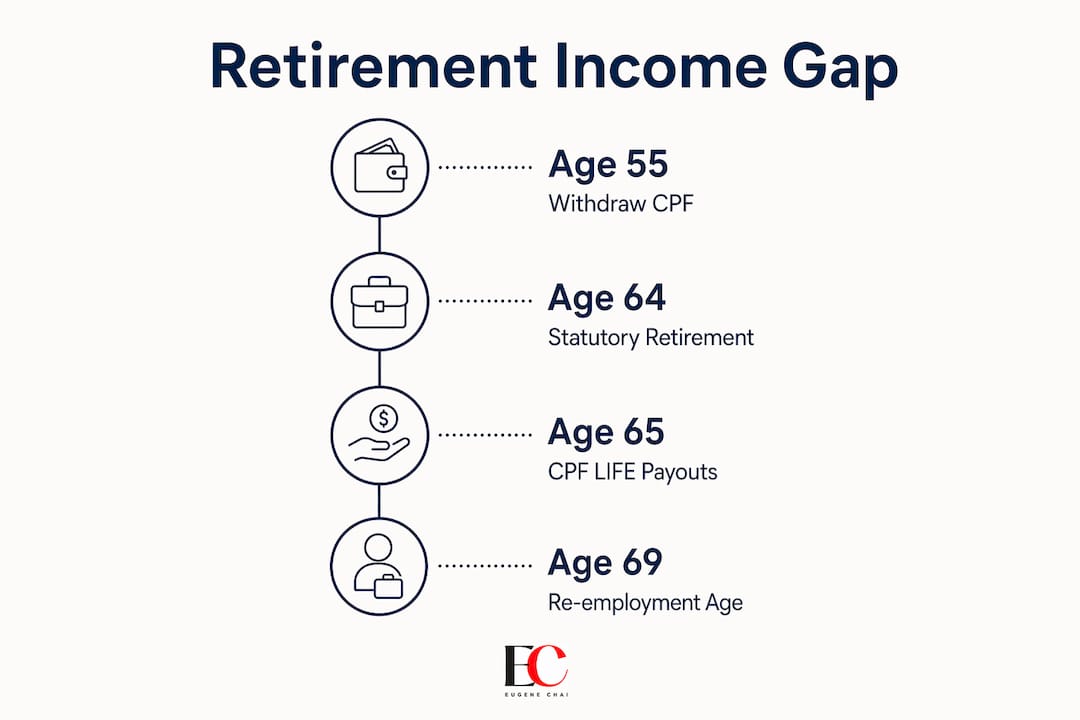
The 10-year income gap
There is a critical gap between age 55, when you can withdraw excess CPF savings, and age 65, when CPF LIFE payouts begin. During this decade, you receive no monthly CPF income unless you have other sources. With the retirement age now at 64, many workers will stop receiving a salary one full year before CPF LIFE kicks in. That one-year shortfall requires deliberate planning.
From 2027, CPF contribution rates for workers aged 55–60 will increase by 1.5 percentage points, and for those aged 60–65 by 1 percentage point. Higher contributions mean larger RA balances and, consequently, higher CPF LIFE payouts from 65.
Eligible Singaporeans aged 50 and above in 2026 will also receive a one-time CPF top-up of up to $1,500, credited to the RA or SA in december 2026. The amount depends on your residential property’s Annual Value and existing CPF savings. This top-up will not close the income gap on its own, but it does add to your compounding base.
Pro Tip: Use the CPF Retirement Sum calculator on the CPF Board website to model different scenarios. Knowing your projected CPF LIFE payout at 65 tells you exactly how much you need to bridge from your own savings between 64 and 65.
What are the recent SRS changes and why do they matter?
The Supplementary Retirement Scheme (SRS) is a voluntary, tax-deferred savings scheme administered by IRAS. Contributions reduce your assessable income in the year they are made, and withdrawals at the statutory retirement age are taxed at 50% of the amount withdrawn. This makes SRS one of the most tax-efficient tools available to Singaporean residents.
The 2026 budget announced an increase in SRS contribution limits, directly linked to the raised retirement age. The rationale is straightforward: if workers are expected to retire later, they need more time and capacity to accumulate retirement savings outside CPF.
How SRS fits into your retirement plan
- Tax relief now: Every dollar contributed to SRS reduces your taxable income in the current year, lowering your IRAS bill immediately.
- Tax-efficient withdrawals: Only 50% of each SRS withdrawal is taxable, and withdrawals spread over ten years can keep you within a low tax bracket.
- Bridging the pre-65 gap: SRS funds can be invested in unit trusts, Singapore Government Securities, or Singapore Exchange-listed equities. Returns compound within the account, tax-free, until withdrawal.
- Flexibility: Unlike CPF, SRS funds can be withdrawn before the statutory retirement age, though a 5% penalty applies and the full amount becomes taxable.
The SRS is particularly useful for covering the period between retirement at 64 and CPF LIFE payouts at 65. A well-funded SRS account, invested in low-cost instruments, can generate the income needed to avoid drawing down on other savings prematurely. Financial experts recommend viewing retirement adequacy as a combined strategy involving CPF LIFE, SRS, and private investments, especially given rising life expectancy.
If you have not yet opened an SRS account, the three participating banks are DBS, OCBC, and UOB. The process takes under 30 minutes and the tax benefits begin in the same year you make your first contribution.
Practical financial planning strategies for retirement at 64
Retiring at 64 in Singapore requires planning that goes well beyond your CPF balance. Retirement readiness involves housing suitability, healthcare costs, caregiving responsibilities, and lifestyle sustainability. Here is a structured approach.
1. Map your income sources from 64 to 75
List every income source you expect in retirement: CPF LIFE (from 65), SRS withdrawals, rental income, dividends, and part-time work. Identify the gaps, particularly the 64-to-65 window, and assign a specific savings pool to cover each one.
2. Build a liquid cash buffer
Keep at least 12 months of living expenses in a high-yield savings account or Singapore Savings Bonds (SSBs). This prevents you from selling investments at a loss during a market downturn in your early retirement years. SSBs are capital-guaranteed and can be redeemed with one month’s notice.
3. Right-size your housing
Many Singaporeans hold most of their net worth in their HDB flat or private property. Right-sizing your housing by downsizing to a smaller flat can unlock significant cash. The HDB Silver Housing Bonus provides an additional cash grant for eligible seniors who right-size and top up their CPF RA with the proceeds.
4. Plan for healthcare costs
MediShield Life covers large hospitalisation bills, but Integrated Shield Plans (IPs) cover ward upgrades and specialist fees. Review your IP coverage before 64. Premiums rise sharply after 65, so locking in a plan earlier can reduce long-term costs.
5. Consider a second career or part-time income
Working past 64, even part-time, reduces the rate at which you draw down savings and keeps you socially engaged. Some retirees find that a TEFL certification opens doors to teaching English abroad or locally, providing both income and purpose in the early retirement years.
“The biggest retirement planning mistake I see is treating CPF as the entire plan. CPF LIFE is a foundation, not a ceiling. Your SRS, your investments, your housing equity, and your health all determine whether retirement at 64 is comfortable or stressful.”
For a detailed look at managing your money month by month in retirement, the retirement budget guide on Eugenechaitf covers practical spending frameworks for 2026.
Key takeaways
Singapore’s retirement age is now 64, and the gap between that age and CPF LIFE payouts at 65 makes proactive planning with CPF, SRS, and private savings the only reliable path to financial adequacy.
| Point | Details |
|---|---|
| Retirement age is now 64 | The statutory minimum retirement age rose to 64 on 1 july 2026, with 65 targeted by 2030. |
| Re-employment is not automatic | Workers need two years of service, satisfactory performance, and medical fitness to qualify. |
| The 10-year CPF gap is real | No CPF LIFE payouts occur between ages 55 and 65, requiring separate savings to bridge the period. |
| SRS limits have increased | Higher SRS contribution limits in 2026 allow more tax-deferred savings to cover the pre-65 years. |
| Holistic planning is necessary | CPF, SRS, housing equity, and healthcare costs must all be factored in for true retirement adequacy. |
My honest view on Singapore’s shifting retirement timeline
I have watched the retirement age in Singapore inch upward for years, and my honest view is that the increases are both necessary and, for many people, genuinely helpful. Living to 85 or 90 is no longer unusual. Retiring at 62 with CPF LIFE not starting until 65 and savings that need to last 25 years is a real financial risk.
What concerns me more than the policy itself is the number of people who treat the retirement age as their planning deadline. They focus on reaching 64 and assume the rest will sort itself out. It will not. The CPF income gap, the rising cost of healthcare, and the unpredictability of investment returns all demand that you start planning seriously before 55, not after.
My own approach has been to treat CPF as the floor, SRS as the tax-efficient middle layer, and a diversified private portfolio as the growth engine. None of these works well in isolation. Together, they create a retirement income structure that can absorb shocks. If you are in your forties or early fifties, the time to build that structure is now, not when your employer hands you a re-employment contract.
For readers who want to build financial literacy as a foundation for these decisions, start with the basics and build up. The policies will keep changing. A clear understanding of how the system works will always serve you better than chasing the latest rule update.
— Eugene
Retirement planning resources on Eugenechaitf
Navigating CPF rules, SRS changes, and the new retirement age regulations is genuinely complex. Eugenechaitf covers these topics in plain language, drawing on real experience rather than textbook theory.
The personal finance hub on Eugenechaitf brings together guides on CPF shielding, SRS strategy, budgeting for retirement, and investment options for risk-averse Singaporeans. Whether you are five years from retirement or already past 64 and reassessing your plan, the resources are practical, Singapore-specific, and written for real people managing real money. Start with the guides that match where you are right now, and build from there.
FAQ
What is the current retirement age in Singapore?
The statutory retirement age in Singapore is 64 years, effective 1 july 2026. The government plans to raise it further to 65 by 2030.
What is the re-employment age in Singapore?
The re-employment age is 69 as of 1 july 2026, rising to 70 by 2030. Employers must offer re-employment to eligible workers from retirement age up to this ceiling.
When do CPF LIFE payouts start?
CPF LIFE payouts begin at age 65, regardless of when you retire. Workers who retire at 64 must fund the one-year gap from personal savings or SRS withdrawals.
How does the SRS help with retirement planning?
SRS contributions reduce your taxable income now, and only 50% of withdrawals are taxable at the statutory retirement age. This makes SRS a tax-efficient way to build income for the years before CPF LIFE begins.
Can an employer force you to retire at 64?
An employer can end your employment contract at the statutory retirement age of 64, but must offer re-employment if you meet the eligibility criteria under the Retirement and Re-employment Act.
Disclaimer: Informational only. Consult an MAS-licensed advisor before investing.






Leave a Reply