



TL;DR:
- Budgeting as a young adult establishes the habits necessary for long-term financial independence and wealth building. It provides visibility into spending, encourages disciplined saving, and lays a foundation for effective investing through early compounding. Using simple frameworks like the 50/30/20 rule helps young adults control their finances and adapt as their income and goals evolve.
Budgeting as a young adult is the single most effective step you can take toward financial independence and long-term wealth. 42% of Gen Z live paycheck to paycheck, and 25% have no budget at all. That statistic reveals a clear gap between earning money and actually controlling it. Personal budgeting, the formal term for tracking and allocating your income against your expenses, gives you that control before life gets more complicated. Whether you are managing your first salary, paying off a student loan, or saving for an HDB BTO, knowing why you should budget as a young adult changes how every dollar moves through your life. This guide covers the habits, frameworks, and mindset shifts that make budgeting work in Singapore.
Why budget as a young adult: the habits that stick
The most valuable outcome of budgeting in your 20s is not the money you save. It is the financial habits you build. Financial advisors emphasize that building fundamentals early is more valuable than capital alone. A 22-year-old who tracks spending consistently will outperform a 30-year-old who earns more but spends blindly.
Budgeting builds four core habits that compound over time:
- Spending visibility: You see exactly where your money goes, which removes guesswork and reveals patterns you did not know existed.
- Debt awareness: Tracking your OCBC or DBS credit card statements monthly prevents balances from creeping up unnoticed.
- Resilience: A budget you adjust regularly trains you to respond to income changes, unexpected bills, or MRT fare increases without panic.
- Intentional saving: The “pay-yourself-first” principle means you transfer a fixed amount to savings the moment your salary arrives, before spending anything else.
The pay-yourself-first approach works because it removes the decision entirely. You do not wait to see what is left at the end of the month. You decide in advance what you keep.
Emergency funds are the other non-negotiable habit. A liquid reserve of 3–6 months of expenses, held in a high-yield savings account like the UOB One or OCBC 360, protects you from job loss, medical bills, or urgent home repairs without derailing your other financial goals.
Pro Tip: Set up a standing instruction on your DBS or POSB account to auto-transfer your savings amount on the same day your salary arrives. Automating this one step removes the temptation to spend first and save later.
Only 9% of young adults feel fully in control of their money habits despite earning income. Budgeting is the direct fix for that gap.
Which budgeting framework works best for you?
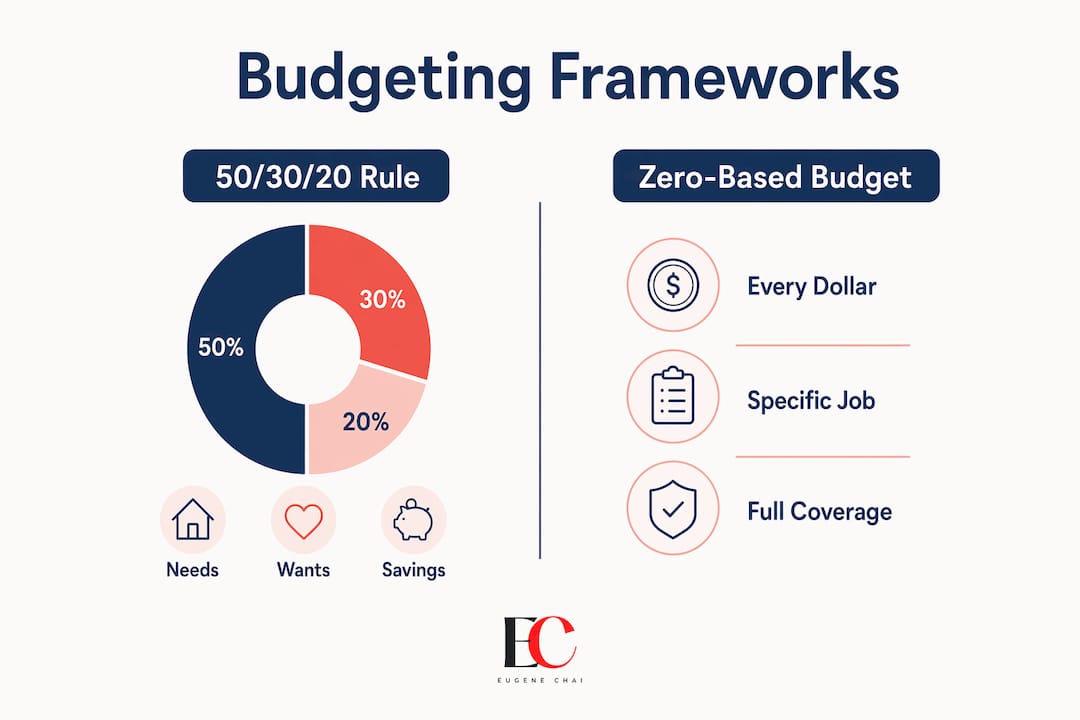
The 50/30/20 rule is the most widely used personal budgeting framework for young adults. It allocates 50% to needs, 30% to wants, and 20% to savings or debt repayment. That structure gives you a clear starting point without requiring a finance degree.
In Singapore, a practical 50/30/20 split on a $3,500 monthly take-home salary looks like this: $1,750 for needs (rent, MRT, groceries, MediShield Life premiums), $1,050 for wants (dining at hawker centres, streaming subscriptions, weekend activities), and $700 for savings and CPF top-ups or investments.
Zero-based budgeting is the alternative. Every dollar of income is assigned a job until you reach zero. This method suits people who want maximum control and are willing to track spending in detail. The trade-off is that it requires more time and discipline to maintain.
Here is a direct comparison of the two most practical methods for young adults:
| Method | Best For | Effort Level | Flexibility |
|---|---|---|---|
| 50/30/20 Rule | Beginners and those with stable income | Low | High |
| Zero-Based Budgeting | Detail-oriented planners | High | Low |
| Pay-Yourself-First | Savers who struggle with discipline | Very Low | Very High |
The right method is the one you will actually use. Budgets should be reviewed every few months as your income, goals, and expenses shift. A fresh graduate’s budget at 23 will look very different from the same person’s budget at 27 after a promotion or a BTO application.
Pro Tip: Start with the 50/30/20 rule for your first three months. Once you have real spending data, switch to zero-based budgeting if you want tighter control. Do not try to perfect your system before you start.
For a step-by-step walkthrough on setting up your first budget, the first monthly budget guide on Eugenechaitf covers the full process in practical detail.
How does early budgeting accelerate wealth growth?
The compounding effect is the strongest argument for starting your financial planning as a young adult. $5,000 invested at age 24 grows to $54,000 by age 64 at a 6% annual return. The same $5,000 invested at age 34 grows to only $30,000. That $24,000 difference comes entirely from starting 10 years earlier, not from investing more money.

Budgeting is what makes consistent investing possible. Without a budget, most young adults cannot identify a reliable monthly surplus to invest. With one, you can direct $200 or $300 a month into a Regular Savings Plan (RSP) through platforms like Syfe, StashAway, or the POSB Invest-Saver, and let compounding do the work over decades.
Your lifestyle baseline forms in your 20s and influences every financial decision that follows. This is a critical insight. If you build a lifestyle on $2,500 a month at 24, a salary increase to $4,000 at 27 creates a $1,500 monthly surplus you can direct toward investments or CPF SA top-ups. If you inflate your lifestyle to match every raise, that surplus disappears permanently.
Financial mistakes cost less in your 20s and are far more recoverable than at 40. Trying a budgeting method that does not work, overspending one month, or choosing the wrong investment product at 24 carries a fraction of the long-term cost of the same mistake at 40. Your 20s are the lowest-risk period to experiment, adjust, and build the money management strategies that will carry you forward.
For a broader view of how budgeting connects to your financial goals in your 20s, Eugenechaitf has a dedicated 2026 guide covering CPF planning, HDB considerations, and investment milestones.
What are the most common budgeting pitfalls to avoid?
70% of Gen Z feel stressed about financial decisions. Much of that stress comes not from a lack of income but from avoidable budgeting mistakes. Recognising these pitfalls early saves you months of frustration.
The most common mistakes young adults make:
- Waiting for a perfect budget: The goal of your first budget is visibility, not perfection. Seeing all your accounts, your DBS checking, OCBC savings, and credit cards, in one place reveals your real spending patterns before you categorise anything.
- Underestimating variable expenses: Groceries, transport, and dining out fluctuate month to month. Most people budget the best-case figure and then blow past it. Budget the realistic or slightly high figure instead.
- Building a budget too rigid to survive real life: A budget that makes you feel guilty every time you spend on a hawker meal is not sustainable. Flexibility is a feature, not a flaw.
- Ignoring irregular expenses: Annual insurance premiums, MediShield Life top-ups, and festive spending are predictable. Divide them by 12 and include them as monthly line items.
Overestimating variable expenses creates a margin of error that absorbs real-life surprises without breaking your budget. Budget $400 for groceries when you typically spend $350, and any month you come in under budget feels like a win.
Automating saving and creating buffers reduces stress and improves how consistently young adults stick to their budgets. A liquid buffer of a few hundred dollars inside a zero-based budget prevents the anxiety of watching your account hit zero before the month ends.
Pro Tip: Use the Seedly app or a simple Google Sheets template to connect all your Singapore bank accounts in one view. Seeing the full picture weekly takes less than five minutes and removes the guesswork that causes most budgets to fail.
Budgeting is about progress and awareness, not perfection. If you feel guilty after a spending category goes over, that is a signal to adjust your budget, not a sign that you have failed.
Key takeaways
Budgeting as a young adult is the foundation of financial independence, and starting in your 20s gives you the longest runway to build wealth through compounding, habit formation, and controlled lifestyle growth.
| Point | Details |
|---|---|
| Start with visibility | Connect all accounts first to see real spending before building any categories. |
| Use the 50/30/20 rule | Allocate 50% to needs, 30% to wants, and 20% to savings or debt as a starting framework. |
| Automate savings immediately | Transfer savings on payday before spending to remove temptation and build discipline. |
| Compounding rewards early starters | $5,000 invested at 24 grows to $54,000 by 64 versus $30,000 if started at 34. |
| Overestimate variable costs | Budget slightly above your typical spend to absorb surprises without breaking your plan. |
My honest take on budgeting young in singapore
I started budgeting seriously in my mid-20s, and the single biggest lesson I learned was that I had been overcomplicating it. I spent weeks trying to build the perfect spreadsheet before tracking a single dollar. That delay cost me months of clarity I could have had immediately.
Singapore’s cost structure makes early budgeting especially important. Housing costs through HDB BTOs, CPF contributions, and MediShield Life premiums are not optional expenses. They are baked into your financial life from the moment you start working. If you do not account for them in a budget, they quietly consume your salary without you realising how little discretionary income you actually have.
The mindset shift that changed everything for me was treating budgeting as information, not restriction. A budget does not tell you that you cannot spend. It tells you what you are actually choosing. Once I saw that my daily coffee and grab rides were costing me $280 a month, I did not feel restricted. I felt informed. I made a conscious choice about what mattered.
Generic savings advice is far less effective than a plan built from your specific numbers and goals. Your budget should reflect your actual life in Singapore, not a template designed for someone earning in a different currency with different obligations.
Start simple. Review monthly. Adjust without guilt. The habit you build now will be worth more than any single investment you make in your 20s.
— Eugene
Take your next step toward financial clarity
If this article has shown you the value of starting early, the next step is putting a real budget in place. Eugenechaitf has built a library of practical resources designed specifically for young adults in Singapore, covering everything from your first budget to CPF planning and investment strategies.
Visit the personal finance hub to explore budgeting guides, saving strategies, and investment tips tailored for Singaporeans at every income level. If you are ready to go beyond budgeting and start growing your money, the investing for beginners guide is the natural next read. Your financial foundation starts with one honest look at your numbers.
FAQ
Why should a young adult start budgeting early?
Starting early gives you the longest compounding runway and builds money habits that persist for life. $5,000 invested at 24 grows to $54,000 by 64 versus $30,000 if started at 34.
How do i budget effectively on a starting salary in singapore?
Use the 50/30/20 rule as your starting point: 50% for needs like rent and MRT, 30% for wants, and 20% for savings or CPF top-ups. Review and adjust every few months as your income grows.
What is the biggest budgeting mistake young adults make?
The most common mistake is waiting for a perfect budget before starting. Begin with visibility across all your accounts and build categories from real spending data, not estimates.
How much should i keep in an emergency fund?
A liquid emergency fund covering 3–6 months of expenses is the standard recommendation. Keep it in a high-yield account like UOB One or OCBC 360 so it earns interest while remaining accessible.
Does budgeting mean i cannot enjoy my money?
Budgeting means you spend consciously, not restrictively. A well-structured budget includes a clear allocation for wants, so you enjoy your money without guilt or financial stress.
Disclaimer: Informational only. Consult an MAS-licensed advisor before investing.






Leave a Reply