


TL;DR:
- To improve your credit score in Singapore quickly, stop all new credit applications, pause discretionary spending, and dispute any errors on your credit report. Consistent, on-time repayment over 12 months and keeping utilization below 30 percent are essential for credit recovery. Automating payments with GIRO and maintaining a clean repayment record are crucial steps toward rebuilding trust with lenders.
If your credit score in Singapore needs urgent attention, these six steps are where to start: stop all new credit applications, pause discretionary card spending, pull your Credit Bureau Singapore (CBS) report, dispute any errors, contact creditors to negotiate a repayment plan, and set up GIRO for every outstanding account. The CBS score runs on a scale where higher values indicate lower risk. Most lenders want to see you well above the midpoint before approving new facilities.
Do each of these within 72 hours:
- Stop new credit applications. Every hard enquiry signals credit hunger to lenders and remains visible on your record for a significant period.
- Pause discretionary card use. Aim to keep utilisation below 30% of your combined available credit limits. Most major bank guidance in Singapore cites this threshold as the level at which exposure looks manageable to lenders.
- Check your CBS report. MoneySense recommends reviewing your report for errors and understanding how lenders read your repayment history.
- Dispute any errors immediately. Wrong entries compound damage; CBS has a formal dispute process.
- Negotiate with creditors. A documented repayment plan is better than silence; negotiated settlements remain visible for roughly three years, but active defaults can show indefinitely.
- Automate payments via GIRO. CBS weights recent repayment history heavily, so consistent on-time payments now matter more than past mistakes.
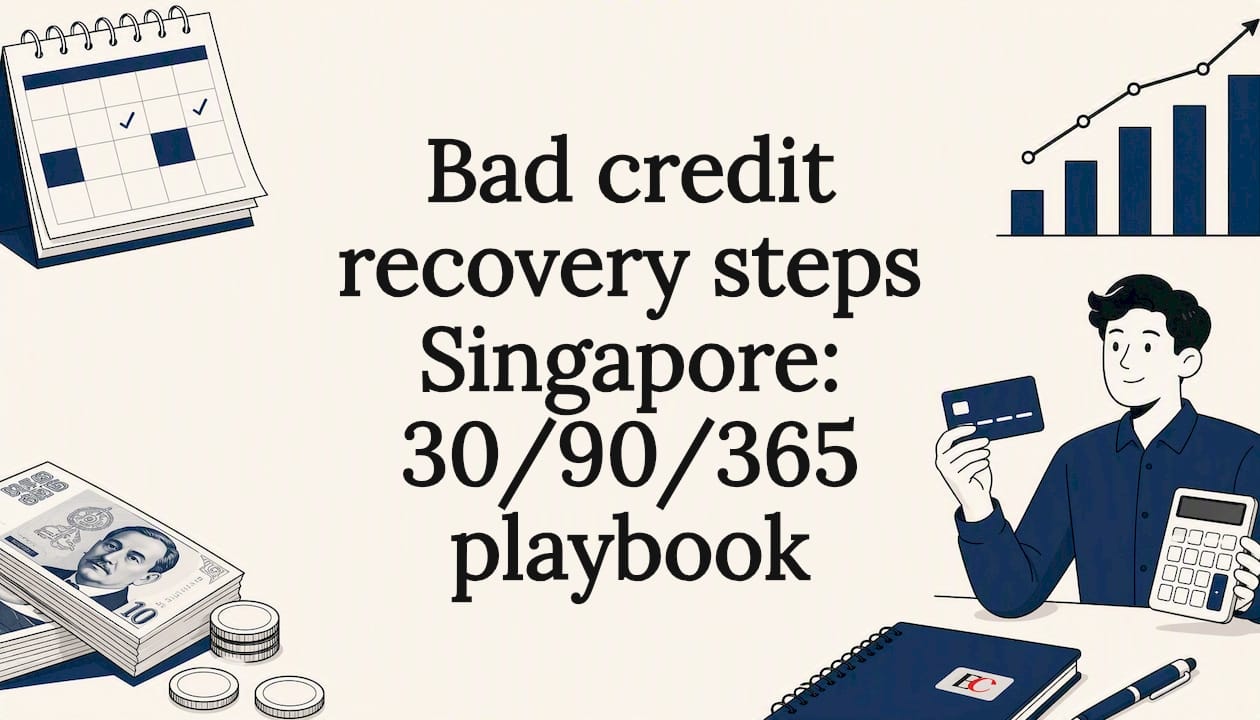
Your 30/90/365 arc: at 30 days, your disputes are filed and GIRO is running. At 90 days, utilisation is falling and creditors have confirmed plans. At 365 days, a full 12-month clean repayment window is in place and your score should reflect it.
Table of Contents
- Key takeaways
- What actually worked for me, and what to avoid
- Practical resources on Eugenechaitf to keep your recovery on track
- Trusted Singapore sources for your credit recovery
- FAQ
Key takeaways
Consistent, on-time repayments over a 12-month window, combined with utilisation below 30% and a freeze on new enquiries, form the fastest credible path to credit repair in Singapore.
| Point | Details |
|---|---|
| Automate every payment | Set up GIRO for all accounts; missed payments reset your 12-month repayment window. |
| Keep utilisation below 30% of your combined available credit limits. Most major banking guidance in Singapore cites this threshold as the level at which exposure looks manageable to lenders. | |
| Freeze new applications | Hard enquiries stay on record for a significant period; space any new applications appropriately apart. |
| Check reports every 3–6 months | Monitor both CBS and the Moneylenders Credit Bureau (MLCB) if you hold any licensed moneylender loans. |
| Use Eugenechaitf’s guides | The 30/90/365 plan maps directly to the budgeting and debt-prioritisation resources on this site. |
30/90/365 milestones at a glance:
- Day 30: GIRO active, CBS report reviewed, disputes lodged, creditor contact made.
- Day 90: Utilisation trending down, repayment plans confirmed in writing, no new enquiries.
- Month 12: Clean repayment record established; minor issues can show improvement within 3–6 months, multiple defaults typically need 12–18 months of steady repayments.
What actually worked for me, and what to avoid
The single most effective change I made was setting up GIRO for all creditors simultaneously. Not one account, all of them. Automating repayments removes the human error that causes most missed payments, and the compounding effect on your 12-month repayment window is real.

Paying more than the minimum is non-negotiable for active rebuilding. Minimum payments keep you out of formal default but perpetuate high utilisation and interest accrual. If you can only afford $50 above the minimum, pay it. The principal reduction matters.
On negotiating with creditors, keep it simple and documented. A short written request works:
Save every email, letter, and reference number. When a settlement is reached, ask the creditor explicitly to update CBS. Negotiated settlements remain visible for some years, but that is preferable to active defaults that have no end date.
Pro Tip: If you have any loans with licensed moneylenders, monitor the Moneylenders Credit Bureau (MLCB) separately from CBS. Resolving an active default on MLCB does not automatically improve your CBS record, and vice versa.
Mistakes that slow recovery: applying for new cards while repairing, paying only minimums, and using unlicensed moneylenders. The last one is the most damaging because it creates debt outside any regulated framework, with no path to a clean CBS record.
Practical resources on Eugenechaitf to keep your recovery on track
Knowing the steps is one thing; having a system to follow them is another. The budgeting guides on Eugenechaitf are built specifically to help you free up cash for priority repayments, which is exactly what the 30/90/365 plan requires in months one through three. The Singapore credit counselling guide explains when to approach Credit Counselling Singapore (CCS) and how their structured repayment programmes work, which is worth reading before any creditor negotiation.
For more complex cases involving multiple creditors or formal defaults, professional help from CCS or an MAS-licensed advisor is the right call. Start with the budgeting guide to map your repayment capacity, then use the credit counselling explainer to decide whether you need structured support.
Trusted Singapore sources for your credit recovery
Use these official and authoritative resources at each stage of your recovery:
| Source | What it offers | When to use it |
|---|---|---|
| Credit Bureau Singapore (CBS) | Full consumer credit report; dispute process | Pull your report first; re-check every 3–6 months |
| MoneySense | Plain-language guidance on credit reports and score improvement | Background reading; share with family members |
| Credit Counselling Singapore (CCS) | Debt management programmes; creditor negotiation support | When managing multiple creditors or formal defaults |
| DBS credit score guide | Explains CBS score ranges, enquiry and settlement timelines | Understanding how long negative markers stay visible |
Key timelines to know:
- Hard enquiries: visible for a significant period
- Negotiated or full settlements: visible for several years
- Outstanding or sold-off defaults: may remain on record indefinitely
- CBS repayment window for score calculation: based on recent months of repayment history
Your next steps checklist:
- Request your CBS report at creditbureau.com.sg
- If you have moneylender loans, request your MLCB report separately
- Lodge any disputes in writing with supporting documents
- Contact CCS at ccs.org.sg if you need structured negotiation support
- Read the role of credit scores in Singapore to understand how lenders use your CBS data
FAQ
How long does bad credit recovery take in Singapore?
Minor late payments can show improvement within 3–6 months of consistent good behaviour; multiple defaults typically need 12–18 months of steady repayments to reflect meaningful score recovery.
Where do I get my credit report in Singapore?
Request your consumer credit report directly from Credit Bureau Singapore at creditbureau.com.sg. If you have licensed moneylender loans, request a separate report from the Moneylenders Credit Bureau (MLCB).
Does settling a debt remove it from my CBS record immediately?
No. Negotiated or full settlements remain visible on your CBS record for approximately three years; outstanding defaults with no resolution can show indefinitely, which is why resolving active defaults is the first priority.
How do I dispute an error on my CBS report?
Contact CBS directly with written evidence (bank statements, payment receipts, correspondence) supporting your dispute. CBS will investigate and update the record if the error is confirmed.
What credit utilisation rate should I aim for in Singapore?
Keep utilisation below 30% of your combined available credit limits. Most major bank guidance in Singapore cites this threshold as the level at which exposure looks manageable to lenders.
Disclaimer: Informational only. Consult an MAS-licensed advisor before making financial decisions.






Leave a Reply