


TL;DR:
- A debt spiral is a self-perpetuating cycle where taking on new high-cost credit causes debt to grow faster than it can be repaid. To break free, individuals must immediately stop borrowing, list all debts, and seek free UK advice before further payments. Recovery often takes months or years, but early action improves outcomes significantly.
A debt spiral is a self-reinforcing cycle where borrowing to cover existing obligations causes total debt to grow faster than you can repay it. Crucially, as Experian notes, you can be in a debt spiral while still making every payment on time — if you are using new, high-cost credit to fund those payments, the spiral is already turning. The single most important thing to do right now: stop taking on any new debt immediately.
TL;DR — act on these in the next 24–48 hours:
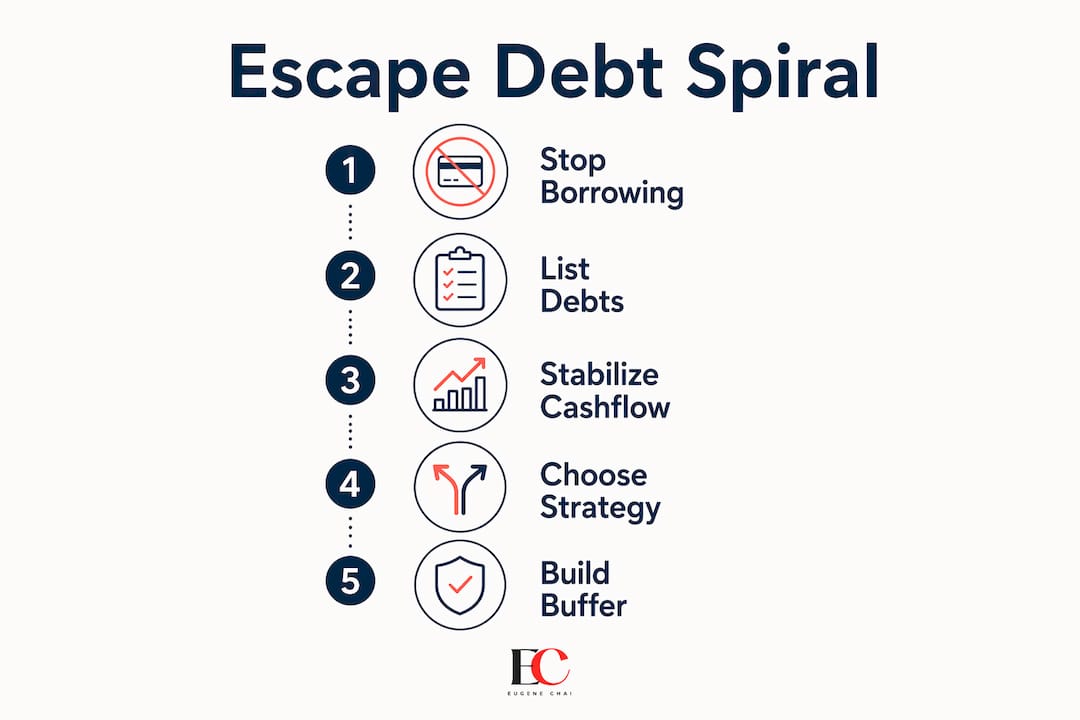
- Stop borrowing. Freeze or put away any credit cards you are actively using for essentials.
- List every debt: creditor name, balance, interest rate, minimum payment, and due date.
- Contact your most expensive creditor and ask about a hardship arrangement or payment break.
- Set aside even a small emergency buffer (£200–£500) before throwing everything at repayments.
- Call a free UK debt adviser — MoneyHelper (0800 138 7777), StepChange, or Citizens Advice.
Table of Contents
- How does a debt spiral usually start?
- Warning signs that you are sliding into a debt spiral
- What happens if the spiral continues unchecked?
- How to get out of a debt spiral: a step-by-step plan
- Debt avalanche vs debt snowball: which should you choose?
- UK formal debt solutions: DMP, DRO, IVA, and bankruptcy
- Where to get free, trustworthy UK debt advice
- Evidence-based insights that improve your recovery
- Key takeaways
- A candid note on recovery time
- Useful sources and further reading
- FAQ
How does a debt spiral usually start?
Most debt spirals begin with a single financial shock. Job loss, a medical bill, a relationship breakdown, or even a run of overspending on a high-APR credit card can tip a manageable budget into deficit. The problem is not the initial shock — it is what happens next.
Once you cannot cover your monthly outgoings from income alone, the instinct is to borrow the shortfall. A credit card cash advance here, a short-term loan there. Each new borrowing carries its own interest charge, which increases the total monthly obligation. Soon you are taking one loan to repay another, and the interest compounds faster than any realistic income can absorb.
Common UK triggers include:
- Redundancy or reduced hours — income drops suddenly while fixed commitments (rent, car finance, subscriptions) remain.
- Revolving credit at high APR — carrying a balance on a card charging 30%+ APR means interest alone can exceed your minimum payment over time.
- Payday or short-term loans — borrowing a few hundred pounds at very high representative APR to cover a gap, then rolling it over when the repayment date arrives.
- Using credit for everyday essentials — groceries, utilities, and transport charged to a card because the current account is empty.
The credit card trap is particularly common among younger adults who use reward cards without tracking the balance, only to find the interest charges outpace any benefit earned.
Warning signs that you are sliding into a debt spiral
Catching the signs early is the difference between a difficult few months and a multi-year recovery. Here are the clearest red flags, in rough order of severity:
- You only ever make the minimum payment. Minimum payments on credit cards are designed to keep you in debt longer, not to clear it. If you have been paying the minimum for three or more consecutive months, the balance is likely growing.
- You use credit to pay for food, fuel, or utilities. When essentials go on a card because there is nothing left in your current account, your income is already insufficient to cover basic costs.
- You have taken a cash advance or payday loan to meet another debt payment. This is the clearest structural sign of a spiral — debt servicing debt.
- Your overdraft is a permanent fixture. Dipping into an arranged overdraft occasionally is normal; living in it every month means your income never fully covers your outgoings.
- Your total balances are rising despite making payments. Pull your credit report via a free service and compare balances month on month. Rising totals despite regular payments confirm the spiral is active.
- You are cutting essentials to meet debt payments. Skipping meals, delaying prescriptions, or turning off heating to free up cash for a minimum payment is a serious warning.
- You feel anxious opening post or checking your bank app. Avoidance behaviour is a psychological signal that the situation feels out of control, and it tends to make things worse.
Pro Tip: The most commonly missed sign is what practitioners call “hidden stability” — you are current on all payments, but only because you opened a new 0% balance transfer card or took a personal loan last month. Experian describes this as still falling deeper into debt despite appearing on time. If your total debt is higher than it was six months ago, the spiral is real regardless of your payment history.
What happens if the spiral continues unchecked?
The financial consequences accelerate in a predictable pattern. High-APR balances compound monthly, meaning the interest charge in month six is calculated on a larger balance than in month one. A credit card balance at high APR can incur substantial interest over a year if you only make minimum payments — and the balance barely moves.
Beyond the numbers, the non-financial toll is significant. The NHS acknowledges that financial worry is a leading cause of stress, anxiety, and disrupted sleep. Relationship strain is common, particularly when one partner is unaware of the full picture. Some professional roles — notably in financial services, law enforcement, and the civil service — require periodic credit checks, so a deteriorating credit file can affect employment.
If debts go unpaid, creditors typically follow a sequence: late payment fees, default notices, and eventually a County Court Judgement (CCJ). A CCJ stays on your credit file for six years and can restrict access to mortgages, rental agreements, and even some mobile phone contracts. Enforcement action — including bailiffs or an attachment of earnings — becomes possible once a CCJ is in place.
The Investopedia debt spiral analysis notes that practitioners flag the hidden phase — where minimums are met only by sacrificing savings — as the most dangerous, because it can persist for months before a single missed payment triggers a cascade of defaults.
How to get out of a debt spiral: a step-by-step plan
Recovery is possible, but it requires a clear sequence. Trying to do everything at once usually leads to burnout. Work through these steps in order.

Step 1: Stop all new borrowing immediately
Cut up, freeze, or lock away any credit card you are tempted to use. Cancel any buy-now-pay-later arrangements you do not need. The spiral cannot tighten if you stop feeding it.
Step 2: Build a complete debt inventory
List every debt you owe. For each one, record:
- Creditor name and account type
- Current balance
- Interest rate (APR)
- Minimum monthly payment
- Next due date
This inventory is also what a free debt adviser will ask for on your first call, so having it ready saves time. Budgeting and a clear inventory of balances, rates, and due dates is the foundation any adviser uses when negotiating with creditors.
Step 3: Stabilise your cashflow before attacking debt
Contact your most expensive creditors and ask about hardship arrangements, payment deferrals, or reduced-interest periods. Most UK lenders have a formal hardship process and are legally required to treat you fairly under FCA rules. Do this before you miss a payment — calling proactively puts you in a much stronger position.
Review your monthly budget and identify any non-essential spending you can pause: subscriptions, gym memberships, streaming services.
Step 4: Choose a repayment strategy and commit
Once your cashflow is stable, pick either the Debt Avalanche or Debt Snowball method (explained in the next section) and direct any surplus income there. Always maintain the minimum payment on every other account to avoid defaults.
Step 5: Build a small emergency buffer
Before you throw every spare pound at debt, set aside a modest cash buffer. Financial advisers warn that without a buffer, a single unexpected expense — a car repair, a dental bill — forces you back onto credit and restarts the spiral. Keeping a small emergency buffer in a separate account makes a material difference to relapse risk.
Pro Tip: If you are unsure where to start, call a free debt adviser before doing anything else. They can negotiate with creditors on your behalf, set up a Debt Management Plan, and signpost formal options — all at no cost to you. Stopping new borrowing and engaging free advisers significantly improves the likelihood of a structured, manageable outcome.
For a broader financial recovery plan, Eugenechaitf has a dedicated guide that walks through the medium-term rebuild once the immediate crisis is stabilised.
Debt avalanche vs debt snowball: which should you choose?
Both methods require you to maintain minimum payments on all debts. The difference is where you direct any extra money each month.
Debt Avalanche targets the debt with the highest interest rate first. Once that is cleared, you roll the freed-up payment onto the next highest rate, and so on. Mathematically, this minimises the total interest you pay over the life of your debts.
Debt Snowball targets the smallest balance first, regardless of interest rate. Clearing a small debt quickly frees up a payment and delivers a psychological win that helps you stay motivated.
| Factor | Debt Avalanche | Debt Snowball |
|---|---|---|
| Focus | Highest APR first | Smallest balance first |
| Total interest paid | Lower | Higher |
| Speed of first win | Slower | Faster |
| Best for | Disciplined repayers with high-rate debts | Those who need early momentum to stay on track |
| Completion rate | Lower for some personality types | Higher for clients with motivational constraints |
Counsellors consistently observe higher completion rates with the snowball for clients who need psychological gains to stay engaged, even though the avalanche saves more in interest. The honest answer: the best method is the one you will actually stick to.
Quick checklist to pick your approach:
- Do you have one debt with a dramatically higher APR than the rest? Use the avalanche.
- Do you have several small balances you could clear within 1–3 months? Start with the snowball for momentum.
- Have you tried repayment plans before and given up? The snowball’s early wins are likely to help you persist.
UK formal debt solutions: DMP, DRO, IVA, and bankruptcy
When self-managed repayment is not enough, the UK offers four main formal routes. Each has specific eligibility criteria, timelines, and consequences for your credit file.
| Solution | What it does | Who it’s for | Typical timeline | Fees / cost | Credit file impact |
|---|---|---|---|---|---|
| Debt Management Plan (DMP) | A free or low-cost arrangement where you make one monthly payment to a charity or provider, who distributes it to creditors. Interest may be frozen. | Anyone with multiple unsecured debts who can afford reduced payments. No formal eligibility threshold. | Varies; often 5 years depending on total debt and payment level. | Free via charities (StepChange, National Debtline). | Defaults and missed payments recorded; file affected for 6 years from default date. |
| Debt Relief Order (DRO) | A 12-month moratorium period. If your situation has not improved after 12 months, the debts are written off. | Debts below specified thresholds; limited assets; low disposable income; not a homeowner. | 12 months. | £90 application fee (paid to the Insolvency Service via an approved intermediary). | Recorded on credit file for 6 years. |
| Individual Voluntary Arrangement (IVA) | A legally binding agreement with creditors to repay a portion of debt over a fixed period, with the remainder written off. | Typically debts over £10,000 with two or more creditors; regular income to fund payments. | Usually 5–6 years. | Insolvency practitioner fees (taken from monthly payments, not upfront). | Recorded on credit file for 6 years from the IVA start date. |
| Bankruptcy | A legal process that writes off most unsecured debts. Assets may be sold; income payments may be required for up to 3 years. | Suitable when debts cannot realistically be repaid and other options are exhausted. | Typically discharged after 12 months, though restrictions can last longer. | An application fee payable to the Insolvency Service. | Recorded on credit file for 6 years; restrictions on credit, some professions, and directorships. |
Official eligibility details and application processes for Debt Management Plans, Debt Relief Orders, and bankruptcy are published on GOV.UK. Always verify current thresholds directly with the Insolvency Service or a free debt adviser before applying, as eligibility criteria can change.
For a detailed breakdown of how a DMP works in practice, Eugenechaitf’s debt management plan guide covers the process step by step.
Where to get free, trustworthy UK debt advice
Every service listed below is free to use and staffed by trained advisers. None of them will judge you.
- MoneyHelper (moneyhelper.org.uk / 0800 138 7777): The government-backed service that covers all aspects of debt, budgeting, and benefits. Offers a free Debt Advice Locator tool to find regulated advisers near you.
- StepChange Debt Charity (stepchange.org / 0800 138 1111): One of the UK’s largest debt charities. Can set up a DMP directly, negotiate with creditors, and refer to insolvency practitioners where needed.
- Citizens Advice (citizensadvice.org.uk): Local branches and an online advice tool covering debt, benefits, housing, and employment. Particularly useful if your debt problems are linked to a benefits issue or housing arrears.
- National Debtline (nationaldebtline.org / 0808 808 4000): Specialist telephone and online debt advice. Strong on self-help tools and factsheets for people who prefer to manage their own negotiations.
What to prepare before you call:
- A list of all debts (creditor, balance, APR, minimum payment)
- Your monthly take-home income (all sources)
- Your essential monthly outgoings (rent/mortgage, utilities, food, travel)
- Any correspondence from creditors, including default notices or court letters
A debt adviser can contact creditors on your behalf, negotiate reduced or frozen interest, set up a DMP, and signpost you to formal insolvency routes if needed. The earlier you call, the more options remain open.
Evidence-based insights that improve your recovery
The research on debt recovery points consistently to a few behaviours that separate those who escape the spiral from those who relapse.
Stopping new borrowing is non-negotiable. Every pound of new credit taken during a repayment plan adds to the total you must clear and signals to creditors that the plan is not working. Maintaining minimum payments on all accounts while directing surplus cash to a chosen strategy is the structural foundation of any recovery.
The avalanche versus snowball debate is genuinely settled by individual psychology rather than mathematics alone. Practitioners report that clients who need early wins to stay motivated complete their plans at higher rates with the snowball, even when the avalanche would have saved them money in interest. Knowing yourself matters as much as knowing the maths.
Practising wealth advisers emphasise that establishing a modest cash buffer before aggressively repaying debt reduces the likelihood of relapse after a small financial shock. Even a few hundred pounds set aside in a separate account changes the decision calculus when something unexpected happens.
Pro Tip: Build your emergency fund before you accelerate repayments, not after. The goal is to build a small emergency buffer to start. Once your highest-rate debt is cleared, redirect that freed payment into growing the buffer further.
Key takeaways
A debt spiral requires immediate triage: stop new borrowing, list every debt, contact creditors early, and get free advice before a single payment is missed.
| Point | Details |
|---|---|
| Stop borrowing first | No repayment strategy works if new debt keeps entering the picture. |
| Build a small buffer | A modest emergency fund helps prevent a single shock from restarting the spiral. |
| Choose one repayment method | Avalanche saves more interest; snowball builds momentum — pick the one you will stick to. |
| Use free UK advice services | MoneyHelper, StepChange, Citizens Advice, and National Debtline are all free and can negotiate on your behalf. |
| Formal options exist | DRO, IVA, and bankruptcy are structured routes when self-managed repayment is not realistic. |
Your 30-day action plan:
- Days 1–3: Stop all new borrowing; complete your full debt inventory; set aside a small emergency buffer.
- Days 4–7: Call a free debt adviser (MoneyHelper or StepChange); ask creditors about hardship arrangements.
- Week 2: Agree on a repayment strategy (avalanche or snowball); set up a realistic monthly budget.
- Week 3–4: Make your first structured repayments; confirm any hardship arrangements in writing; check your credit report.
A candid note on recovery time
Debt spirals rarely resolve in a matter of weeks. A realistic recovery — depending on the total owed and your income — often takes months to years, and that is worth saying plainly rather than glossing over. Recovery is slow, and persistence matters more than perfection. Missing one payment does not mean the plan has failed; it means you adjust and continue.
What I find most encouraging, having written about personal finance for some time, is that the people who seek help early consistently reach better outcomes than those who wait until enforcement action forces their hand. The free services in the UK are genuinely good — StepChange and National Debtline in particular have helped hundreds of thousands of people negotiate their way out of situations that felt impossible.
If you are reading this because you recognise your own situation in these pages, that recognition is the hardest step. The next one is a phone call.
For deeper guides on budgeting, saving, and rebuilding your finances, explore the resources at Eugenechaitf — the personal finance hub covers everything from building your first budget to longer-term wealth building once the crisis has passed.
Useful sources and further reading
The following authoritative sources provide official guidance, eligibility checks, and deeper reading on each formal debt route:
- MoneyHelper (moneyhelper.org.uk): Government-backed debt advice, budgeting tools, and a regulated adviser locator. Start here if you are unsure which route applies to you.
- GOV.UK Insolvency pages: Official eligibility criteria and application processes for DMPs, DROs, and bankruptcy. Always check current thresholds directly before applying.
- Citizens Advice (citizensadvice.org.uk): Covers debt alongside benefits, housing, and employment — useful when multiple issues overlap.
- StepChange Debt Charity (stepchange.org): Full debt management services including DMP setup and insolvency referrals.
- National Debtline (nationaldebtline.org): Detailed self-help factsheets and telephone advice for those who prefer to manage their own negotiations.
- Experian (experian.com): Useful for understanding how debt affects your credit file and for monitoring your report during recovery.
What to bring to your first appointment or call:
- Photo ID and proof of address
- Bank statements for the last three months
- A list of all debts with balances and creditor contact details
- Payslips or benefit letters showing your current income
- Any court letters, default notices, or creditor correspondence
This article is general information only and does not constitute financial or legal advice. Debt rules, eligibility thresholds, and fees change — always confirm the current position with MoneyHelper, GOV.UK, or a regulated debt adviser before making any formal application.
FAQ
What happens in a debt spiral?
A debt spiral occurs when interest and new borrowing grow faster than you can repay, causing total debt to increase even when you make regular payments. Left unchecked, it typically leads to defaults, County Court Judgements, and formal insolvency.
How do you get out of a debt spiral?
Stop all new borrowing immediately, list every debt with its balance and APR, contact creditors about hardship arrangements, and call a free UK debt adviser such as StepChange or MoneyHelper. Choose either the Debt Avalanche or Debt Snowball repayment method and maintain minimum payments on all accounts throughout.
What is the debt spiral method?
There is no single “debt spiral method” — the term usually refers to the Debt Avalanche or Debt Snowball repayment strategies used to escape a spiral. The avalanche targets the highest-APR debt first to minimise total interest; the snowball clears the smallest balance first to build momentum.
Can I be chased for a debt after 20 years in the UK?
Most unsecured debts in England and Wales become statute-barred after six years from the last payment or written acknowledgement, meaning a creditor can no longer pursue them through the courts. However, the debt does not disappear entirely, and some debts (such as HMRC tax debts) have different limitation periods — always seek advice from Citizens Advice or National Debtline for your specific situation.






Leave a Reply