



TL;DR:
- Singapore offers government-backed financial aid programs to help residents facing income disruptions through cash support and social services. Eligibility depends on holistic household assessments rather than fixed income caps, requiring application and active engagement with social service offices. Applying early and combining schemes like ComCare, HDB support, and union grants improves financial stability during hardship.
Singapore financial hardship assistance is defined as a set of government-backed schemes providing temporary cash support and tailored social services to residents facing income disruption. The main programmes include ComCare Short-to-Medium-Term Assistance (SMTA), ComCare Long-Term Assistance (LTA), the NTUC Care Hardship Grant, and debt management services through Credit Counselling Singapore. Social Service Offices (SSOs) across the island administer most of these schemes, assessing each household on its full circumstances rather than a fixed income ceiling. Understanding how these programmes work is the first step towards stabilising your finances. This guide covers the types of financial hardship assistance in Singapore, eligibility, payout amounts, and the practical steps to access support in 2026.
What types of financial hardship assistance are available in Singapore?
Singapore’s financial aid system is segmented by need, duration, and household type. No single scheme covers every situation, so knowing which programme fits your circumstances is critical.
ComCare cash assistance schemes

ComCare SMTA is the primary cash assistance programme for households experiencing temporary income loss. Monthly payouts range from S$400 for a single person to over S$1,500 for households of five or more, reviewed every 3–12 months. These amounts are not fixed entitlements. They reflect household size, expenses, and the social worker’s assessment of your full situation.
ComCare LTA serves residents with permanent incapacity or no ability to work. Payouts are lower but ongoing, providing a stable floor for the most vulnerable. Both schemes are administered through SSOs and require an active application.
NTUC Care Hardship Grant
The NTUC Care Hardship Grant targets union members facing personal crises or rising living costs. In 2026, NTUC raised the household income threshold from S$1,800 to S$4,300 per month, significantly widening access. That change means many working families who previously did not qualify can now apply. If you or your spouse is an NTUC member, this grant is worth checking immediately.
Debt management and housing support
Credit Counselling Singapore offers free debt management programmes for residents struggling with unsecured debt. Their structured repayment plans address root causes rather than simply deferring payments. HDB (Housing and Development Board) provides loan rescheduling, payment reductions, and instalment plans for homeowners behind on mortgage payments. These housing measures protect home ownership and prevent formal defaults.
Healthcare and education assistance
MediFund assists Singapore Citizens who cannot afford their Medisave or MediShield Life co-payments. The Ministry of Education’s Financial Assistance Scheme (MOE FAS) covers school fees, uniforms, and textbooks for eligible pupils. Both programmes operate on separate eligibility criteria and are worth applying for alongside cash assistance if your household includes children or members with medical needs.
How do I qualify and apply for financial hardship assistance in Singapore?
Eligibility for most schemes centres on citizenship, income disruption, and willingness to work rather than a fixed income ceiling. SSO social workers conduct in-depth evaluations covering income, assets, debts, caregiving duties, and motivation to return to employment. That holistic approach means two households with identical incomes can receive different outcomes based on their full circumstances.
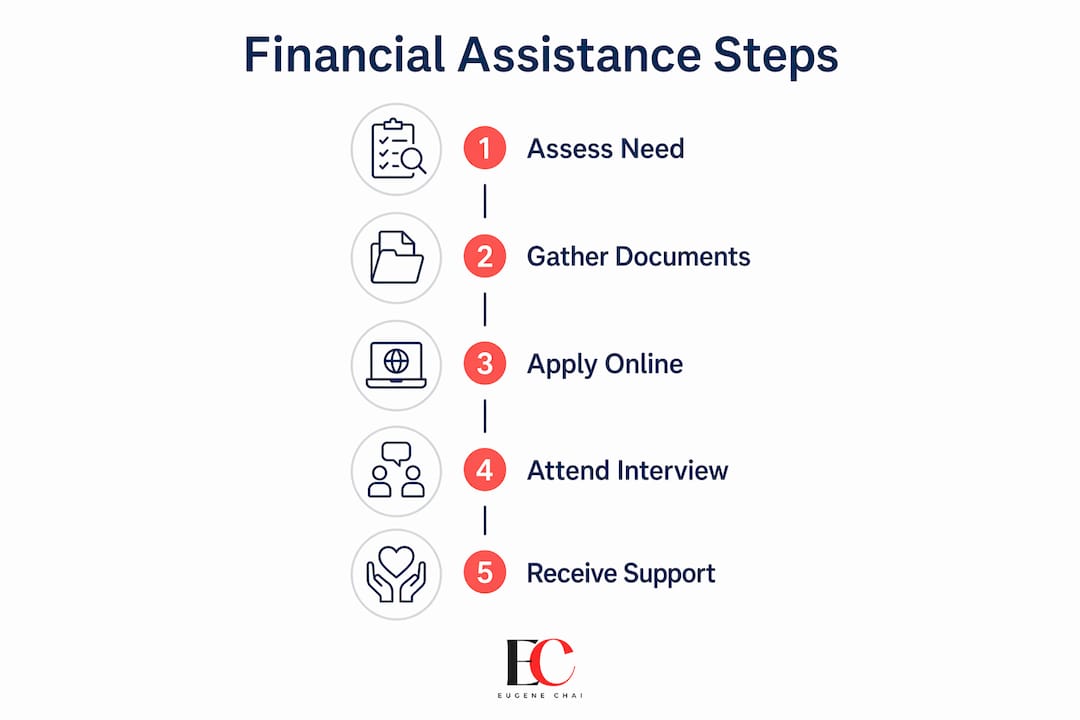
The general application process for ComCare SMTA follows these steps:
- Visit your nearest SSO. Walk-ins are accepted, but booking an appointment reduces waiting time. Bring all household members’ NRICs or birth certificates.
- Prepare your documents. You will need recent payslips or proof of income loss, CPF statements, utility bills, tenancy agreements or HDB ownership details, and medical certificates if applicable.
- Attend the social worker interview. Be honest and thorough. The assessment is personalised, and incomplete information can delay or reduce your assistance.
- Await the outcome. SSOs typically process applications within a few weeks. You may be referred to additional schemes such as MediFund or the MOE FAS during this process.
- Review and renew. ComCare SMTA is not permanent. Renewal is required at each review period, and your circumstances will be reassessed.
Some schemes, such as GST Vouchers and Workfare Income Supplement, are disbursed automatically without an application. ComCare and the NTUC Care Hardship Grant require you to apply. Many residents miss out simply because they assume aid will arrive without action.
Pro Tip: Bring a written summary of your household’s monthly expenses and income changes to the SSO interview. Social workers appreciate preparation, and it speeds up the assessment considerably.
How much financial help can I expect?
ComCare SMTA payouts are calculated by household size and assessed need. The table below shows the indicative monthly ranges.
| Household size | Indicative monthly payout |
|---|---|
| 1 person | S$400–S$600 |
| 2 persons | S$600–S$900 |
| 3 persons | S$900–S$1,300 |
| 4 persons | S$1,200–S$1,700 |
| 5 or more persons | S$1,500 and above |
These figures come from ComCare SMTA 2026 guidelines and represent ranges, not guarantees. Your actual payout depends on assets, existing debts, caregiving responsibilities, and the social worker’s overall assessment.
Review periods run from 3 to 12 months. Shorter reviews apply when income disruption is expected to be temporary, such as retrenchment. Longer reviews apply to households with more complex or persistent needs. Assistance does not renew automatically. You must re-engage with your SSO before each review period ends.
Pro Tip: If your household situation changes significantly before your review date, contact your SSO immediately. Waiting for the scheduled review can mean months of under-support.
Understanding your household income position relative to Singapore’s median helps you frame your application accurately and set realistic expectations for the outcome.
What practical steps maximise your financial assistance?
Accessing the right support requires a proactive and organised approach. The following steps give you the best chance of receiving the full range of aid available.
- Apply early. Acting early prevents long-term financial strain. Delays in applying for ComCare mean weeks or months without support you are entitled to receive.
- Combine multiple schemes. Singapore’s aid is segmented, so combining SSO support, NTUC grants, HDB housing measures, and healthcare assistance produces the best outcome. No single scheme covers everything.
- Contact HDB early if you are behind on mortgage payments. HDB’s tailored loan rescheduling prevents formal defaults and protects your home ownership. Waiting until you are in arrears reduces your options significantly.
- Use Credit Counselling Singapore for unsecured debt. Their free debt management programmes address the root cause of financial stress rather than deferring it. Contact them at 6225-5227.
- Treat CPF withdrawal as a last resort. Withdrawing CPF savings during hardship permanently reduces your retirement compounding benefits. Exhaust all government schemes, community support, and family assistance first.
- Augment income where possible. Even modest additional income from part-time work or a side hustle reduces your reliance on assistance and strengthens your renewal case with the SSO.
- Build a basic budget immediately. A clear picture of your monthly inflows and outflows helps you identify where to cut spending and shows your SSO social worker that you are managing your situation responsibly.
A family financial plan built around your current income and assistance amounts gives you a structured path out of hardship rather than a month-to-month scramble.
Key takeaways
Singapore’s financial hardship assistance system works best when you apply early, combine multiple schemes, and treat CPF withdrawal as a last resort rather than a first response.
| Point | Details |
|---|---|
| Apply actively, not passively | ComCare SMTA and NTUC grants require applications; they are not disbursed automatically. |
| Payouts scale with household size | ComCare SMTA ranges from S$400 for one person to over S$1,500 for five or more. |
| Assessment is holistic | SSO social workers evaluate assets, debts, caregiving duties, and willingness to work, not just income. |
| Combine schemes for best results | Pair SSO cash aid with HDB housing support, Credit Counselling Singapore, and union grants. |
| Protect your CPF | Premature CPF withdrawal sacrifices retirement compounding; use it only after all other options are exhausted. |
My honest view on navigating hardship assistance in Singapore
I have spoken with many Singaporeans who waited too long before seeking help. The most common reason is pride, followed closely by the mistaken belief that assistance is automatic. Both assumptions cost people money and time they cannot afford to lose.
The SSO assessment process is more personal than most people expect. Social workers are not there to catch you out. They are there to understand your full situation. Going in prepared, honest, and organised makes a genuine difference to the outcome. I have seen households receive meaningfully higher support simply because they documented their expenses clearly and communicated their caregiving responsibilities upfront.
My strongest advice is this: treat government assistance as a temporary bridge, not a long-term solution. Use the breathing room it provides to rebuild your budget, address your debts through Credit Counselling Singapore, and protect your CPF for retirement. Personal loans and early CPF withdrawals look attractive under pressure, but they carry long-term costs that structured government aid does not. The schemes exist precisely so you do not have to make those costly trade-offs.
— Eugene
Practical finance resources for managing hardship
Getting financial assistance is one part of the picture. Managing your money well during and after hardship is the other.
Eugenechaitf covers the practical side of personal finance for Singaporeans at every income level. The budgeting tips and strategies section walks you through building a realistic monthly budget that works alongside your assistance payments. Structured budgeting helps you stretch every dollar further and gives you a clear target for when you no longer need support. For broader financial guidance, the savings strategies section offers practical ideas to rebuild your financial position once your situation stabilises.
FAQ
What is ComCare SMTA and who can apply?
ComCare Short-to-Medium-Term Assistance (SMTA) is a monthly cash payout scheme for Singapore Citizens and Permanent Residents facing temporary income disruption. Applications are made through Social Service Offices, and eligibility is assessed holistically based on household income, assets, and circumstances.
Is there a fixed income limit to qualify for financial hardship assistance?
There is no fixed income ceiling for most schemes. SSO social workers assess the full household situation, including debts, assets, and caregiving responsibilities, rather than applying a single income cut-off.
How long does ComCare SMTA assistance last?
ComCare SMTA is reviewed every 3–12 months depending on your household’s circumstances. Assistance does not renew automatically; you must re-engage with your SSO before each review period ends.
Can I access financial help if I am not an NTUC member?
Yes. ComCare SMTA, MediFund, and HDB financial assistance measures are available to eligible residents regardless of union membership. The NTUC Care Hardship Grant is specifically for NTUC members, with a household income threshold of S$4,300 per month in 2026.
Should I withdraw my CPF savings if I am in financial difficulty?
CPF withdrawal should be a last resort. Withdrawing early permanently reduces your retirement savings and the compounding growth on those funds. Exhaust ComCare, community support, and family assistance before considering CPF.
Disclaimer: Informational only. Consult an MAS-licensed advisor before investing.






Leave a Reply