



TL;DR:
- Singapore’s Laws limit interest rates, fees, and borrowing amounts for licensed moneylenders to protect borrowers from exploitation. Verification of licensed lenders through government tools is essential before borrowing, ensuring compliance with legal protections. Borrowers have rights to clear contracts, fair treatment, and legal recourse if lenders breach regulations.
Licensed moneylending in Singapore is governed by the Moneylenders Act, a law that sets hard limits on interest rates, fees, and lender conduct to protect borrowers from exploitation. The singapore moneylender rules explained in this guide cover everything you need to know before signing any loan contract. Whether you are a young adult facing a cash shortfall or a family managing unexpected expenses, understanding these rules is your strongest defence against predatory lenders and illegal loan sharks. The Ministry of Law enforces these rules through the Registry of Licensed Moneylenders, and only lenders on that list are legally permitted to operate.
What are the legal limits on interest rates, fees, and borrowing amounts?
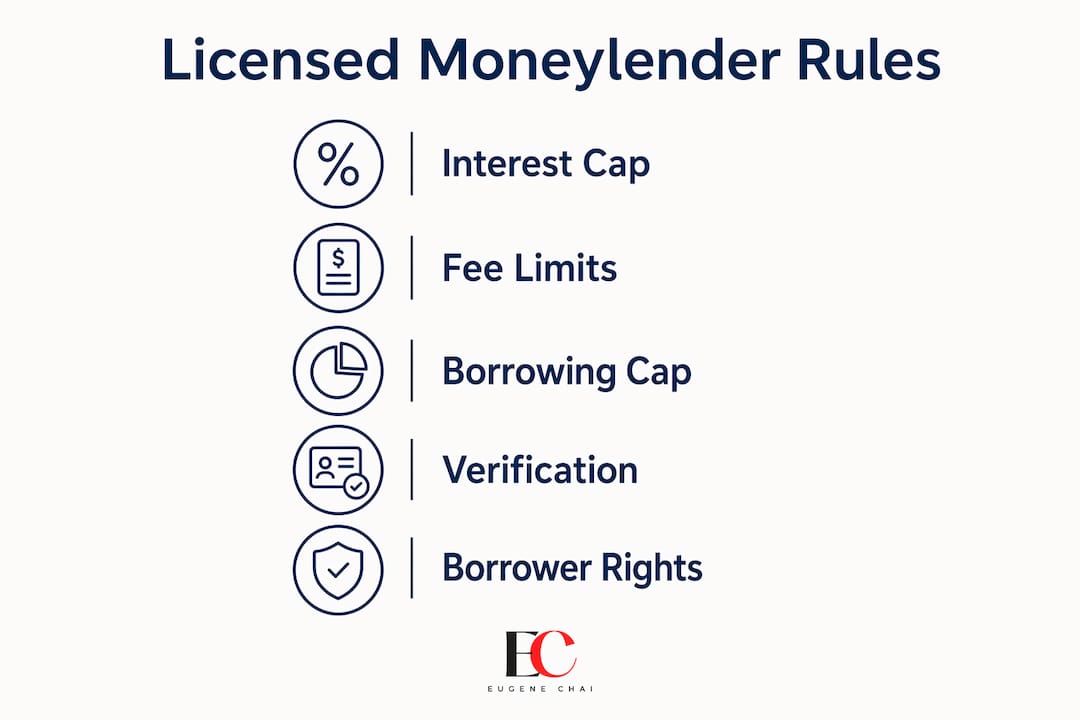
The Moneylenders Act sets firm financial caps that every licensed lender must follow. These limits exist to prevent debt from spiralling out of control, and knowing them gives you real negotiating power before you borrow.

Interest rate limits
The interest rate cap is 4% per month on the outstanding balance. This means interest applies only to what you still owe, not the original loan amount. Licensed lenders must use the reducing balance method rather than a flat rate, which keeps your total interest cost lower as you repay.
Fee limits
- Administrative fee: A one-time fee of up to 10% of the loan principal, deducted at disbursement. If you borrow $1,000, the lender may deduct up to $100 upfront.
- Late payment fee: Capped at $60 per month, regardless of how many instalments you miss in that month.
- Total cost cap: All interest and fees combined cannot exceed the original loan principal. If you borrow $2,000, you will never owe more than $4,000 in total, including every charge.
Borrowing limits
The law ties your maximum loan amount to your annual income. If your annual income is below $20,000, your total borrowing from all licensed moneylenders is capped at $3,000. For those earning $20,000 or more, the limit rises to six times your monthly income. This cap applies across all licensed moneylenders combined, not per lender.
Pro Tip: Before you borrow, calculate your six-times monthly income cap and compare it against your existing loan balances. Staying well below the cap gives you a financial buffer if your circumstances change.
How do you verify a licensed moneylender and spot unlicensed lenders?
Verifying a lender’s licence is the single most important step before you hand over any personal information or sign any document. The Ministry of Law makes this straightforward through its official tools.
-
Check the Registry of Licensed Moneylenders. The Registry website is the only reliable source to confirm a lender’s licence. Search by the lender’s name or licence number. If the lender does not appear, do not proceed.
-
Confirm their advertising channels. Licensed moneylenders are only permitted to advertise on their physical premises, approved business directories, or their own official websites. Any advertisement via SMS, WhatsApp, social media, or physical flyers is a clear sign of an unlicensed lender.
-
Visit the physical office. A licensed moneylender must have a registered business address. If a lender insists on conducting everything online or refuses to meet in person, treat that as a red flag.
-
Verify their identity documents. Ask to see the lender’s licence certificate. A legitimate lender will produce it without hesitation.
-
Reject any pressure tactics. Licensed lenders do not rush you into signing. If you feel pressured to decide immediately, walk away.
Government officials and the Registry will never request bank login details or ask you to transfer money over the phone. If you receive such a call, hang up and report it to the police or the Registry immediately. For broader guidance on spotting financial fraud, the scam awareness guide on Eugenechaitf covers the tactics scammers use across different financial products.
Pro Tip: Screenshot the Registry listing for your lender before signing anything. If a dispute arises later, you have documented proof that you verified their licence at the time of borrowing.
What borrower rights and protections does the Moneylenders Act guarantee?
The Moneylenders Act does not just regulate lenders. It actively protects you as a borrower with enforceable rights that lenders cannot waive or override.
Your core rights include:
- Written contract before disbursement. The lender must provide a clear, written loan contract before releasing any funds. You have the right to read it fully and ask questions.
- Explanation in your language. Licensed lenders must explain all contract terms in a language you understand. If you are not comfortable with English, request an explanation in Mandarin, Malay, or Tamil.
- No blank signatures. You must never sign a blank or incomplete contract. Lenders who request this are breaking the law.
- Protection from harassment. Licensed lenders cannot intimidate, threaten, or harass you. Any such behaviour should be reported to the Registry immediately.
- Debt cap protection. Because total charges cannot exceed the principal, your debt has a legal ceiling. Unlicensed lenders ignore this entirely, which is why they are so dangerous.
“Borrowers must never sign blank or partial contracts. Lenders are legally required to explain all terms in a language the borrower understands before any funds are released.” — Moneylenders Act guidance
If a lender breaches any of these protections, the Registry can suspend or revoke their licence. You can also seek recourse through the Small Claims Tribunals for disputes involving loan amounts within their jurisdiction.
How are licensed moneylenders supervised and what happens if rules are broken?
The Registry of Licensed Moneylenders, operating under the Ministry of Law, is responsible for licensing, monitoring, and enforcing compliance across all legal moneylenders in Singapore. The process is rigorous by design.
| Supervision mechanism | What it involves |
|---|---|
| Licensing requirements | Capital requirements, background checks, and regulatory knowledge tests for all applicants |
| Ongoing audits | Registry conducts regular compliance checks on licensed lenders |
| Licence suspension | Registry can suspend a licence immediately if a lender breaches regulations |
| Licence revocation | Repeated or serious breaches result in permanent revocation |
| Criminal penalties | Lenders who break rules face heavy fines, imprisonment, and caning for repeat offences |
| Unenforceable loans | Any loan made by an unlicensed lender, or after a licence is revoked, is legally unenforceable |
The unenforceability rule is particularly powerful for borrowers. If you unknowingly borrow from an unlicensed lender, the courts will not compel you to repay. That said, unlicensed lenders do not follow court rulings, which is why avoiding them entirely is the only safe approach. Report any suspicious lender activity to the Registry or call the police. Understanding how compound interest works also helps you appreciate why the reducing balance method and the total cost cap are such meaningful protections.
Key takeaways
The Moneylenders Act gives Singapore borrowers firm legal protections on interest, fees, and lender conduct, making the Registry of Licensed Moneylenders your first and most important verification tool.
| Point | Details |
|---|---|
| Interest rate cap | Licensed lenders cannot charge more than 4% per month on the outstanding balance. |
| Fee limits | Administrative fees cap at 10% of principal; late fees cap at $60 per month. |
| Borrowing limits | Earners below $20,000 annually are capped at $3,000 total; others at six times monthly income. |
| Total cost ceiling | All interest and fees combined can never exceed the original loan principal. |
| Verify before borrowing | Always check the Registry of Licensed Moneylenders before signing any contract. |
My honest view on navigating Singapore’s moneylending rules
I have spoken with readers who borrowed from lenders they found through WhatsApp messages, believing the low advertised rates were genuine. Almost every one of those cases ended badly. The rules governing licensed moneylenders in Singapore are genuinely protective, but they only work if you use them.
My strongest advice is this: the Registry check takes two minutes. There is no excuse to skip it. I have also seen people sign contracts they did not read because they felt embarrassed to ask for time. A legitimate lender will always give you time to read and ask questions. If they will not, that tells you everything.
Keep a copy of every document you sign and every payment receipt you receive. If repayment becomes difficult, contact the lender early. Licensed lenders are required to treat you fairly, and many will negotiate a revised repayment schedule rather than escalate. Reaching out early is always better than going silent. For younger readers still building their financial foundations, the financial goals guide on Eugenechaitf is worth reading before you consider borrowing at all.
— Eugene
Managing your finances alongside borrowing
Understanding the rules around licensed moneylending is only part of the picture. Borrowing responsibly also means having a clear plan for repayment and a longer-term view of your financial health.
Eugenechaitf has a practical guide on budgeting for repayments that walks you through managing monthly cash flow when you have loan obligations. If you want to build a stronger financial base so that borrowing becomes a last resort rather than a habit, the saving strategies section covers approaches suited to Singapore residents at every income level. Both resources are free and written specifically for the Singaporean context.
FAQ
What is the maximum interest rate a licensed moneylender can charge?
Licensed moneylenders in Singapore are capped at 4% per month on the outstanding loan balance. This applies to both standard interest and late interest.
How do I check if a moneylender is licensed in Singapore?
Visit the Registry of Licensed Moneylenders on the Ministry of Law website and search by the lender’s name or licence number. This is the only reliable verification method.
Can a licensed moneylender contact me by SMS or social media?
No. Licensed lenders may only advertise through their physical premises, approved directories, or their own official websites. SMS or social media contact is a sign of an unlicensed lender.
What happens if I borrow from an unlicensed moneylender?
Loans from unlicensed lenders are legally unenforceable in Singapore. However, unlicensed lenders often use harassment and threats to collect, so the safest approach is to avoid them entirely and report them to the police.
Is there a cap on how much I can borrow from licensed moneylenders?
Yes. If your annual income is below $20,000, your total borrowing across all licensed moneylenders is capped at $3,000. For those earning $20,000 or more, the cap is six times your monthly income.
Disclaimer: Informational only. Consult an MAS-licensed advisor before making financial decisions.






Leave a Reply